JERUSALEM: Israeli Prime Minister Benjamin Netanyahu has denied Turkish claims of covert involvement in Iraqi Kurdistan’s recent independence vote, reiterating however his “sympathy” for the Kurdish people.
On Saturday, Turkish President Recep Tayyip Erdogan said Israel’s intelligence agency played a role in the Sept. 25 referendum, citing as proof the waving of Israeli flags during celebrations for the overwhelming “yes” victory.
“This shows one thing, that this administration (in northern Iraq) has a history with Mossad, they are hand-in-hand together,” Erdogan said in a televised speech.
Speaking at the start of his weekly Cabinet meeting, Netanyahu noted Turkey’s support for Hamas which rules Gaza, before denying Erdogan’s charge.
“I can understand why those who support Hamas want to see the Mossad wherever things don’t work out for them,” Netanyahu said in remarks relayed by his office.
“But Israel had no part in the Kurdish referendum, aside from the deep, natural and years-long sympathy of the Jewish people to the Kurdish people and its aspirations,” he said.
Israel has been the only country to openly support Kurdish independence, with Netanyahu backing “the legitimate efforts of the Kurdish people to attain a state of its own.”
Netanyahu did not specify how and where such a state should come into being.
Turkey fiercely opposed the referendum and has threatened sanctions against the region, reflecting its worries about its own sizeable Kurdish minority.
Netanyahu's remarks came as Sayyed Hassan Nasrallah, head of the Iran-backed Hezbollah group, said Israel had come out in support of Kurdish statehood and described the referendum as part of a US-Israeli plot to carve up the region.
Nasrallah said the Kurdish independence vote marked a first step toward the partition of the Middle East, warning that this would lead to “internal wars” and must be opposed.
He said events in northern Iraq were a threat to the whole region and not just Iraq and neighboring states with Kurdish populations.
“It will open the door to partition,” Nasrallah said.
Hezbollah’s operatives are currently fighting along with other Iran-backed militias and the Syrian army against Daesh in eastern Syria.
“Daesh is at its end. It is a matter of time in Iraq and Syria,” Nasrallah said.
He said counter attacks mounted by Daesh in eastern Syria in the last two days were expected as the group was besieged, adding that it was “incapable of recovering ground.”


![]()
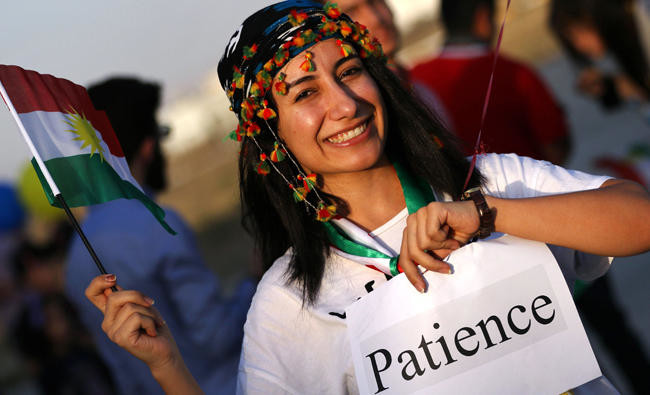
Israel denies Turkish claim of involvement in Kurd vote
Israel denies Turkish claim of involvement in Kurd vote

Latest updates


© 2026 SAUDI RESEARCH & PUBLISHING COMPANY, All Rights Reserved And subject to Terms of Use Agreement.