LONDON: Saudi Arabia’s decision to allow women behind the wheel has laid the foundations for a growth spurt in the Kingdom’s tourism sector, analysts forecast.
The country has the ambitious target to attract 1.5 million visitors by 2020 as the country reduces its dependence on oil.
Apart from pilgrimages, Saudi Arabia attracts relatively few international tourists, with the sector dominated by the domestic market. But with tourism earmarked to become a major driver of growth, the Kingdom is looking to widen its appeal.
“Ending the ban on women driving will help to change Saudi Arabia’s image around the world, and will make both men and women more likely to travel to Saudi Arabia,” said Jane Kinninmont, a senior research fellow and deputy head of the Middle East and North Africa program at the Chatham House think-tank in London.
“Previously (the driving ban) was one of the best-known facts about Saudi Arabia and was seen as a symbol of the oppression of women — so much so that many people didn’t realize Saudi women could study, work and do many other things,” Kinninmont said.
The move to allow women to drive comes as part of a program of reforms designed to curb restrictions and facilitate female access to employment, with the aim to raise the level of women’s participation in the labor force to 30 percent from 22 percent.
Crispin Hawes, managing director for the Middle East and North Africa at advisory firm Teneo Intelligence, said that while much remains to be done to develop the Kingdom’s tourism sector to appeal to the global market, lifting the ban on women driving represents “a significant step forward.”
“In the past five years the issue of women driving has taken on a life of its own and frequently comes top in external perceptions of the Kingdom. What the Saudi (government) has done is neuter that issue, which of itself is an important visual gesture,” he said.
“It’s part of a longer-term process that will make Saudi more attractive to people who might consider spending money and time visiting the country, but this is one element in a multi-stage journey.”
The decision also bodes well for domestic tourism, which stands to benefit from the increased mobility of Saudi families. “One implication is that households will no longer have to pay out for drivers, giving them more disposable income, which could be used for trips,” said Jason Tuvey, Middle East economist at Capital Economics.
Women will also be able to carry out their share of driving errands, freeing up family leisure time which could be used for domestic tourism purposes.
Tourism currently accounts for around 2.5 percent of Saudi Arabia’s gross domestic product (GDP) compared to the vast 50 percent contribution generated by the oil and gas sector, according to the World Travel and Tourism Council (WTTC). Plans to increase investment in tourism from $8 billion to almost $46 billion by 2020 will see a significant shake-up of the industry, as a series of high-profile projects get underway, according to the WTTC.
These include the ambitious Red Sea resort development, which will transform a 200 km stretch of coastline into a luxury tourism destination complete with an airport, seaport, hotels, residences and transport infrastructure.
The project, which is set to create 35,000 jobs and add SR15 billion ($4 billion) to the Saudi economy, will target foreign visitors with relaxed rules within a specified tourism zone.
According to Saudi Arabia’s Public Investment Fund (PIF), which will finance the initial stages of the project, “It will set new standards for sustainable development and bring about the next generation of luxury travel to put Saudi Arabia on the international tourism map.”
Last week PIF announced the launch of the Entertainment Investment Company with SR10 billion to support development of the sector and encourage Saudis to spend their leisure money at home rather than seeking amusement abroad.
“The Saudi Arabian government has been a great example to the travel and tourism public sector in prioritizing tourism growth in the country in order to generate further economic wealth and jobs as the country diversifies their income streams,” said Gloria Guevara, WTTC president and CEO, in a recent statement.
Another major project in the pipeline will include a Six Flags theme park, safari and recreational facilities as part of a 334 square kilometer city south of Riyadh.


![]()
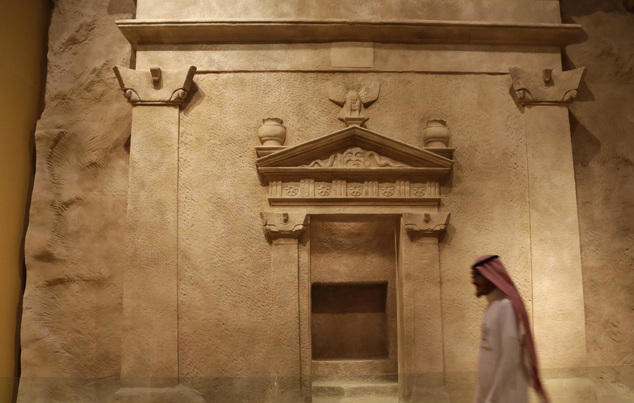
Saudi tourism set to accelerate as ban on women driving lifted
Saudi tourism set to accelerate as ban on women driving lifted

Latest updates


© 2026 SAUDI RESEARCH & PUBLISHING COMPANY, All Rights Reserved And subject to Terms of Use Agreement.