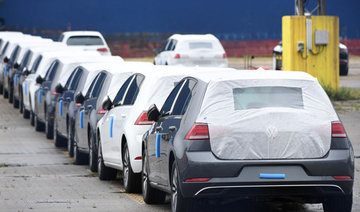
VW takes new €2.5 billion hit for modifying diesel vehicles in US

Volkswagen said it will publish third-quarter results on October 27. (Reuters)
Updated 29 September 2017
Follow

VW takes new €2.5 billion hit for modifying diesel vehicles in US

BERLIN: Volkswagen will take a hit of around €2.5 billion (SR11 billion) to its third-quarter results because a program to buy back or retrofit diesel engine cars in North America is proving more complex and time-consuming than expected, it said on Friday.
Its shares dropped after the statement and were down 2.8 percent at 0724 GMT.
Volkswagen said it will publish third-quarter results on October 27.


UAE non-oil business growth at 1-year high in February: PMI report

Updated 04 March 2026
Follow

UAE non-oil business growth at 1-year high in February: PMI report

RIYADH: The growth of the non-oil private sector in the UAE ticked up to a 12-month high in February, driven by rapid increases in business activity and new work orders, an economic tracker showed.

In its latest Purchasing Managers’ Index report, S&P Global revealed that the UAE’s PMI rose to 55 in February from 54.9 in January.

Any PMI reading above 50 indicates expansion, while a reading below 50 reflects contraction.

The upturn of the non-oil private sector in the UAE aligns with the broader trend observed in the Gulf Cooperation Council region, where countries, including Saudi Arabia, are pursuing economic diversification efforts to reduce reliance on crude revenues.

In January, the Kingdom’s PMI stood at 56.3, the highest in the region, while Kuwait recorded a reading of 54.5.

“The UAE PMI signalled the strongest growth in non-oil business conditions for a year in February, with output increasing rapidly in response to strong inflows of new work. So far, the data points to an encouraging picture for the domestic economy in the first quarter of this year,” said David Owen, senior economist at S&P Global Market Intelligence.

According to the report, stronger output among non-oil sectors was driven by higher demand, successful contract wins, and growth in key sectors including construction, real estate, logistics, and technology.

Additional factors that contributed to this growth include rising tourist arrivals, the expansion of e-commerce channels, and growing demand for AI-related products.

While international orders also contributed to the expansion of the non-oil sector, the increase in export sales remained modest, suggesting that sales growth was mainly driven by domestic demand.

The analysis highlighted that employment numbers rose modestly in February, marking the largest uplift since last November.

UAE non-oil businesses successfully increased their inventories of purchased inputs for the second month running, supported by another rapid improvement in supplier delivery times.

Regarding the future outlook, non-oil firms in the UAE expressed optimism, although the level of confidence declined from the recent high in January.

“The outlook is positive, as demand has continued to pressure business capacity, suggesting additional expansions in output and employment may be necessary,” added Owen.

In the same report, S&P Global revealed that Dubai’s PMI slipped to 54.6 in February from 55.9 observed in January.

Rates of output and new order growth lost momentum, but remained sharp overall, with firms highlighting increased opportunities and new projects.

The release highlighted that demand was also lifted by various factors, including marketing activities, AI adoption, population growth and increased tourism.