Over 130,000 flee menacing volcano in Indonesia

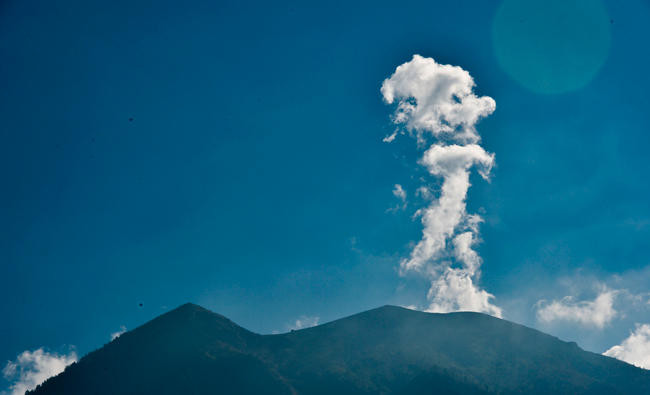
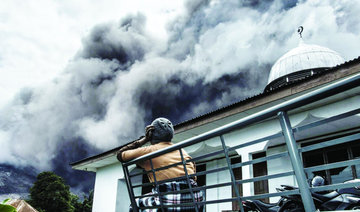
Mount Agung volcano spews smoke to the air as seen from Karangasem, on paradise island of Bali on Thursday. (AFP)
Updated 28 September 2017
Follow

Over 130,000 flee menacing volcano in Indonesia

BALI: More than 130,000 people have fled the region around the Mt. Agung volcano on the Indonesian tourist island of Bali, fearing it will soon erupt, an official said Thursday.
The disaster mitigation agency’s command post in Bali said the number of evacuees has swelled to about 134,200. The figure is more than double the estimated population within an immediate danger zone but people further away are leaving too.
Those who have fled are scattered in more than 500 locations across the island famed for its beaches, lush green interior and elegant Hindu culture, taking shelter in temporary camps, sports centers and other public buildings.
The volcano has been at its highest alert level since Friday, sparking the massive exodus of villagers. Thousands of cows left behind by rural communities are also being evacuated.
The exclusion zone around the mountain extends as far as 12 km from the crater in places.
“I was very worried about the situation” said Nyoman Suarta, who was leaving a village a few kilometers outside the official no-go radius. “So I decided to get out to save myself with my stuff and my pet,” he said, carrying a cage housing a bird.
Agung, which dominates the landscape in the northeast of the island, last erupted in 1963, killing more than 1,100 people. It remained active for about a year.
Volcanologists say the past week’s dramatic escalation in tremors indicates an eruption is more likely than not, but they can’t say with certainty when it will happen.
“I would definitely be following the advice to stay outside the exclusion zone,” said Heather Handley, an assistant Earth sciences professor at Sydney’s Macquarie University. The increase in tremors suggests an eruption is “imminent,” she said.
Its eruptions in 1963 produced deadly clouds of searing hot ash, gases and rock fragments that traveled down its slopes at great speed. Lava spread for several kilometers and people were also killed by lahars — rivers of water and volcanic debris.
Officials this week installed warning sirens in several townships.
“If Mt. Agung erupts, I’m in charge of pressing the alarm button,” said Nyoman Kasna, a local official. “Sirens will sound and tell the community the mountain has erupted.”
Agung, about 70 km to the northeast of the tourist hotspot of Kuta, is among more than 120 active volcanoes in Indonesia.
Another volcano, Mt. Sinabung on Sumatra, has been erupting sporadically since 2010, sometimes blasting volcanic ash several kilometers into the air and forcing more than 30,000 to evacuate their villages.
Indonesia, an archipelago of thousands of islands, is prone to seismic upheaval due to its location on the Pacific “Ring of Fire,” an arc of volcanoes and fault lines encircling the Pacific Basin.


Saudi ambassador becomes first foreign envoy to meet Bangladesh’s new PM

Updated 22 February 2026
Follow

Saudi ambassador becomes first foreign envoy to meet Bangladesh’s new PM

  • Tarique Rahman took oath as PM last week after landslide election win
  • Ambassador Abdullah bin Abiyah also meets Bangladesh’s new FM

Dhaka: Saudi Arabia’s ambassador to Dhaka became on Sunday the first foreign envoy to meet Bangladesh’s new Prime Minister Tarique Rahman since he assumed the country’s top office.

Rahman’s Bangladesh Nationalist Party made a landslide win in the Feb. 12 election, securing an absolute majority with 209 seats in the 300-seat parliament.

The son of former Prime Minister Khaleda Zia and former President and BNP founder Ziaur Rahman, he was sworn in as the prime minister last week.

The Saudi government congratulated Rahman on the day he took the oath of office, and the Kingdom’s Ambassador Abdullah bin Abiyah was received by the premier in the Bangladesh Secretariat, where he also met Bangladesh’s new foreign minister.

“Among the ambassadors stationed in Dhaka, this is the first ambassadorial visit with Prime Minister Tarique Rahman since he assumed office,” Saleh Shibli, the prime minister’s press secretary, told Arab News.

“The ambassador conveyed greetings and best wishes to Bangladesh’s prime minister from the king and crown prince of Saudi Arabia … They discussed bilateral matters and ways to strengthen the ties among Muslim countries.”

Rahman’s administration succeeded an interim government that oversaw preparations for the next election following the 2024 student-led uprising, which toppled former leader Sheikh Hasina and ended her Awami League party’s 15-year rule.

New Cabinet members were sworn in during the same ceremony as the prime minister last week.

Foreign Minister Khalilur Rahman is a former UN official who served as Bangladesh’s national security adviser during the interim government’s term.

He received Saudi Arabia’s ambassador after the envoy’s meeting with the prime minister.

“The foreign minister expressed appreciation for the Saudi leadership’s role in promoting peace and stability in the Middle East and across the Muslim Ummah. He also conveyed gratitude for hosting a large number of Bangladeshi workers in the Kingdom and underscored the significant potential for expanding cooperation across trade, investment, energy, and other priority sectors, leveraging the geostrategic positions of both countries,” the ministry said in a statement.

“The Saudi ambassador expressed his support to the present government and his intention to work with the government to enhance the current bilateral relationship to a comprehensive relationship.”

Around 3.5 million Bangladeshis live and work in Saudi Arabia. They have been joining the Saudi labor market since 1976, when work migration to the Kingdom was established during the rule of the new prime minister’s father.

Bangladeshis are the largest expat group in the Kingdom and the largest Bangladeshi community outside Bangladesh and send home more than $5 billion in remittances every year.