LONDON: Saudi soldier-turned-artist Abdulnasser Gharem thinks it is time the world heard more about the Kingdom’s art scene.
He has just completed his first exhibition at California-based Los Angeles County Museum of Art (LACMA). He told Arab News that it represented a turning point in his career. “There were over 80,000 visitors to my show from April to July,” he said, visibly pleased. “It was amazing because in Saudi Arabia we don’t yet have (many) art galleries, so it was a chance get our voice heard.”
His show “Abdulnasser Gharem: Pause” brought together work influenced by Gharem’s experiences following the Sept. 11 Twin Towers attacks. Two of the hijackers had been his school classmates. “To me, in that moment, it was like the whole world stopped … it felt like a pause. That realization was the inspiration behind my work and then the idea of the show followed,” he said in an interview with CNN International’s “Inside the Middle East” program at the time of the show.
The 44-year-old Riyadh-based artist continued: “It made me think about the situation that my old classmates were in. We grew up in the same environment, I found so many similarities in our situations, so it was at that moment, really, that I started to look for my own path.”
The exhibition consisted of 11 works, including sculptures as well as film and print pieces.
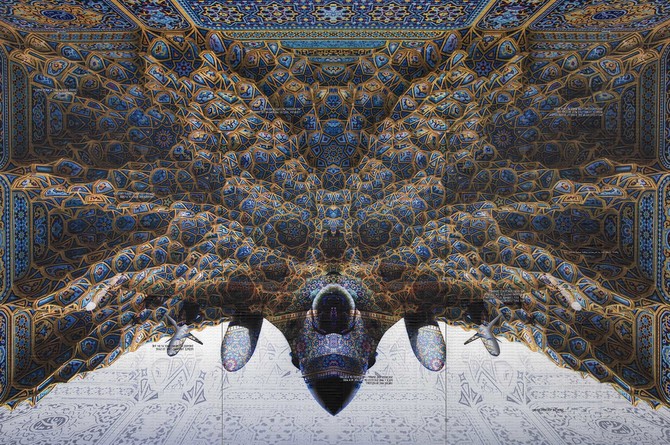
One of the newer pieces, created in 2017, is titled “Camouflage” and shows an army tank with an orange flower painted on its cannon in front of an Iranian mosque. The piece is chock-full of political messages relating to arms deals and sectarianism in the Middle East.
Another noteworthy piece is “The Path (Siraat),” a three-minute performative video and silkscreened photograph of a broken bridge in Saudi Arabia. An image of a damaged road leading into darkness is repeatedly emblazoned with the words “The Path” in an eerie and powerful visual loop.
Gharem was in the army for 23 years before he branched out as a full-time artist, earning the accolade of the highest-paid living Arab artist when he sold a piece of installation art for $842,500 at Christie’s Dubai in 2011.
“I have been in many places. The war affects the artist in every way. Trends in society evolve after war,” he explained.
“You can see all the military elements in my work, such as tanks and airplanes. I’m a contemporary artist so my issues are related to my current life.”
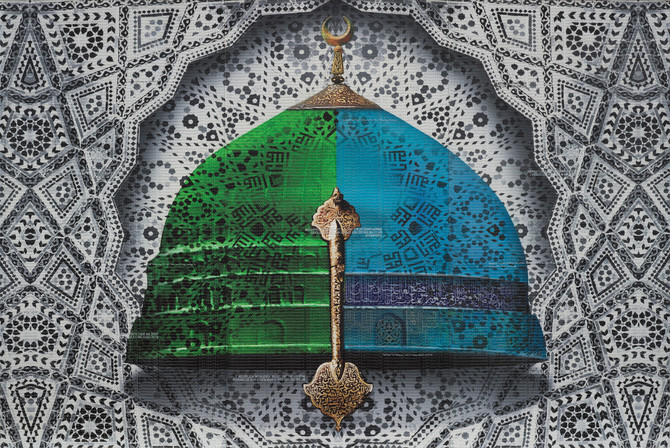
Although the media and platforms for Gharem’s work borrow from the mainstream of modern art, the narratives and images are drawn from his everyday world, while many of his motifs — including geometric designs and floral arabesques — belong to the canon of Islamic art.
Gharem said: “I’m trying to say a lot of things. Saudi Arabians are complaining that they are stereotyped by the world, but no one from my country is trying to change it. Contemporary art is the best medium for showing your side of the story. The piece is complete and can be engaged with. It’s an international language.”
He continued, “I’m trying to research my heritage and infuse it with contemporary art and use this to represent us because no one else is touching it.
“We don’t have artists who dig into their history and show it through the new medium or a medium that everyone can understand. It’s a mission of mine.”
Gharem’s next show will be in Washington DC in six months’ time and showcase new instalments, he says.
“There are many themes to my work. It’s like Saudi Arabia is made of mosaics. I’m trying to display social issues and turn them into something global so that the people will see that we have our own perspective and our own voice.
“For example, the phenomenon of terrorism. It’s not just an issue that affects the West. It’s multi-sided. It’s affecting everyone, we (Saudi Arabia) are also suffering from that.”
“I can speak directly through the artwork. It’s an opportunity to speak to the media and the world without a middle man.”
Gharem says there is a small but promising art movement in Saudi Arabia, but he calls for more government support.
“There are no museums, no facilities, no art schools and no proper galleries — but there is a movement. The country has some very talented young artists.
“The government needs to realize the importance of culture’s role in society. It’s only through culture that society can understand its people and its how the international community can understand us.”


![]()
![]()
![]()
![]()
![]()

Soldier-turned-artist wants world to hear Saudi Arabia’s voice


Soldier-turned-artist wants world to hear Saudi Arabia’s voice

Latest updates


© 2026 SAUDI RESEARCH & PUBLISHING COMPANY, All Rights Reserved And subject to Terms of Use Agreement.