Journalist accused of terror links freed from jail in Turkey

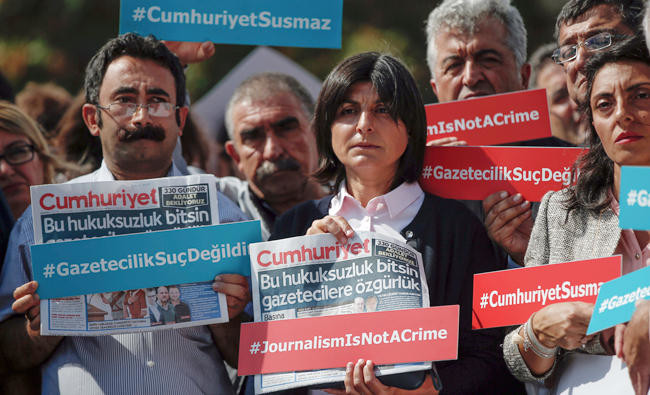
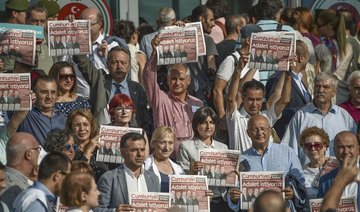
Journalists hold copies of Cumhuriyet hours before Kadri Gursel, a columnist for Cumhuriyet, Turkey's main opposition newspaper, being released from Silivri prison outside Istanbul, on Sept. 25, 2017. (AP)
Updated 27 September 2017
Follow

Journalist accused of terror links freed from jail in Turkey

ISTANBUL: A court in Istanbul has ordered the release from prison on bail of a leading Turkish journalist accused of having links to terrorist organizations.
Kadri Gursel, a columnist and editorial director at the opposition newspaper Cumhuriyet, was freed on Monday night after 11 months in Silivri jail in Istanbul. The court ruled that four other detained Cumhuriyet staff must remain behind bars while their trial continues.
“There is nothing to celebrate because several Cumhuriyet journalists are still facing unfair and baseless accusations,” Gursel said after his release. “Their freedoms have been taken away.”
He said he would continue his journalistic work despite difficult conditions for media freedom in Turkey.
Gursel and the other journalists are charged with having links to terrorism through their coverage of the outlawed Kurdistan Workers Party (PKK), the ultra-left Revolutionary People’s Liberation Party-Front (DHKP-C), and the movement of Fethullah Gulen, the US-based cleric accused by Ankara of being behind last year’s coup attempt. Their trial began in July and continues on Oct. 31.
Gonenc Gurkaynak, a lawyer in Istanbul, said Gursel’s release did not mean justice in Turkey had been fully delivered.
“As a British statesman famously said, justice delayed is justice denied,” he told Arab News.
“Instead of cheering his release, we should all feel shame and be astonished for every day he spent in jail for the past year.”
Steven M. Ellis, director of advocacy and communications at the International Press Institute, where Gursel is a board member, said his release was a step forward.
“We’re extremely glad that Kadri Gursel was released, but equally disappointed our other colleagues were not,” he said.
“Monday’s proceedings, with a parade of witnesses offering irrelevant commentary instead of facts, demonstrated again how absurd this case is,” and the ruling was a further reminder of the pressure on press freedom in Turkey.
However, the Turkish President Recep Tayyip Erdogan says most of those imprisoned are not journalists, but terrorists. “Many of them have been involved in bombing incidents or burglary,” he said in New York last week.
With 171 journalists behind bars, Turkey ranks 155 out of 179 in the 2017 World Press Freedom Index of Reporters Without Borders. The Cumhuriyet trial is being closely followed by international observers and EU representatives, because Turkey has been a candidate country for the EU since 1999 and must meet accession criteria for press freedom.
Laura Batalla, secretary-general of the European Parliament Turkey Forum, said Gursel’s release was a sign of hope to other imprisoned journalists.
“Justice should be applied fairly and impartially in the trials of all those accused. The space for freedom of speech is worryingly shrinking in Turkey and it needs to be protected now more than ever,” she told Arab News.
Before Monday’s trial, pro-government newspapers Star and Aksam reported on Twitter that all the Cumhuriyet journalists would remain in prison. Both newspapers deleted the tweets, but the court lodged a criminal complaint against them.


Israel confirms ban on 37 NGOs in Gaza

A Palestinian woman carries wood for fire in the Nuseirat refugee camp in the central Gaza Strip on December 31, 2025. (AFP)
Updated 01 January 2026
Follow

Israel confirms ban on 37 NGOs in Gaza

  • UN has warned that this will exacerbate the humanitarian crisis in the war-ravaged Palestinian territory
  • Several NGOS have said the requirements contravene international humanitarian law or endanger their independence

JERUSALEM: Israel on Thursday said 37 humanitarian agencies supplying aid in Gaza had not met a deadline to meet “security and transparency standards,” and would be banned from the territory, despite an international outcry.
The international NGOs, which had been ordered to disclose detailed information on their Palestinian staff, will now be required to cease operations by March 1.
The United Nations has warned that this will exacerbate the humanitarian crisis in the war-ravaged Palestinian territory.
“Organizations that have failed to meet required security and transparency standards will have their licenses suspended,” Israel’s Ministry of Diaspora Affairs and Combating Antisemitism said in a statement.
Several NGOS have said the requirements contravene international humanitarian law or endanger their independence.
Israel says the new regulation aims to prevent bodies it accuses of supporting terrorism from operating in the Palestinian territories.
Prominent humanitarian organizations hit by the ban include Doctors Without Borders (MSF), the Norwegian Refugee Council (NRC), World Vision International and Oxfam, according to a ministry list.
In MSF’s case, Israel accused it of having two employees who were members of Palestinian militant groups Islamic Jihad and Hamas.
MSF said this week the request to share a list of its staff “may be in violation of Israel’s obligations under international humanitarian law” and said it “would never knowingly employ people engaging in military activity.”
‘Critical requirement’ 
NRC spokesperson Shaina Low told AFP its local staff are “exhausted” and international staff “bring them an extra layer of help and security. Their presence is a protection.”
Submitting the names of local staff is “not negotiable,” she said. “We offered alternatives, they refused,” hse said, of the Israeli regulators.
The ministry said Thursday: “The primary failure identified was the refusal to provide complete and verifiable information regarding their employees, a critical requirement designed to prevent the infiltration of terrorist operatives into humanitarian structures.”
In March, Israel gave NGOs 10 months to comply with the new rules, which demand the “full disclosure of personnel, funding sources, and operational structures.”
The deadline expired on Wednesday.
The 37 NGOs “were formally notified that their licenses would be revoked as of January 1, 2026, and that they must complete the cessation of their activities by March 1, 2026,” the ministry said Thursday.
A ministry spokesperson told AFP that following the revocation of their licenses, aid groups could no longer bring assistance into Gaza from Thursday.
However, they could have their licenses reinstated if they submitted the required documents before March 1.
Minister of Diaspora Affairs and Combating Antisemitism Amichai Chikli said “the message is clear: humanitarian assistance is welcome — the exploitation of humanitarian frameworks for terrorism is not.”
‘Weaponization of bureaucracy’
On Thursday, 18 Israel-based left-wing NGOs denounced the decision to ban their international peers, saying “the new registration framework violates core humanitarian principles of independence and neutrality.”
“This weaponization of bureaucracy institutionalizes barriers to aid and forces vital organizations to suspend operations,” they said.
UN Palestinian refugee agency chief Philippe Lazzarini had said the move sets a “dangerous precedent.”
“Failing to push back against attempts to control the work of aid organizations will further undermine the basic humanitarian principles of neutrality, independence, impartiality and humanity underpinning aid work across the world,” he said on X.
On Tuesday, the foreign ministers of 10 countries, including France and Britain, urged Israel to “guarantee access” to aid in the Gaza Strip, where they said the humanitarian situation remains “catastrophic.”
A fragile ceasefire has been in place since October, following a deadly war waged by Israel in response to Hamas’s unprecedented October 7, 2023 attack on Israel.
Nearly 80 percent of buildings in Gaza have been destroyed or damaged by the war, according to UN data.
About 1.5 million of Gaza’s more than two million residents have lost their homes, said Amjad Al-Shawa, director of the Palestinian NGO Network in Gaza.