

75,000 flee homes in Bali as Mount Agung volcano rumbles

Indonesia President Joko Widodo (C) talks with children as he visits a temporary shelter for people who live near Mount Agung, a volcano on the highest alert level, on the resort island of Bali, in Karangasem, Indonesia on Tuesday. (Reuters)
Updated 26 September 2017
Follow

75,000 flee homes in Bali as Mount Agung volcano rumbles

KARANGASEM, Indonesia: Vehicles laden with food, facemasks and bedding have been sent to help more than 75,000 people who have fled a volcano on the tourist island of Bali, as the Indonesian president flew in to visit crowded aid centers.
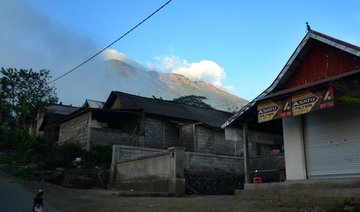
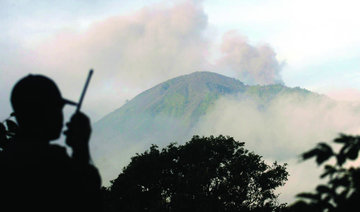
Mount Agung, 75 km from the resort hub of Kuta, has been rumbling since August and threatening to erupt for the first time since 1963 — a potential blow to the country’s lucrative tourism industry.
Increasingly frequent tremors show that the molten magma is still rising toward the surface, with the mountain entering a “critical phase,” said the National Disaster Mitigation Agency (NDMA).
It said the number fleeing their homes had increased as fears grow that the mountain could blow.
“The local mitigation agency reported that until 12 p.m. Tuesday, the number has reached 75,673 people, spread across 377 evacuation centers in nine districts,” said agency spokesman Sutopo Purwo Nugroho.
Around 62,000 people lived in the danger zone before the evacuations, according to the agency, but residents just outside the area have also left as a precaution.
“The number is expected to continue to rise,” Nugroho said.
The Indonesian Center for Volcanology and Geological Hazard Mitigation said there has been an increase in volcanic tremors, with a total of 564 recorded Monday.


Evacuees have packed into temporary shelters or moved in with relatives. Some 2,000 cows have also been evacuated from the flanks of the volcano.
President Joko Widodo was due to visit crammed evacuation centers in Bali on Tuesday afternoon.
Balinese residents, international NGOs and the central government have begun organizing aid.
Vehicles loaded with noodles, mineral water and blankets have been sent to the evacuation centers, while residents around the island have been collecting donations.
Bali’s “sister village” program and tradition of communal assistance means evacuees have been able to stay in villages outside the danger zone.
I Ketut Subandi, head of logistics at the village of Tana Ampo, said basic food items like rice, instant noodles, cooking oil and water were most needed.
“This morning we were worried because we had limited rice supply, but now we have received more rice stocks from donors,” Subandi said.
NDMA has sent 640,000 face masks, 12,500 mattresses, 8,400 blankets and 50 tents. The central government has a relief fund totalling nearly $150 million to meet the cost of natural disasters, which could be tapped in case of an eruption.
Officials announced the highest possible alert level on Friday due to the increasing volcanic activity and warned people to stay at least nine kilometers away from the crater.
Operators have canceled trekking tours on the mountain but officials have otherwise been at pains to assure tourists the island is safe.
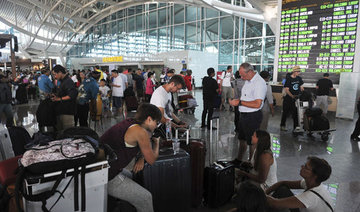
The airport in Bali’s capital Denpasar, through which millions of foreign tourists pass every year, has not been affected, but several countries including Australia and Singapore have issued a travel advisory.
Flights to and from the island have not been interrupted but airlines are watching the situation closely.
Virgin Australia said it would be making an extra fuel stop in Darwin for some of its flights between Australia and Bali in case it is forced to turn back.
Singapore Airlines said customers traveling between Sept. 23 and Oct. 2 could rebook flights or ask for a refund.
Mount Agung is one of more than 120 active volcanoes extending the length of Indonesia, which straddles the Pacific Ring of Fire.
It last erupted in 1963, killing nearly 1,600 people and sending ash as far as the capital Jakarta.
Analysis: Understanding the illegitimacy of Somaliland independence

Updated 5 sec ago
Follow

Analysis: Understanding the illegitimacy of Somaliland independence

  • Israel’s recognition of Somaliland has drawn condemnation as a violation of international law and Somalia’s sovereignty
  • Regional and global critics warn the move risks militarizing the Red Sea and destabilizing the Horn of Africa

LONDON: For 34 years, the breakaway state of Somaliland, which declared independence from Somalia in 1991, has wandered in the diplomatic wilderness, its claim to sovereignty unrecognized by the entire world.

All that changed on Dec. 26 with the surprise announcement by the Israeli government that it was establishing full diplomatic relations with the territory, which occupies a strategically sensitive position along the northern coast of the Horn of Africa, overlooking the Gulf of Aden and the mouth of the Red Sea.

On Dec. 28, Israel’s Foreign Minister Gideon Sa’ar, took to Facebook to publish the declaration of recognition, signed by himself and Prime Minister Benjamin Netanyahu.

The recognition, it read, had been made “in light of the shared values, strategic interests, and the spirit of mutual respect that binds our people.”


The relationship, it added, “will contribute to advancing peace, stability, and prosperity in the Horn of Africa, the Middle East, and beyond.”

But for the many international critics of the move, including Turkiye, Saudi Arabia, the EU, the UK, China and the African Union, the Israeli recognition of Somaliland’s sovereignty is likely to only increase tensions in an already turbulent region.

Somalia’s President Hassan Sheikh Mohamud has claimed that, as the price for Israel’s recognition, Somaliland has agreed to accept Palestinians displaced from Gaza by Israel. The Somaliland regime has denied this, but pro-Palestinian states are not convinced.

On Dec. 27, Saudi Arabia was among 21 Arab, Islamic and African nations that issued a joint statement declaring their “unequivocal rejection of Israel’s recognition of the ‘Somaliland’ region of the Federal Republic of Somalia.”

They rejected “any potential link between such a measure and any attempts to forcibly expel the Palestinian people out of their land, which is unequivocally rejected in any form as a matter of principle.”

Israel’s recognition of Somaliland, they added, constituted “a grave violation of the principles of international law and the UN Charter, which explicitly stipulates the imperative of protecting the sovereignty of states and their territorial integrity.”

There would, they added, be “serious repercussions of such an unprecedented measure on peace and security in the Horn of Africa, the Red Sea, and … serious effects on international peace and security as a whole.”

Much of the rest of the world, including Europe, is in lockstep with the Arab states on the issue.


On Dec. 26, the EU issued a statement in which it “reaffirms the importance of respecting the unity, the sovereignty and the territorial integrity of the Federal Republic of Somalia pursuant of its constitution, the Charters of the African Union and the UN.”

It added: “This is key for the peace and stability of the entire Horn of Africa region.”

China, too, has criticized the Israeli move. In a statement, the Foreign Ministry said that “no country should encourage or support other countries’ internal separatist forces for its own selfish interests.”

At a meeting of the UN Security Council on Dec. 29, Khaled Khiari, assistant secretary-general for the Middle East, Asia and the Pacific, relayed Somalia’s indignation at what it called “a deliberate attack” on its sovereignty.

Khiari said Somalia had “also underscored that it would not permit the establishment of any foreign military bases or arrangements that would draw the country into proxy conflicts.”

Somalia declared that “no external actor has the authority” to alter its territorial configuration.


The UK was among numerous countries that spoke up for Somalia, with its charge d’affaires reaffirming his country’s continuing “support for the sovereignty, territorial integrity, political independence, and unity of Somalia.”

The UK, added Ambassador James Kariuki, “does not recognize Somaliland’s independence.

“We maintain that any change to Somaliland’s status depends on mutual agreement between Mogadishu and Hargeisa, through dialogue, and must conform to the purposes and principles of the UN Charter.”

Israel’s Sa’ar, who visited Somaliland on Tuesday, brushed aside the chorus of criticism. “Somaliland was not created this past weekend,” he wrote on Facebook. “It has existed as a functioning state for more than 34 years.

“The attacks on Israel’s recognition of Somaliland are hypocritical. Only Israel will decide who to recognize and with whom to maintain diplomatic relations.”

Netanyahu, meanwhile, has said he only wants to “support a democratic, moderate country, a Muslim country, that wants to join the Abraham Accords.”


But some observers believe Israel may be planning to use Somaliland as a military base from which to attack the Houthis in Yemen. Since 2023, the Houthis have launched several missile attacks on Israel, and Israel has struck many targets in Yemen in response.

Now the Houthis have warned that any Israeli military presence in Somaliland would be considered a target, which puts Somalis in the firing line of a war that has nothing to do with them.

Israel’s act of recognition appears likely to stoke tensions in the region.

For example, relations between Somalia and Ethiopia, its western neighbor, are already fraught following talks between Somaliland and Addis Ababa aimed at giving the landlocked state access to the Red Sea.

Ethiopia lost its own coastline in 1993 when its northern region of Eritrea declared independence.

The plan to give Ethiopia a naval base on Somaliland’s Red Sea coast is bitterly opposed by Somalia, which resents what it sees as its territory being given away.

It has also angered Egypt. Cairo has its own dispute with Ethiopia over the Grand Ethiopian Renaissance Dam, which the country has built on the Blue Nile and which Egypt says is threatening its water supplies.

The region’s current crisis is rooted in colonialism.


Before the European “scramble for Africa,” there was no central “Somalian” state. Instead, a region roughly equivalent to modern-day Somaliland, Somalia, Djibouti, the eastern Ogaden region of Ethiopia and parts of northern Kenya was occupied by scattered groups of Somali-speaking pastoral tribes.

In the 19th century, European powers divided up the area into French Somaliland (Djibouti) in the extreme northwest, British Somaliland (today’s Somaliland), and Italian Somaliland (now Somalia).

The British and Italian-held territories gained their independence in 1960 and came together briefly as the Somali Republic. The union proved fragile, however, and in 1969 ended with the assassination of President Abdirashid Ali Sharmarke and a subsequent military coup.

The leader of the coup was Mohamed Siad Barre, the commander of the army, who declared himself president.

In 1991, widespread anger at the regime escalated into civil war. Barre fled to Kenya (reportedly in a tank loaded with millions of dollars of the state’s money), and the government collapsed.

This was the moment, in May 1991, that political leaders in the former British Somaliland declared independence as the Republic of Somaliland, an entity that until now had received no international recognition.

Abdirahman Sahal Yusuf, former media adviser to the Office of the Prime Minister of Somalia and editor of the Qiraat Somali online news platform, says it is clear that “Israel has no right to recognize Somaliland. It is a move that violates international law.”


In doing so, he told Arab News, he believes Israel has two strategic goals: “Establishing a military base in this region to confront the Houthis, but at the same time there is an agreement to transfer Palestinians to Somaliland, which is a red line.”

Establishing an Israeli military base in Somaliland, he said, “would pose a threat to the national security of Egypt and Saudi Arabia, since this region is very sensitive.

“Israel wants to move its battles to this region, ruining Arab national security and dividing countries. The unity of Somalia must be protected.”

For Abdihakim Kalale, an Ethiopian political and security analyst, “the core issue is not recognition itself. States recognize one another, exchange interests, and recalibrate alliances as part of normal international politics.

“The problem lies in how Israel recognized Somaliland and the assumptions that informed that decision.”

Israel, he told Arab News, “appears to have treated Somaliland as a single, unified separatist movement. In reality, it is neither politically nor socially homogeneous. Fragmentation exists, not only in the east, but also in the west.”

In western Somaliland, two major clans inhabiting territories that represent roughly 15-20 percent of the claimed area have not fully integrated into the Somaliland system.

“These groups are actively pursuing the creation of a separate federal member state aligned with Mogadishu rather than Hargeisa. This alone demonstrates that Somaliland lacks internal political cohesion.”


In the east, the situation is even more fragmented. Here, following clan-based fighting in 2023, “a new federal member state, the Northeastern State of Somalia, emerged from territories internationally referred to as Somaliland.

“This entity is now aligned with Mogadishu and exercises effective control over large areas where the Somaliland government has no presence. These eastern territories account for approximately 40 to 45 percent of the land Somaliland claims.”

Furthermore, he said: “Somaliland is neither institutionally nor socially prepared to be integrated into larger geopolitical frameworks such as the Abraham Accords,” which Netanyahu has suggested is on the cards.

“Israel engaged with a leadership eager for recognition but lacking the capacity to manage the profound internal and regional consequences that recognition entails. This creates a governance vacuum that radical and violent actors are well positioned to exploit.

“There is a real risk that this decision could accelerate radicalization and a region long regarded as relatively stable compared to southern Somalia could, in the coming years, evolve into a new security hotspot.”

Liban Abd Ali, a consultant and former media and communications director in the Office of the Prime Minister of Somalia, agrees that Israeli recognition of the breakaway territory is “a very bad move.

“It’s a violation of a sovereign state and a violation of international laws and norms, and Israel is going to divide Somalia’s territorial integrity, fuel conflicts and destroy domestic cohesion,” he told Arab News.


He believes “the main objective is to forcibly move over 1.5 million Palestinians from their own land to northern Somalia.

“They also want to use this area as a launchpad for their fight against the Houthis in Yemen, and beyond that to control the Gulf of Aden and the Red Sea. Israel’s main goal is to destabilize the region by dividing countries.”
