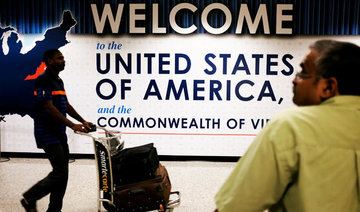
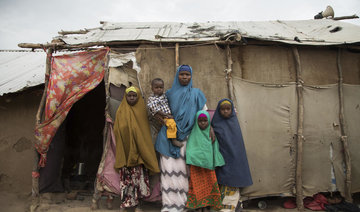
WASHINGTON: US rights groups on Monday blasted the new, open-ended version of President Donald Trump’s travel restrictions as a masked Muslim ban and pledged to keep fighting it in courts.
Despite the removal of Sudan from the expiring 90-day ban on six mainly-Muslim countries, and the addition of Chad, Venezuela and North Korea for tight restrictions or bans, activists and legal experts said Trump’s intent remained the same, to sharply cut off the flow of Muslim visitors and immigrants into the United States.
“This ban is not any better than the previous one,” said Zahra Billoo of the Council on American-Islamic Relations.
“The fact that Trump has added North Korea — with few visitors to the US — and a few government officials from Venezuela doesn’t obfuscate the real fact that the administration’s order is still a Muslim ban,” said Anthony Romero, executive director of the American Civil Liberties Union.
“President Trump’s original sin of targeting Muslims cannot be cured by throwing other countries onto his enemies list.”
Late Sunday the White House issued a new executive order to replace the expiring 90-day temporary ban on travelers from Sudan, Syria, Yemen, Iran, Somalia and Libya.
The ban, which Trump has been fighting to put in place since days after he became president in January, has been repeatedly delayed and watered down in a series of court challenges and appeals.
At the end of June, the Supreme Court allowed it finally to be implemented, with restrictions, together with a 120-day ban on refugees.
The new order Sunday, which has no expiration date, targeted eight countries but was less uniform.
North Korea, Chad, Syria, Yemen, and Libya face full bans, until they can improve their information collection on their own citizens and boost cooperation with US security authorities, who say the main target is to prevent potential terrorists from entering the country.
For Iran, an exception was left for students and exchange visitors. For Somalia, new immigrants are blocked but business, official and personal temporary visitors will be allowed, though subject to tougher vetting.
With Venezuela, only officials from certain key ministries and government agencies, and their families, are banned.
In Caracas, the foreign ministry called the US action “psychological terrorism” aimed at bringing down Venezuela’s leftist government.
The original ban is due to be heard at the Supreme Court on October 10, focusing in part on whether Muslims were targeted from the beginning.
The new order could shape the way the issue is addressed, possibly even mooting the case.
“Religion, or the religious origin of individuals or nations, was not a factor,” a senior government official told reporters on Sunday.
“The inclusion of those countries, Venezuela and North Korea, was about the fact that those governments are simply not compliant with our basic security requirements.”
But critics called that “window dressing.” One noted there were only eight visitors last year from North Korea, which does not have diplomatic relations with the United States.
Adding Chad, North Korea and Venezuelan government officials “does little to undercut the argument that the government is imposing a ban based on religion,” said Carl Tobias of the University of Richmond School of Law.
In addition, lawyers say Trump has over-extended his executive powers on placing limits on immigration.
“He’s basically rewriting the immigration law, entirely,” said Justin Cox, an attorney at the National Immigration Law Center and one of the lawyers making the arguments against the travel ban at the Supreme Court.
“If he can indefinitely ban people from these countries, he can indefinitely ban guest workers, he can indefinitely ban Mexicans, do basically whatever he wants,” Cox said.

New US travel restrictions are still ‘Muslim ban’: rights groups
Peru Congress to debate impeachment of interim president
LIMA: Peru’s Congress is set to consider Tuesday whether to impeach interim president Jose Jeri, the country’s seventh head of state in 10 years, accused of the irregular hiring of several women in his government.
A motion to oust Jeri, 39, received the backing of dozens of lawmakers on claims of influence peddling, the latest of a series of impeachment bids against him.
The session, set for 10:00 am local time (1500 GMT), is expected to last several hours.
Jeri, in office since October, took over from unpopular leader Dina Boluarte who was ousted by lawmakers amid protests against corruption and a wave of violence linked to organized crime.
Prosecutors said Friday they were opening an investigation into “whether the head of state exercised undue influence” in the government appointments of nine women on his watch.
On Sunday, Jeri told Peruvian TV: “I have not committed any crime.”
Jeri, a onetime leader of Congress himself, was appointed to serve out the remainder of Boluarte’s term, which runs until July, when a new president will take over following elections on April 12.
He is constitutionally barred from seeking election in April.
The alleged improper appointments were revealed by investigative TV program Cuarto Poder, which said five women were given jobs in the president’s office and the environment ministry after visiting with Jeri.
Prosecutors spoke of a total of nine women.
Jeri is also under investigation for alleged “illegal sponsorship of interests” following a secret meeting with a Chinese businessman with commercial ties with the government.
- Institutional crisis -
The speed with which the censure process is being handled has been attributed by some political observers as linked to the upcoming presidential election, which has over 30 candidates tossing their hat into the ring, a record.
The candidate from the right-wing Popular Renewal party, Rafael Lopez Aliaga, who currently leads in polls, has been among the most vocal for Jeri’s ouster.
If successfully impeached, Jeri would cease to exercise his functions and be replaced by the head of parliament as interim president.
But first a new parliamentary president would have to be elected, as the incumbent is acting in an interim capacity.
“It will be difficult to find a replacement with political legitimacy in the current Congress, with evidence of mediocrity and strong suspicion of widespread corruption,” political analyst Augusto Alvarez told AFP.
Peru is experiencing a prolonged political crisis, which has seen it burn through six presidents since 2016, several of them impeached or under investigation for wrongdoing.
It is also gripped by a wave of extortion that has claimed dozens of lives, particularly of bus drivers — some shot at the wheel if their companies refuse to pay protection money.
In two years, the number of extortion cases reported in Peru jumped more than tenfold — from 2,396 to over 25,000 in 2025.
A motion to oust Jeri, 39, received the backing of dozens of lawmakers on claims of influence peddling, the latest of a series of impeachment bids against him.
The session, set for 10:00 am local time (1500 GMT), is expected to last several hours.
Jeri, in office since October, took over from unpopular leader Dina Boluarte who was ousted by lawmakers amid protests against corruption and a wave of violence linked to organized crime.
Prosecutors said Friday they were opening an investigation into “whether the head of state exercised undue influence” in the government appointments of nine women on his watch.
On Sunday, Jeri told Peruvian TV: “I have not committed any crime.”
Jeri, a onetime leader of Congress himself, was appointed to serve out the remainder of Boluarte’s term, which runs until July, when a new president will take over following elections on April 12.
He is constitutionally barred from seeking election in April.
The alleged improper appointments were revealed by investigative TV program Cuarto Poder, which said five women were given jobs in the president’s office and the environment ministry after visiting with Jeri.
Prosecutors spoke of a total of nine women.
Jeri is also under investigation for alleged “illegal sponsorship of interests” following a secret meeting with a Chinese businessman with commercial ties with the government.
- Institutional crisis -
The speed with which the censure process is being handled has been attributed by some political observers as linked to the upcoming presidential election, which has over 30 candidates tossing their hat into the ring, a record.
The candidate from the right-wing Popular Renewal party, Rafael Lopez Aliaga, who currently leads in polls, has been among the most vocal for Jeri’s ouster.
If successfully impeached, Jeri would cease to exercise his functions and be replaced by the head of parliament as interim president.
But first a new parliamentary president would have to be elected, as the incumbent is acting in an interim capacity.
“It will be difficult to find a replacement with political legitimacy in the current Congress, with evidence of mediocrity and strong suspicion of widespread corruption,” political analyst Augusto Alvarez told AFP.
Peru is experiencing a prolonged political crisis, which has seen it burn through six presidents since 2016, several of them impeached or under investigation for wrongdoing.
It is also gripped by a wave of extortion that has claimed dozens of lives, particularly of bus drivers — some shot at the wheel if their companies refuse to pay protection money.
In two years, the number of extortion cases reported in Peru jumped more than tenfold — from 2,396 to over 25,000 in 2025.
© 2026 SAUDI RESEARCH & PUBLISHING COMPANY, All Rights Reserved And subject to Terms of Use Agreement.