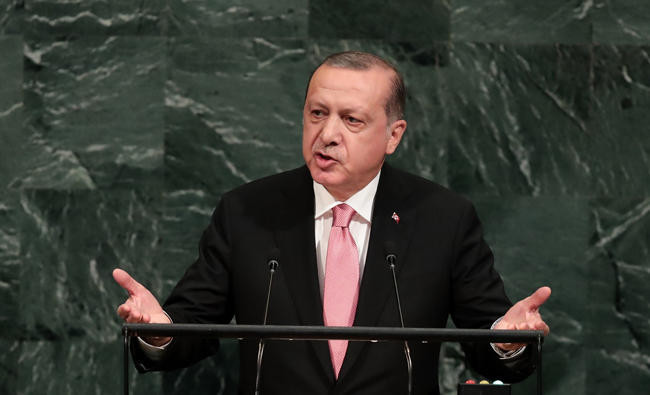
ISTANBUL: Turkish President Recep Tayyip Erdogan has accused the security forces in Myanmar of waging a “Buddhist terror” against the Rohingya Muslim minority in the country, hundreds of thousands of whom have fled to Bangladesh.
Erdogan, who has repeatedly highlighted the plight of the Rohingya, again accused the Yangon government of carrying out a “genocide” against the people in Rakhine state.
In a speech in Istanbul, Erdogan lamented the failure of the international community to lay sanctions against the Myanmar government over its campaign.
“There is a very clear genocide over there,” Erdogan said.
Erdogan, who has held talks by phone with Myanmar’s key leader and Nobel Peace Prize winner Aung Sang Suu Kyi, added: “Buddhists always get represented as envoys of goodwill. At the moment, there is a clear Buddhist terror in Myanmar... I don’t know how you can gloss over this with yoga, schmoga. This is a fact here. And all humanity needs to know this.”
Erdogan takes a sharp interest in the fate of Muslim communities across the world and notably sees himself as a champion of the Palestinian cause.
Returning for a key personal theme, he lambasted the international community for being quick to denounce “Islamic terror” but not “Christian terror,” “Jewish terror” or “Buddhist terror.”
Erdogan’s remarks came as UN High Commissioner for Refugees Filippo Grandi said Bangladesh must not force Rohingya Muslims who have fled Myanmar to move to camps on a desolate island.
Authorities have stepped up moves to house the Rohingya on the island in the Bay of Bengal since a new surge which now totals 436,000 refugees started arriving on Aug. 25.
Grandi said Prime Minister Sheikh Hasina had mentioned the relocation plan when they met in July. There were already 300,000 Rohingya in camps near the border at Cox’s Bazar before the latest influx started.
But he insisted that any move from the camps to Bhashan Char island — also known as Thengar Char — “has to be voluntary on the part of the refugees.”
“We cannot force people to go to the place. So the option for the medium term, let’s say — I don’t want to talk about long-term — has to be also something that is acceptable to the people that go there,” he said.
“Otherwise it won’t work. Otherwise people won’t go.”
The UN has praised Bangladesh for taking in the Rohingya, who fled a military crackdown in Myanmar. It has appealed for international help for the authorities.
“It is good to think ahead. These people (Rohingya) may not be able to go back very quickly and especially now the population has now doubled,” Grandi told a Dhaka press briefing.
The UNHCR chief said his agency was ready to help the island plan with a “technical study of the options.
“That’s all that we are ready to give. We are not giving it yet because I have not seen any concrete options on any paper.”
The small island in the estuary of the Meghna river is a one-hour boat ride from Sandwip, the nearest inhabited island, and two hours from Hatiya, one of Bangladesh’s largest islands.
The government has tasked the navy with making it ready for the Rohingya. Two helipads and a small road have been built.
The authorities first proposed settling the Rohingya there in 2015, as the refugee camps in Cox’s Bazar became overstretched.
But the plan was apparently shelved last year amid reports that the silty island, which only emerged from the sea in 2006, was often unhabitable due to regular tidal flooding.
In recent weeks, Bangladesh has appealed for international support to move the Rohingya to the island as the impoverished nation struggles to cope with the influx
More than 436,000 refugees have crossed the border from Myanmar’s Rakhine state since August 25 when a military crackdown was launched following attacks by Rohingya militants.
There is not enough food, water or medicine to go around. Roads around the camps are littered with human excrement, fueling UN fears that serious disease could quickly break out.

Erdogan accuses Myanmar of ‘Buddhist terror’ against Rohingya

New Zealand mosque shooter seeks to discard his guilty pleas, saying prison made him irrational
WELLINGTON: The man who killed 51 Muslim worshipers at two mosques in New Zealand’s deadliest mass shooting told an appeals court Monday that he felt forced to admit to the crimes because of “irrationality” due to harsh prison conditions, as he sought to have his guilty pleas discarded.
A panel of three judges at the Court of Appeal in Wellington will hear five days of evidence about Brenton Tarrant’s claim that he was not fit to plead to the terrorism, murder and attempted murder charges he faced after the 2019 attack in the city of Christchurch. If his bid is successful, his case would return to court for a trial, which was averted in March 2020 when he admitted to the hate-fueled shooting.
He is also seeking to appeal his sentence of life without the chance of parole, which had never been imposed in New Zealand before. Tarrant’s evidence Monday about his mental state when he pleaded guilty was the first time he had spoken substantively in a public setting since he livestreamed the 2019 massacre on Facebook.
Shooter says he suffered “nervous exhaustion”
The Australian man, a self-declared white supremacist, migrated to New Zealand with a view to committing the massacre, which he planned in detail. He amassed a cache of semiautomatic weapons, took steps to avoid detection and wrote a lengthy manifesto before he drove from Dunedin to Christchurch in March 2019 and opened fire at two mosques.
Along with 51 people killed, the youngest a 3-year-old boy, dozens of others were severely wounded. The attack was considered one of New Zealand’s darkest days and institutions have sought to curb the spread of Tarrant’s message through legal orders and a ban on possession of his manifesto or video of the attack.
Monday’s hearing took place under tight security constraints that severely limited who could view Tarrant’s evidence, which included some reporters and those hurt or bereaved in the massacre. Tarrant, who wore a white button-down shirt and black-rimmed glasses and had a shaved head, spoke on video from a white-walled room at Auckland Prison.
Answering questions from a Crown lawyer and from lawyers representing him, Tarrant, 35, said his mental health had deteriorated due to conditions in prison, where he was held in solitary confinement with limited reading material or contact with other prisoners.
By the time he pleaded guilty, Tarrant said he was suffering from “nervous exhaustion” and uncertainty about his identity and beliefs. He had admitted to the crimes a few months before his trial was due to begin because there was “little else I could do,” he told the court.
Crown lawyers say no evidence of serious mental illness
Crown lawyer Barnaby Hawes suggested to Tarrant during questioning that the Australian man had other options. He could have requested a delay in his trial date on mental health grounds or could have proceeded to trial and defended himself, Hawes said.
Hawes also put to Tarrant that there was little evidence in the documentation of his behavior by mental health experts and prison staff that he was in any kind of serious mental crisis. Tarrant suggested that signs of mental illness he displayed hadn’t been recorded and that at times he had sought to mask them.
“I was definitely doing everything possible to come across as confident, assured, mentally well,” he told the court. Tarrant’s behavior “reflected the political movement I’m a part of,” he added. “So I always wanted to put on the best front possible.”
He agreed that he had had access to legal advice throughout the court process. Tarrant’s current lawyers have been granted name suppression because they feared representing him would make them unsafe.
The appeal outcome is due later
Bids to appeal convictions or sentences in New Zealand must be made within 20 working days. Tarrant was about two years late in seeking an appeal, filing documents with the court in September 2022.
He told the court Monday that his bid had been late because he hadn’t had access to the information required to make it.
The hearing is due to run for the rest of the week but the judges are expected to release their decision at a later date. If they reject Tarrant’s attempt to have his guilty pleas discarded, a later hearing will focus on his bid to appeal his sentence.
A panel of three judges at the Court of Appeal in Wellington will hear five days of evidence about Brenton Tarrant’s claim that he was not fit to plead to the terrorism, murder and attempted murder charges he faced after the 2019 attack in the city of Christchurch. If his bid is successful, his case would return to court for a trial, which was averted in March 2020 when he admitted to the hate-fueled shooting.
He is also seeking to appeal his sentence of life without the chance of parole, which had never been imposed in New Zealand before. Tarrant’s evidence Monday about his mental state when he pleaded guilty was the first time he had spoken substantively in a public setting since he livestreamed the 2019 massacre on Facebook.
Shooter says he suffered “nervous exhaustion”
The Australian man, a self-declared white supremacist, migrated to New Zealand with a view to committing the massacre, which he planned in detail. He amassed a cache of semiautomatic weapons, took steps to avoid detection and wrote a lengthy manifesto before he drove from Dunedin to Christchurch in March 2019 and opened fire at two mosques.
Along with 51 people killed, the youngest a 3-year-old boy, dozens of others were severely wounded. The attack was considered one of New Zealand’s darkest days and institutions have sought to curb the spread of Tarrant’s message through legal orders and a ban on possession of his manifesto or video of the attack.
Monday’s hearing took place under tight security constraints that severely limited who could view Tarrant’s evidence, which included some reporters and those hurt or bereaved in the massacre. Tarrant, who wore a white button-down shirt and black-rimmed glasses and had a shaved head, spoke on video from a white-walled room at Auckland Prison.
Answering questions from a Crown lawyer and from lawyers representing him, Tarrant, 35, said his mental health had deteriorated due to conditions in prison, where he was held in solitary confinement with limited reading material or contact with other prisoners.
By the time he pleaded guilty, Tarrant said he was suffering from “nervous exhaustion” and uncertainty about his identity and beliefs. He had admitted to the crimes a few months before his trial was due to begin because there was “little else I could do,” he told the court.
Crown lawyers say no evidence of serious mental illness
Crown lawyer Barnaby Hawes suggested to Tarrant during questioning that the Australian man had other options. He could have requested a delay in his trial date on mental health grounds or could have proceeded to trial and defended himself, Hawes said.
Hawes also put to Tarrant that there was little evidence in the documentation of his behavior by mental health experts and prison staff that he was in any kind of serious mental crisis. Tarrant suggested that signs of mental illness he displayed hadn’t been recorded and that at times he had sought to mask them.
“I was definitely doing everything possible to come across as confident, assured, mentally well,” he told the court. Tarrant’s behavior “reflected the political movement I’m a part of,” he added. “So I always wanted to put on the best front possible.”
He agreed that he had had access to legal advice throughout the court process. Tarrant’s current lawyers have been granted name suppression because they feared representing him would make them unsafe.
The appeal outcome is due later
Bids to appeal convictions or sentences in New Zealand must be made within 20 working days. Tarrant was about two years late in seeking an appeal, filing documents with the court in September 2022.
He told the court Monday that his bid had been late because he hadn’t had access to the information required to make it.
The hearing is due to run for the rest of the week but the judges are expected to release their decision at a later date. If they reject Tarrant’s attempt to have his guilty pleas discarded, a later hearing will focus on his bid to appeal his sentence.
© 2026 SAUDI RESEARCH & PUBLISHING COMPANY, All Rights Reserved And subject to Terms of Use Agreement.