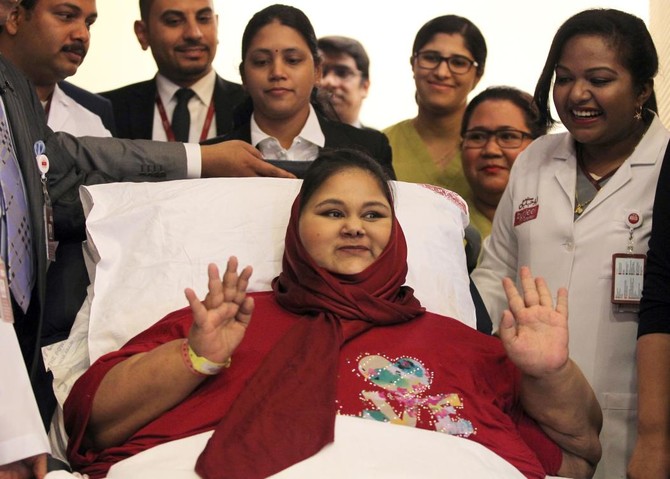
ABU DHABI: An Egyptian believed to be the world’s heaviest woman died Monday of heart and kidney failure at an Abu Dhabi hospital, following months of treatment to help her lose weight and one day walk again.
A team of more than 20 doctors had been caring for the bedridden Eman Ahmed Abd El Aty, 37, since her arrival at Burjeel Hospital in May.
El Aty first sought treatment in India, traveling from the port city of Alexandria to Mumbai aboard a specially modified Airbus in early February.
She had a long wait as no airlines were willing to fly her due to her health complications.
She had not left home in more than two decades and weighed around 500 kilograms (1,100 pounds).
Her request for an Indian visa was initially denied, but she was granted passage after the doctor who volunteered to do her initial surgery tweeted a plea for help directly to India’s foreign minister, who intervened.
She underwent bariatric surgery — a stomach-shrinking bypass procedure — the following month, initially shedding 100 kilograms at Saifee Hospital.
Her family told the doctor that as a child she was diagnosed with elephantiasis, a condition that causes the limbs and other body parts to swell, leaving her almost immobile.
By the time she left Mumbai, doctors said El Aty had lost more than half her original weight.
El Aty left Mumbai when her sister clashed with the hospital, disputing her progress and treatment.
In Abu Dhabi’s Burjeel Hospital, doctors were hoping to help El Aty walk again, according to a report in the Indian Express.
El Aty celebrated her birthday last month with her family and doctors by her side.
The Alexandria native had dreamed to one day visit the beach again, the Indian Express said, quoting her sister.

’World’s heaviest woman’ dies in Abu Dhabi hospital
Chef serves up a taste of Spain at Ithra Cultural Days in Saudi Arabia
DHAHRAN: Among the attractions of the Ithra Cultural Days: Spain at the King Abdulaziz Center for World Culture (Ithra), visitors can try a tantalizing selection of Spanish foods — none more renowned than its famous paella.
Arab News spoke with chef Jose Zafra at the event, which runs until Jan. 31, who flew in from Spain to offer a taste of his homeland to the people of Saudi Arabia.
A “master rice cook, paella researcher and promoter,” according to his business card, his logo is even designed around the recognizable cooking pan and the phrase “Pasion por la paella,” or “Passion for paella.”
“That's why the pan is round because people get around and eat all together — to share culture and passion and life,” Zafra told Arab News as foodies lined up behind him, eager to try a plateful.
“It’s not just a food. It’s a link, a connection. Paella is the symbol of unity and sharing. And people now are going to try it — authentic Spanish paella in Saudi Arabia.”
The word “paella” comes from the Latin “patella,” meaning pan.
In Spanish, it refers both to the rice dish itself and the pan in which it is cooked.
Paella was introduced to Spain during Moorish rule. It originated in Valencia, on the country’s eastern coast, as a rural peasant dish that was cooked by farm workers over open fires using local ingredients. Over time, the dish’s popularity spread and other versions evolved, for example featuring seafood and meat.
It is different to Saudi Arabia’s kabsa, a communal dish which similarly uses rice and meat. Kabsa is cooked in a deep pot to ensure the rice stays soft and aromatic from the meaty broth, whereas paella uses a wide, shallow pan to fully absorb flavors evenly, often creating a prized crispy layer at the bottom.
Visitors to Ithra’s Culture Days can enjoy the flavors of Spain made with a sprinkling of local love — true to the origins of the dish.
Find the scoops of Spanish joy near the food truck area and try chicken paella, seafood paella —or both! You will see the signs offering a plate, at SR35 ($9) for chicken and SR40 for seafood, or let your nose lead you there.
Zafra concluded: “The chicken is from here, the seafood is from here — and the passion, well, that is from Spain.”