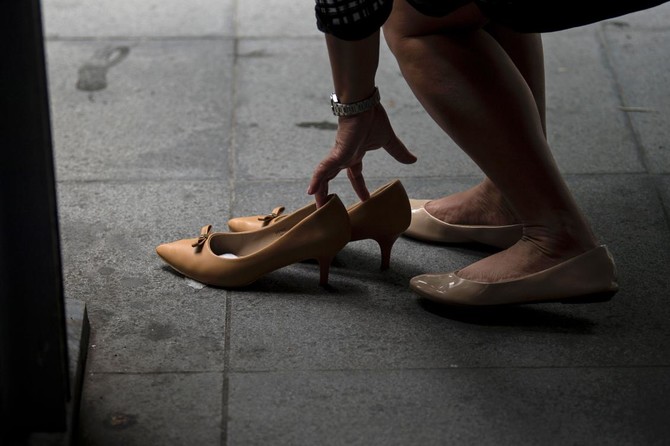
MANILA: The Philippines has banned companies from compelling women to wear high heels to work under a government order hailed by a labor group Monday as a victory against sexism and pain.
The labor department order took effect on Sunday as the government took up the cudgels for long-suffering shopping mall clerks, hotel receptionists and flight attendants.
Employers should implement the use of “practical and comfortable footwear” to improve the health of workers who stand for long periods, said the order, which applies to heels measuring 2.54-centimeters (one inch) or higher unless the employee chooses to wear them.
“It’s a form of torture. It’s a form of oppression and slavery. Imagine having to endure that pain for eight to 10 hours a day,” Alan Tanjusay, spokesman for the Associated Labor Unions, told AFP.
“It’s also a form of sexism because culturally employers say women wearing high heels look taller and sexier and are then more attractive, more effective in selling products. They don’t know the women are suffering.”
The department order said female sales clerks and security guards who had been compelled to work in high heels suffered from sore feet, aching muscles and “hazardous” pressure on joints.
“These (work shoes) should not pinch the feet or toes; are well-fitted and non-slipping; provide adequate cushion and support to the arch of the feet; either flat or with low heels that must be wide-based or wedge type,” it said.
The labor department also ordered companies to give these workers rest periods or seats to reduce the time they spend standing or walking.
Tanjusay said unions lobbied the labor department last month following complaints from saleswomen, hotel receptionists and flight attendants.
Malls are a mainstay in the Southeast Asian nation, mainly employing women as sales clerks, cashiers and so-called “promo girls.”
Most of these women are short-term contract workers, Tanjusay said.
Under the department order female workers can still wear high heels if they prefer them, Tanjusay added.

Philippines bans compulsory high heels in workplace
US says Mexican cartel drones breached Texas airspace
- Drone breach comes some five months into a US military campaign targeting alleged drug-smuggling boats
- US media also reported that the El Paso airspace closure may have been caused by the US military
HOUSTON: The Trump administration said Wednesday that Mexican cartel drones caused the temporary closure of a Texas airport, but some Democratic lawmakers pushed back, suggesting US military activity was responsible for the disruptive shutdown.
The report of the drone breach comes some five months into a US military campaign targeting alleged drug-smuggling boats, and could provide a pretext for President Donald Trump to follow through on his threats to expand the strikes to land.
Trump has specifically threatened to attack cartels inside Mexico, which said it had “no information” on drones at the border.
The US Federal Aviation Administration (FAA) said late Tuesday the airspace over the Texas border city of El Paso would be shut to all aircraft for 10 days, citing unspecified national “security reasons,” only to lift the closure after less than 24 hours.
Transportation Secretary Sean Duffy said in a post on X that the FAA and the Defense Department “acted swiftly to address a cartel drone incursion,” adding: “The threat has been neutralized, and there is no danger to commercial travel in the region.”
A US administration official meanwhile said the breach was by “Mexican cartel drones,” and that US forces “took action to disable the drones,” without providing specifics.
But Democratic Representative Veronica Escobar, whose district includes El Paso, questioned the Trump administration’s explanation, saying it was “not what we in Congress have been told.”
“The information coming from the administration does not add up and it’s not the information that I was able to gather overnight and this morning,” Escobar told journalists.
And top Democratic lawmakers from the House Committee on Transportation suggested the Pentagon may have been responsible for the situation, saying defense policy legislation allows the US military to “act recklessly in the public airspace.”
The lawmakers called for a solution that ensures “the Department of Defense will not jeopardize safety and disrupt the freedom to travel.”
- War against ‘narco-terrorists’ -
US media also reported that the El Paso airspace closure may have been caused by the US military, with CNN saying the shutdown was the result of Pentagon plans to use a counter-drone laser without coordinating with the FAA.
The Pentagon referred questions on the closure to the FAA, which said when it announced the move that “no pilots may operate an aircraft in the areas” covered by the restrictions and warned of potentially “deadly force” if aircraft were deemed a threat.
It updated its guidance Wednesday morning, saying on X that the closure was lifted.
Trump’s administration insists it is effectively at war with “narco-terrorists,” carrying out strikes on alleged traffickers in the Caribbean and eastern Pacific, while the US president has repeatedly said he plans to expand the strikes to land.
Mexican President Claudia Sheinbaum opposes US military intervention in her country but has so far managed to negotiate a fine diplomatic line with Trump.
She has stepped up extradition of cartel leaders to the United States and reinforced border cooperation amid tariff threats from Trump, for whom curbing illegal migration from Mexico was a key election promise.
Sheinbaum told a news conference Wednesday that she had “no information on the use of drones at the border,” but that her government was investigating.
The United States began carrying out strikes on alleged drug-trafficking boats in September, a campaign that has killed at least 130 people and destroyed dozens of vessels in the Caribbean Sea and eastern Pacific Ocean.
US officials have not provided definitive evidence that the vessels are involved in drug trafficking, prompting heated debate about the legality of the operations, which experts say amount to extrajudicial killings.
Trump also ordered a shocking special forces raid in Caracas at the beginning of January to capture Venezuelan leader Nicolas Maduro, whom Washington accused of leading a drug cartel.