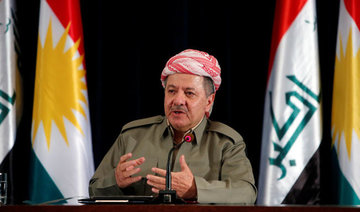
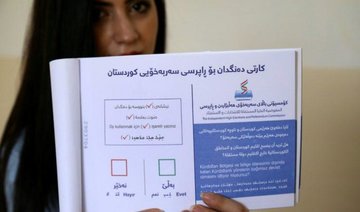
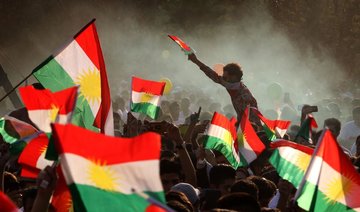
ERBIL, Iraq/ISTANBUL: Iraq’s Kurds will go ahead with a referendum on independence on Monday because their partnership with Baghdad has failed, Kurdistan Regional Government President Massoud Barzani said on Sunday, shrugging off international opposition to the vote.
In response, the Iraqi government asked the autonomous Kurdish region to hand over control of its international border posts, its international airports and called on foreign countries to stop importing Kurdish crude oil.
It asked “the neighboring countries and the countries of the world to deal exclusively with the federal government of Iraq in regards to entry posts and oil,” according to a statement from Iraqi Prime Minister Haider Al-Abadi’s office.
The United States and other Western powers have urged Kurdish authorities in the oil producing region to cancel the vote, arguing that it distracts from the fight against Islamic State.
Turkey and Iran have also kept up the pressure to stop the vote, with presidents Tayyip Erdogan and Hassan Rouhani speaking by phone and expressing concern that it will “bring chaos in the region,” according to Erdogan’s office.
Barzani, at a news conference at his headquarters near Erbil, dismissed the worries of Iraq’s neighbors, committing to respect laws on international boundaries and not seek to redraw the region’s borders.
“We will never go back to the failed partnership” with Baghdad, he said, adding Iraq had become a “theocratic, sectarian state” and not the democratic one that was supposed to be built after the 2003 overthrow of Saddam Hussein.
The vote, expected to result in a comfortable “yes” to independence, is not binding and is meant to give the Kurdistan Regional Government (KRG) a mandate to negotiate secession with Baghdad and the neighboring countries.
Barzani said Iraq’s Kurds would seek talks with the Shiite-led central government to implement the expected “yes” outcome, even if they take two years or more, to settle land and oil sharing disputes ahead of independence.
Abadi’s government in Iraq regards the referendum as anti-constitutional and in a televised address on Sunday he said it “could lead to ethnic divisions, exposing (the Iraqis) to disastrous dangers that only God knows.”
Earlier, Iranian authorities stopped air traffic to Iraqi Kurdistan’s international airports at Erbil and Sulaimaniya in response to a request from Baghdad, Fars News Agency said. Iran also started war games at the Kurdish border.
Speaking by telephone with Abadi, Iran’s Rouhani voiced support for Iraq’s national unity and territorial integrity, the state news agency IRNA reported.
“Iran fully supports Iraq’s central government,” Rouhani was quoted as telling Abadi.
On Saturday, Turkey’s parliament voted to extend by a year a mandate authorizing the deployment of Turkish troops in Iraq and Syria.
Turkey has also vowed political, economic and security steps without specifying what they are, but Turkish Prime Minister Binali Yildirim reinforced the message on Sunday.
Turkey is the transit route of all crude exported by the landlocked Kurdistan region of Iraq.
“Turkey will never ever tolerate any status change or any new formations on its southern borders,” he said in a speech in the capital Ankara. “The KRG will be primarily responsible for the probable developments after this referendum.”
But Barzani said Ankara “won’t benefit” economically should it close the border with Iraqi Kurdistan.
Tehran and Ankara fear the spread of separatism to their own Kurds. Iran also supports Shiite groups who have been ruling or holding key security and government positions in Iraq since the U.S-led invasion which toppled Saddam Hussein.
Barzani said Kurds will “keep extending their hand” to Iran and Turkey, even if they do not reciprocate. He said he recently met in the Kurdish region Iranian Revolutionary Guard Commander Qassem Soleimani, who came to convince him to delay the vote.
The KRG has resisted calls to delay the referendum by the United Nations, the United States and Britain who fear it could lead to unrest in disputed areas like multi-ethnic oil-rich Kirkuk, as well as distracting from the war on Islamic State.
But the Iraqi Kurds say the vote acknowledges their crucial contribution in confronting Islamic State after it overwhelmed the Iraqi army in 2014 and seized control of a third of Iraq. Kurdish Peshmerga fighters who control Kirkuk were given instructions not to respond to any provocation meant to disrupt the vote, but they will defend the region if attacked from outside, he said.
The US embassy in Iraq warned its citizens that there might be unrest during the referendum, especially in disputed areas like Kirkuk, also claimed by the Iraqi central government.
The Iranian military drills, part of annual events held in Iran to mark the beginning of the 1980-1988 war with Iraq, were launched in the Oshnavieh border region, according to Iranian State broadcaster IRIB.
Turkey’s military said on Sunday its aircraft launched strikes against Kurdistan Workers Party (PKK) targets in northern Iraq’s Gara region on Saturday after spotting militants preparing to attack Turkish military outposts on the border.