BAGHDAD: Iraq’s central government in Baghdad ordered the country’s Kurdish region to hand over all border crossings and airports to federal government control late Sunday night, hours before the region is set to carry out a controversial referendum on support for independence.
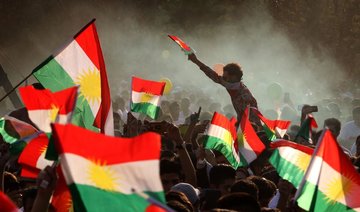
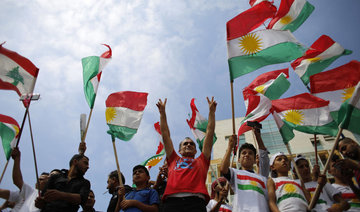
The referendum is set to be held Monday in the three provinces that make up the Kurdistan region as well as dozens of towns and villages that are disputed, claimed by both Baghdad and the country’s Kurds, including the oil-rich city of Kirkuk.
The Iraqi government “requests neighboring counties and the countries of the world to deal with the Iraqi federal government exclusively (with regards to) ports and oil,” read a statement from the prime minister’s national security council released Sunday night.
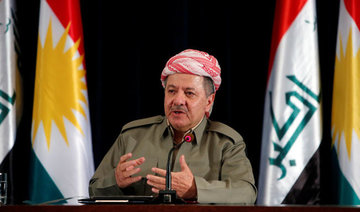
Earlier Sunday, the Kurdish region’s president Masoud Barzani pledged the vote would be held despite pressure from Baghdad and the international community. He said that while the referendum will be the first step in a long process to negotiate independence, the region’s “partnership” with the Iraqi central government in Baghdad is over.
Barzani detailed the abuses Iraq’s Kurds have faced by Iraqi forces, including killings at the hands of former leader Saddam Hussein’s army that left more than 50,000 Kurds dead.
“Only through independence can we secure a future where we will not have the past atrocities,” he said.
Pressure from Baghdad and the international community to call off the referendum has mounted over the past week.
In an address on state television Sunday evening, Iraqi Prime Minister Haider Al-Abadi repeated his call for the vote to be canceled.
“The map of Iraq is suffering attempts at division and tearing up of a united Iraq. Discrimination between Iraqi citizens on the nationalist and ethnic foundation exposes Iraq to dangers known only by God,” Al-Abadi said from Baghdad. Baghdad, the United States and the United Nations have all voiced strong opposition to the vote, warning it could further destabilize the region as Iraqi and Kurdish forces continue to battle the Daesh group.
Turkey renewed a bill on Saturday allowing the military to intervene in Iraq and Syria if faced with national security threats, a move seen as a final warning to Iraqi Kurds.
Also Sunday, Iran closed its airspace to flights taking off from Iraq’s Kurdish region following a request from Baghdad. Iran’s powerful Revolutionary Guard also launched a military exercise in its northwestern Kurdish region, in a sign of Tehran’s concerns over the vote.
At the Irbil press conference, Barzani said he was unaware that Iran had closed its airspace, but that it was Iran’s “own decision.” The leader also confirmed that there had been shelling along Iran’s border with the Kurdish region.
Barzani addressed concerns that Turkey would shut its border with the Kurdish region following the vote, saying he hoped Turkey would leave the crossing open.
“There will be no benefit for either side,” he said of potential border closures.
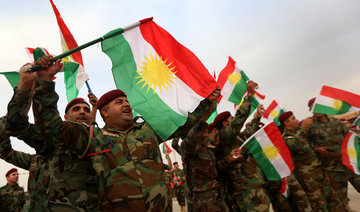
Despite fears in disputed territories — Iraqi territory claimed by both the Kurds and Baghdad — Barzani said he didn’t expect violence to follow the vote, explaining that Iraq’s military and the Kurdish fighters known as the peshmerga have “good coordination in the war against terror.”
The peshmerga forces have been instructed not to respond to “provocations,” in Kirkuk, Barzani added.
Associated Press writer Susannah George in Irbil, Iraq, contributed to this report.


![]()

Baghdad orders Kurdistan region to hand over borders, ports
Baghdad orders Kurdistan region to hand over borders, ports
Related
Latest updates


© 2026 SAUDI RESEARCH & PUBLISHING COMPANY, All Rights Reserved And subject to Terms of Use Agreement.