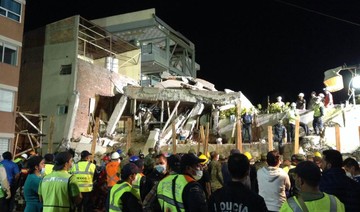
Hopes for Mexico quake survivors dim as search enters 6th day

Mexican soldiers and rescue workers search for survivors in a collapsed building after an earthquake in Mexico City, Mexico September 21, 2017. (File photo by Reuters)
Updated 24 September 2017
Follow

Hopes for Mexico quake survivors dim as search enters 6th day

MEXICO CITY: Emergency workers searched by floodlight in smashed buildings for survivors of Mexico’s deadliest earthquake in 32 years amid fading rescue prospects, five nights after the disaster and as President Enrique Pena Nieto urged Mexicans to turn their attention to rebuilding.
The search continued in a ruined office building in Mexico City’s hip Roma neighborhood and a five-story apartment in historic Tlalpan after Tuesday’s 7.1 quake toppled dozens of buildings and killed over 300 people.
The temblor, Mexico’s worst since a 1985 quake killed thousands, may have left some 30,000 badly damaged homes in the adjacent states of Morelos and Puebla and economic losses of $4 billion to $8 billion.
But authorities called off efforts in the upper-middle class Linda Vista zone, after pulling ten bodies from the rubble, while work at the Tlalpan-based apartment building was briefly halted on Saturday due to a magnitude 6.2 earthquake that shook southern Mexico and spread fear in the capital.
“In Tlalpan, there is still a possibility of finding people alive. It’s URGENT,” read a meme passed around Saturday on social networks.
The government’s response to the disaster is under close scrutiny ahead of a presidential election next year.
Frustration has grown among the thousands left homeless by Tuesday’s quake with critics saying the government reaction pales in comparison to an outpouring of volunteer support, from rescue work to food donations.
When Tuesday’s quake hit, Mexico was already reeling from a Sept. 7 earthquake that killed at least 98 people and was the strongest in the country in 85 years.
Aftershocks on Saturday spread fear among Mexico’s traumatized population, and a plume of ash spewed from the Popocatepetl volcano in another reminder of the country’s volatile geology.
President Enrique Pena Nieto sought to hit back against the criticism, highlighting government aid for survivors on a tour Saturday of Jiquipilas in the poor Southern state of Chiapas, which was badly hit by the Sept. 7 quake.
“Be assured that the federal government is here, the state and local governments, supporting you, hand in hand, to rebuild,” he said.
But many Mexicans are wary of politicians using the quake to score political points, ahead of 2018 elections that are seen as a referendum on the Institutional Revolutionary Party’s patchy record since returning to power in 2012.
Francisco Honoraro, a 46-year-old farmer in Mexico City’s fertile Xochimilco district, is living on the streets while he waits for authorities to assess damage to his home, which is currently propped up by wooden beams after the quake.
“This is going to become political, a campaign issue and a source of profit: If you support me and you vote for me, we will help you,” he said.


Trump cuts India tariffs as Modi ‘agrees’ to stop buying Russian oil

Updated 13 sec ago
Follow

Trump cuts India tariffs as Modi ‘agrees’ to stop buying Russian oil

  • US will impose an 18 percent tariff on Indian goods, down from the earlier 50 percent punitive levy
  • Withdrawal from Russian oil may affect India’s relations with BRICS, expert says

NEW DELHI: The US and India have announced reaching a trade agreement after months of friction, with President Donald Trump saying that Prime Minister Narendra Modi had “agreed” to halt purchases of Russian oil.

In August, Trump accused India, which imports most of its crude oil, of funding Moscow’s war in Ukraine and subjected it to a combined tariff rate of about 50 percent on most of the exports.

Following a call with Modi on Monday, Trump took to social media to say that he would cut with immediate effect US levies on Indian goods to 18 percent after Modi “agreed to stop buying Russian Oil, and to buy much more from the United States and, potentially, Venezuela.”

At the same time, India, Trump wrote, would “reduce their Tariffs and Non Tariff Barriers against the United States, to ZERO,” committing to buy “over $500 BILLION DOLLARS of US Energy, Technology, Agricultural, Coal, and many other products.”

Modi confirmed the agreement on social media, saying: “Made in India products will now have a reduced tariff of 18 percent,” without commenting on Russian oil or duty-free imports of American goods.

When the US announced its punitive tariffs last year, India quickly moved forward with free trade negotiations with other countries — signing a deal with Oman and finalizing negotiations with New Zealand and the EU.

While the agreements were expected to partially offset the loss of exports to the US, economists did not expect they would immediately mitigate it, as shifting supply chains takes time.

The newly announced agreement with the US will therefore offer short-term relief for Indian exporters — especially of textiles, gems, jewelry and marine products — who were facing the threat of a market exit.

“In that case, the trade deal with the US is a welcome step. It provides short-term relief, allowing India to continue exporting to the US without being forced to exit the US market and diversify with a huge transition cost,” said Anisree Suresh, geoeconomics researcher at the Takshashila Institution.

“However, one shouldn’t look at it as a comprehensive long-term trade deal like the one India signed with the EU. The unpredictability of the Trump administration remains a major concern, regardless of whether there is a trade deal with the US ... India cannot treat this deal the same as other FTAs, as it is limited in scope and subject to reversal.”

When the US imposed its punitive tariffs on India, about 66 percent of total Indian exports were subject to that rate. Overall, India recorded a negative margin of 19.5 percent, meaning its exports were taxed more heavily than those of its competitors.

“From that point of view, Indian goods will have a larger market over there. However, there’s a problem when we talk about a 0 percent tariff on the US,” said Prof. Arun Kumar, a development economist.

“The US will be able to export a lot more to India, and therefore it will affect our production within the economy. And that will be a setback, so while exports may rise, the internal economy may actually suffer because of this decrease in tariffs on American goods. And especially if it affects agriculture.”

The sudden withdrawal from India’s partnership with Russia may not have a serious economic impact but politically could affect New Delhi’s relations, also with other countries, especially those from BRICS — a grouping that besides India and Russia includes also Brazil and China, and is the most powerful geopolitical forum outside of the Western world.

“You can always substitute Russian oil with some other oil, but I think it’s more of a strategic question, because India and Russia have had long-standing relationships, and if we bend to US pressure and reduce purchases from Russia, then it will affect in future also our relationship with Russia, because we will not be seen as a stable ally,” Kumar said.

“BRICS nations will not trust India very much in the future ... and that’s what Trump wants. He wants to disrupt BRICS. That’s what he has been doing right since the beginning to divide nations and deal with them individually.”