87th Saudi National Day celebration takes center stage

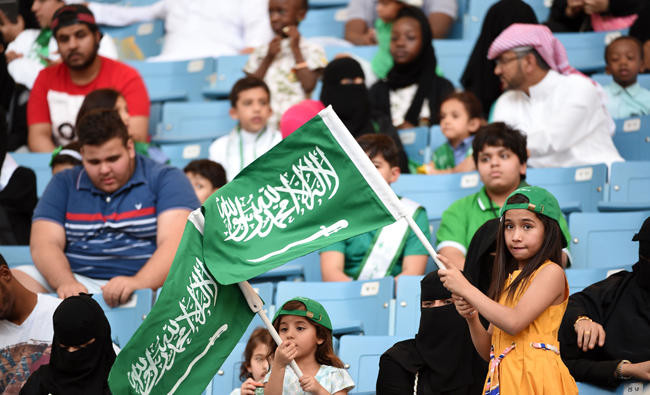
A Saudi girl waves a national flag as she stands by her seat in a stadium, attending an event in the capital Riyadh on Saturday commemorating the anniversary of the founding of the kingdom of Saudi Arabia. (AFP)
Updated 23 September 2017
Follow

87th Saudi National Day celebration takes center stage

RIYADH: The 87th National Day celebrations in the Kingdom took center stage on Saturday with an atmosphere pervaded by euphoric excitement engendered by the various activities lined up to mark the annual historic event.
“The National Day is a precious occasion in which the sons of this country remember the historical saga that was made by the Kingdom’s founder King Abdul Aziz,” Minister of Culture and Information Awwad bin Saleh Al-Awwad said.
Al-Awwad said that “the noble sons of King Abdul Aziz followed him with a wise vision and a sound approach toward the foundations of a strong civilized state that united under the banner of eternal unification.”
Minister of Communications and Information Technology Abdullah Al-Sawah congratulated the people, the king and crown prince on the occasion of the 87th National Day.
Al-Sawah also lauded the Kingdom’s wise leadership for the successful march and rapid development being witnessed by Saudi Arabia at all levels.
He also expressed gratitude and appreciation for the Kingdom’s ongoing development and growth under the visionary leadership that paid special attention to the telecommunications and information technology sector in the country.
In keeping with the occasion, the Saudi capital is decked out in green — the color of the national flag — as an indication of patriotic enthusiasm, while the Kingdom is celebrating the National Day with traditional gaiety and patriotic fervor.
The early hours of Sept. 23 witnessed the birth of the first child at the King Saud Medical City on this auspicious day, which was announced by the hospital on its Twitter account.
The hospital held a celebration after the preparation of one medical room with national words, green shawls and clips containing the words “Homeland in our hearts.”
Festivities showed people — both young and old — dancing in the streets or in programs held in various venues such as hotels, auditoriums and convention centers in celebration of the historic event.
Television channels showed programs which featured young Saudi girls deftly and gracefully dancing in their white dresses with belts in green which symbolized the Kingdom’s color.
Many Saudi nationals were also seen driving cars painted in the national color to celebrate the 87th National Day. Boys were seen enthusiastically distributing national flags and sweets to motorists waiting for traffic signals to turn green on the Kingdom’s various roads.
There were also green lights in underpasses and on bridges, as well as banners and posters with congratulatory remarks and photos of the king and crown prince.
With the Saudi people in a celebratory mode, King Fahd and Khurais roads experienced traffic snarls, with cars moving at a snail’s pace on Friday night. Heavy traffic was also expected Saturday night, as in the past, when the citizens of the city go out to drive the Saudi capital’s main thoroughfares in a celebratory mode.
The Saudi nationals’ patriotic zeal and enthusiasm also rubbed off on expatriate workers, who were also excited and joined local counterparts in their celebration.


‘Stability can’t be bought’: Saudi ministers extol benefits of long-term reform in a fragmented world

Updated 56 min 54 sec ago
Follow

‘Stability can’t be bought’: Saudi ministers extol benefits of long-term reform in a fragmented world

  • They outline during discussion at the World Economic Forum in Davos the ways in which the Kingdom is capitalizing on stability as a competitive advantage
  • They highlight in particular the use of predictable policymaking, disciplined public finances, and long-term planning under Saudi Vision 2030

DAVOS: Stability is the crucial ingredient for long-term economic growth, especially in an increasingly fragmented global economy, Saudi ministers said on Thursday at the World Economic Forum in Davos.

It is not something that can be purchased or improvised, said Faisal Alibrahim, the minister of economy and planning, it must be developed patiently.

“You have to build it, accumulate it over time, for it to be the right kind of stability,” he said. “We treat it as a discipline,” he added.

Speaking during a panel discussion on the Saudi economy, Alibrahim and Finance Minister Mohammed Al-Jadaan outlined the ways in which the Kingdom has sought to capitalize on stability as a competitive advantage.

They highlighted in particular the use of predictable policymaking, disciplined public finances, and long-term planning under the Kingdom’s Vision 2030 plan for national development and diversification.

Al-Jadaan said governments and businesses alike are operating in a world where uncertainty has become the norm, which places a greater burden on policymakers to reduce ambiguity wherever possible.

“Businesses can price tariffs, they can price taxes,” he said. “What they find very difficult to price is ambiguity. We are trying to ensure that we build that resilience within our economy and give the private sector that predictability that they need.”

This focus on predictability, he added, has been central to Saudi Arabia’s economic transformation, by helping the private sector to plan for the long term while the government undertakes deep structural reform.

Alibrahim noted that trust has become a big factor in global trade and investment, particularly as geopolitical tensions and economic fragmentation intensify.

In a fragmenting world, one of the rarest things now is the idea that a “commitment made today will be honored tomorrow,” he said. Yet trust shapes how the world trades and how markets remain active, because it means participants can predict what will happen, he added. Stability therefore becomes a “rare currency, and even a competitive edge.”

He also said that reform on paper was not enough; it must be coupled with streamlined regulation and continuous engagement, so that businesses can develop long-term thinking and navigate uncertainty with more confidence.

Al-Jadaan framed Saudi Vision 2030 as a multiphase journey that began with structural reforms, followed by an execution-heavy phase, and is now entering a third stage focused on the maximization of impact.

He said the Kingdom was in a phase of “learning, reprioritizing and staying the course,” would make bold decisions, and had the “courage to continue through difficulties.” A key anchor of all this, he added, was discipline in relation to public finance.

“You cannot compromise public finance for the sake of growth,” Al-Jadaan said. “If you spend without restraint, you lose your anchor while the economy is still diversifying.”

This discipline underpins what he described as Saudi Arabia’s “deficit by design” — in other words, borrowing strategically to fund capital expenditure that supports long-term growth, rather than consumption.

“If you borrow to spend on growth-enhancing investment, you are safe,” he said. “If you borrow to consume today, you are leaving the burden to your children.”

Alibrahim said the focus in the next phase of Vision 2030 will be on the optimal deployment of capital, ensuring the momentum continues while costs are tightly managed.

Looking ahead, both ministers emphasized the importance of long-term planning, which can be a challenge for some countries constrained by short election cycles.

“If you cannot take a long-term view in a turbulent world, it becomes very difficult,” Al-Jadaan said.

“Success stories like Singapore, South Korea and China were built on decades-long plans, pursued through good times and bad.”

The ministers’ discussion points were echoed by international participants. Noubar Afeyan, founder and CEO of life sciences venture capital firm Flagship Pioneering, said that by utilizing technology, including artificial intelligence, alongside a strategic vision in the form of Vision 2030, the Kingdom had been able to turn vulnerabilities into strengths, becoming not only self-sufficient but a potential exporter of innovation and intellectual property.

“Uncertainty opens up opportunities for countries that might otherwise be overlooked,” he added.

“Saudi Arabia, with Vision 2030, is positioning itself to not only address its own challenges but also become a net exporter of innovation and expertise.”

Ajay Banga, the president of the World Bank, said Vision 2030 had helped create “physical and human infrastructure” that allows Saudi Arabia to capitalize on its demographic dividend.

Jennifer Johnson, CEO of investment management firm Franklin Templeton, said Saudi policymakers stood out for their openness and curiosity.

“I have spoken to Saudi ministers and they ask what they need to do — that doesn’t happen often,” she said.