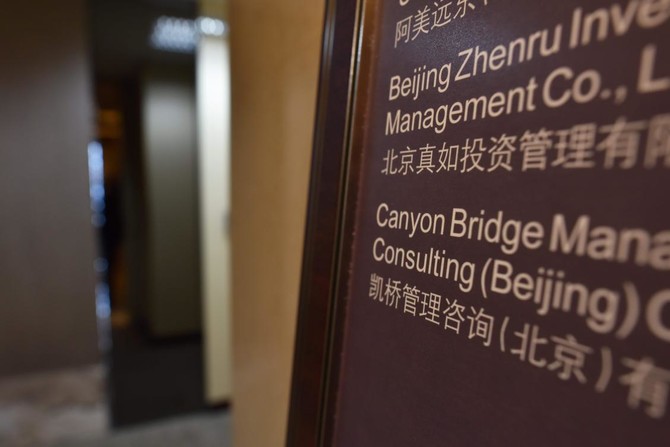
NEW YORK: Canyon Bridge Capital Partners, the China-backed buyout fund that was barred last week by US President Donald Trump from buying a US chipmaker, said it would purchase British chip designer Imagination Technologies Group.
The all-cash £550 million (SR2.79 billion) deal to buy Imagination showed Canyon Bridge remained focused on investing in Western chipmakers after its $1.3 billion deal to buy Lattice Semiconductor in the US was blocked over US natural security concerns.
Canyon Bridge said on Friday it had agreed to pay 182 British pence per Imagination share, a near 42 percent premium to Imagination’s closing price on Friday. But the purchase is contingent on Imagination divesting US chip designer MIPS, which Imagination had bought in 2013, the two companies said in a joint London stock exchange filing, adding that the takeover would not result in job cuts.
Keeping MIPS would subject Canyon Bridge’s purchase of Imagination to a review by the Committee on Foreign Investment in the US (CFIUS), the government panel which rejected its acquisition of Lattice.
Imagination said it had agreed to sell MIPS for $65 million to Tallwood Venture Capital, an investment firm with offices in Palo Alto, California, and Wuxi, southern China. It was not immediately clear whether the divestment would be subject to a CFIUS review.
Canyon Bridge was founded with capital originating from China’s central government and had indirect links to Beijing’s space program. It currently manages about $1.5 billion on behalf of Yitai Capital, a Chinese state-owned company, according to Friday’s statement.
Imagination, whose graphics power Apple’s iPhone, licenses graphics and video-processing technology to semiconductor companies.

China-backed fund shunned by Trump to buy British chipmaker
Acwa inks deal to establish ammonia export corridor from Saudi Arabia to Germany
RIYADH: Saudi utility giant Acwa has signed a memorandum of understanding with Energie Baden-Wrttemberg AG, Rostock Port, and Verbundnetz Gas AG to establish an ammonia export corridor from the Kingdom to Germany.
According to a press statement, the signing ceremony was witnessed by Saudi Arabia’s Energy Minister, Prince Abdulaziz bin Salman, and Germany’s Minister for Economic Affairs and Energy, Katherina Reiche.
Under the deal, the new corridor will extend green ammonia from its project in Yanbu to Germany’s Rostock Port. Later, VNG will convert ammonia to green hydrogen and will be injected into the European country’s national core network.
The development aligns with Acwa’s expansion strategy, as the company aims to establish itself as a key global player in the renewable energy sector.
Commenting on the latest deal, Marco Arcelli, CEO of Acwa, said: “The signing of this memorandum of understanding is an important move for all partners involved. By working together with Acwa, Rostock Port, and VNG, we are taking a step toward building a reliable green ammonia corridor from Saudi Arabia to Germany.”
He added: “It leverages Acwa’s Yanbu hub, where we lead development with support from EnBW, to deliver scale for Europe’s hydrogen needs, with processing at Rostock for core network injection.”
Arcelli further said that these assets are expected to accelerate global decarbonization efforts, bolster energy security, and affirm Saudi Arabia’s role as a key player in the renewable sector.
According to the statement, the ammonia, which will be processed by the cracker under development by VNG, will help Germany to decarbonize hard-to-abate sectors while also serving as a strategic entry point into the German market.
Acwa, with the support of EnBW, is currently leading the development of the green hydrogen and ammonia production site in Yanbu in Saudi Arabia, with a planned commercial operation date in 2030.
“By working together with Acwa, Rostock Port, and VNG, we are taking a step toward building a reliable green ammonia corridor from Saudi Arabia to Germany. International partnerships like this are essential if we want to advance and make the transformation of the energy system affordable and bring innovative solutions to market,” said Georg Stamatelopoulos, CEO of EnBW.
EnBW will act as an offtaker of green ammonia from the Yanbu site and manage its commercial and logistical delivery to the Port of Rostock, which will serve as the port operator.
VNG is progressing plans for an ammonia cracker near the port to convert imported green ammonia into green hydrogen for German customers
“By forming this cooperation, we are establishing a strategic, more efficient and forward-thinking framework for securing a long-term supply of green energy and further investment in Germany,” said Jens Scharner, managing director of Rostock Port.
The agreement came as the Kingdom’s Minister of Industry and Mineral Resources, Bandar Alkhorayef, met with Reiche and discussed ways to strengthen economic ties between the two countries, the Saudi Press Agency reported.
The leaders also explored opportunities to develop investment partnerships in the industrial and mining sectors.
During the meeting, Alkhorayef outlined Saudi Arabia’s potential in the mining sector, which includes the country’s strategic geographical location that connects three continents, advanced infrastructure, competitive energy prices, as well as the presence of advanced industrial cities.
Additional factors that enhance Saudi Arabia’s competitiveness in the mining sector include a business-friendly environment, streamlined government procedures, and a range of enablers and incentives provided by the Kingdom’s industrial and mining ecosystem to support local and international investors.
Attracting international investments in the mining sector also aligns with Saudi Arabia’s ambitious goal to secure $100 billion a year in foreign direct investments by the end of this decade.