Moody’s downgrades UK’s rating on Brexit fear, growth concerns

The UK government has responded to Moody’s assessment of the Brexit hit to the economy saying it was “outdated.” (Reuters)
Updated 23 September 2017
Follow

Moody’s downgrades UK’s rating on Brexit fear, growth concerns

LONDON: Ratings agency Moody’s downgraded Britain’s credit rating by a further notch on Friday, saying the government’s plans to fix the public finances had been knocked off course and Brexit would weigh on the economy.
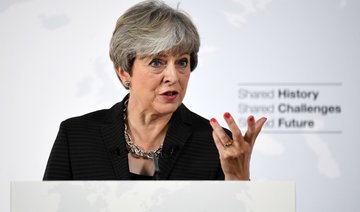
A few hours after Prime Minister Theresa May set out plans for a new relationship with the EU, Moody’s cut the rating to Aa2 from Aa1, underscoring the economic risks that leaving the bloc poses for the world’s fifth-biggest economy.
Britain has worked down its budget deficit from about 10 percent of economic output in 2010, shortly after the global financial crisis hammered the country, to 2.3 percent in the most recent financial year which ended in March.
But Moody’s said the outlook for public finances had weakened significantly as May’s government increasingly put into question the austerity push pursued by former prime minister David Cameron and his finance minister George Osborne.
The government responded by saying Moody’s assessment of the Brexit hit to the economy was “outdated” and that May had set out an “ambitious vision for the UK’s future relationship with the EU” in a speech earlier on Friday.
The Moody’s downgrade was made after a meeting with the government on September 19 and did not reflect May’s speech on Friday, the government said.
Nonetheless, Moody’s verdict on Britain’s public finances will make for grim reading for May and her finance minister Philip Hammond.
After seven years of austerity, the government was coming under pressure to ease its squeeze on public finances and a recent relaxation of a tight public sector pay cap for police and prison workers was likely to be broadened, Moody’s said.
Furthermore, a deal struck by May with a small political party in Northern Ireland after she lost her parliamentary majority in June’s election and the dropping of plans to review costly pension increases would also weigh on the public purse.
“Overall, Moody’s expects spending to be significantly higher than under the government’s current budgetary plans,” Moody’s said.
On the tax side, it noted how the government abandoned a controversial plan to raise national insurance contributions for self-employed workers and was reliant on “highly uncertain revenue gains from tackling tax avoidance to fund tax cuts”.
As a result, the budget deficit was likely to remain at around 3-3.5 percent of GDP in the coming years, higher than the government’s plans to cut it below 1 percent of GDP by 2021/22.
That meant Britain was one of the few big European economies where the public debt ratio was likely to rise, probably peaking at about 93 percent of GDP in 2019, two years later than under the latest government plans.
At the same time, budget pressures would rise as Britain’s economy slowed due to Brexit, with growth of just 1 percent likely next year, down from 1.8 percent in 2017 and not recovering to its historic trend rate over the coming years.
Moody’s said it was no longer confident that Britain would secure a replacement free trade agreement with the EU which substantially mitigated the Brexit hit.
“While the government seeks a ‘deep and comprehensive free trade agreement’ with the EU, even such a best-case scenario would not award the same access to the EU single market that the UK currently enjoys,” it said.
Britain’s government said Moody’s move brought it into line with the other major credit ratings agencies, Fitch and Standard & Poor’s.
Moody’s revised up its outlook on the country to stable from negative, meaning a further downgrade is not imminent.


Saudi Maaden reports 156% profit surge to $2bn on strong commodity prices, record production

Updated 05 March 2026
Follow

Saudi Maaden reports 156% profit surge to $2bn on strong commodity prices, record production

RIYADH: Saudi mining and metals company Maaden has reported a 156 percent jump in its net profit attributable to shareholders for 2025, driven by higher commodity prices, record production volumes, and a one-off bargain purchase gain.

The state-backed giant posted a net profit of SR7.35 billion ($1.95 billion) for the full year 2025, an increase from SR2.87 billion in the previous year. The firm’s revenue surged by 19 percent to SR38.58 billion, up from SR32.55 billion in 2024.

This comes as Saudi Arabia steps up efforts to expand its mining sector as a pillar of economic diversification, encouraging international participation and private investment to unlock the Kingdom’s estimated $2.5 trillion in untapped mineral resources under Vision 2030.    

In a statement on Tadawul, the company said: “Performance was led by record phosphate production, near record aluminum production, an increase in all three of Maaden’s main output commodity prices.”

The performance was also fueled by a 60 percent increase in gross profit, which reached SR14.79 billion. In its annual results announcement, Maaden attributed the top-line growth to “higher commodity market prices for phosphate, aluminum and gold business units,” as well as increased sales volumes in its phosphate and aluminum segments. This was partially offset by slightly lower sales volume in the gold unit.

Maaden’s CEO, Bob Wilt, hailed 2025 as a transformative year for the company, marked by strategic growth and operational excellence. “This was a great year for Maaden’s strategic growth. We delivered strong financial results and sustained operational excellence across the business,” he said in a statement.

“This was driven by growth in production across all businesses, including record-breaking DAP (di-ammonium phosphatevolumes), disciplined cost control across and a clear commitment to our role as a cornerstone of the Saudi economy,” Wilt added.

Profitability was further bolstered by an increased share of net profit from joint ventures and an associate. This included a one-off bargain purchase gain of SR768 million related to Maaden’s investment in Aluminium Bahrain B.S.C. The company also benefited from lower finance costs.

The fourth quarter of 2025 was strong, with Maaden swinging to a net profit of SR1.67 billion, compared to a loss of SR106 million in the same period of the prior year. Quarterly revenue rose 7 percent to SR10.64 billion.

The firm achieved record production of di-ammonium phosphate, reaching 6.72 million tonnes for the year, a 9 percent increase. Aluminum production remained near-record levels, while the company added a net 7.8 million ounces to its reportable gold mineral resources through discovery and resource development.

The phosphate division saw sales jump 17 percent to SR20.77 billion, with the earnings before interest, taxes, depreciation, and amortization margin expanding to 47 percent. The aluminum business reported a 9 percent increase in sales to SR10.99 billion, with EBITDA more than doubling in the fourth quarter.

Looking ahead, Wilt emphasized that the pace of growth will accelerate as the company advances key initiatives, including the Phosphate 3 Phase 1 and Ar Rjum projects, which remain on budget and schedule. Maaden has also secured a gas supply for its future Phosphate 4 project.

“This pace of growth will only accelerate. Not only as we advance projects and increase the scale of our exploration program, but as we continue to grow production and implement technology that will further modernize, streamline and unlock value,” Wilt added.

Earnings per share for the year rose sharply to SR1.91, up from SR0.78 in 2024. Total shareholders’ equity increased by 18.7 percent to SR61.59 billion.