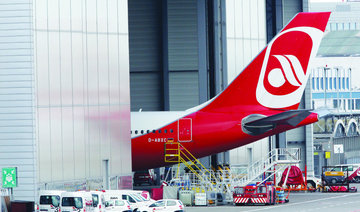
FRANKFURT: Air Berlin’s creditors have picked German flagship carrier Lufthansa and Britain’s easyJet as possible buyers for the insolvent carrier’s aviation business and will negotiate with them for the next three weeks.
“Authority was granted to conclude one or more agreements with one or more of these bidders,” Air Berlin said in a statement late on Thursday.
Talks over its other Air Berlin assets, such as its aircraft maintenance unit, will continue with other bidders, it said.
Air Berlin, which has about 8,000 employees and operates 144 mostly leased planes, filed for insolvency in August after major shareholder Etihad pulled the plug on funding.
Two sources familiar with the matter had told Reuters on Thursday that Lufthansa was set to pick up a large part of the carrier.
Lufthansa’s CEO said earlier that the carrier wanted to secure the 38 crewed planes it leases from Air Berlin, and was interested in a further 20-40 short-haul planes.
Air Berlin said negotiations with Lufthansa and easyJet would continue until October 12, which means Air Berlin’s board may not make a final decision on September 25 as had been expected.
The news comes ahead of a national election on Sunday in which Chancellor Angela Merkel is set to win a fourth term.
At a rally in the western city of Neuss, where dozens of Air Berlin workers wearing fluorescent yellow crew jackets joined Merkel supporters, the chancellor said: “There are pilots from Air Berlin that we of course wish all the best to, like all people who have a job and would like to keep it.”
The prospect of getting access to Air Berlin’s airport slots, planes and crews had drawn interest from those airlines and other investors, including former Formula One driver Niki Lauda, jointly with Thomas Cook’s German airline Condor, and aviation entrepreneur Hans Rudolf Woehrl.
Also, two people familiar with the matter had told Reuters earlier this week that British Airways owner IAG had joined the field of bidders for parts or all of Air Berlin.
Bidders had been especially interested in Air Berlin subsidiary Niki, which operates short-haul flights from Germany and Austria to tourist hot spots.
The deadline for bids for its maintenance unit, which has about 850 employees, has been extended to Oct. 6, Air Berlin said.
Lufthansa declined to comment further on Thursday evening. EasyJet declined to comment and Condor was not immediately available for comment.

Air Berlin to hold carve-up talks with Lufthansa, easyJet
Global trade isn’t deglobalizing — it’s reshuffling, Harvard economist says
ALULA: Global trade is not retreating into deglobalization despite geopolitical shocks, but is instead undergoing a structural reshuffling led by US-China tensions, according to Harvard University economist Pol Antras.
Presenting research at the AlUla Emerging Market Economies Conference, Antras said there is no evidence that countries are systematically turning inward. Instead, trade flows are being redirected across markets, creating winners and losers depending on export structure and exposure to Chinese competition.
This comes as debate intensifies over whether supply-chain disruptions, industrial policy and rising trade barriers signal the end of globalization after decades of expansion.
Speaking to Arab News on the sidelines of the event, Antras said: “I think the right way to view it is more a reorganization, where things are moving from some countries to others rather than a general trend where countries are becoming more inward looking, in a sense of producers selling more of their stuff domestically than internationally, or consumers buying more domestic products than foreign products.”
He said a change of that scale has not yet happened, which is important to recognize when navigating the reshuffling — a shift his research shows is driven by Chinese producers redirecting sales away from the US toward other economies.
He added that countries are affected differently, but highlighted that the Kingdom’s position is relatively positive, stating: “In the case of Saudi Arabia, for instance, its export structure, what it exports, is very different than what China exports, so in that sense it’s better positioned so suffer less negative consequences of recent events.”
He went on to say that economies likely to be more negatively impacted than the Kingdom would be those with more producers in sectors exposed to Chinese competition. He added that while many countries may feel inclined to follow the United States’ footsteps by implementing their own tariffs, he would advise against such a move.
Instead, he pointed to supporting producers facing the shock as a better way to protect and prepare economies, describing it as a key step toward building resilience — a view Professor Antras underscored as fundamental.
Elaborating on the Kingdom’s position amid rising tensions and structural reorganization, he said Saudi Arabia holds a relative advantage in its economic framework.
“Saudi Arabia should not be too worried about facing increased competitive pressures in selling its exports to other markets, by its nature. On the other hand, there is a benefit of the current situation, which is when Chinese producers find it hard to sell in US market, they naturally pivot to other markets.”
He said that pivot could benefit importing economies, including Saudi Arabia, by lowering Chinese export prices. The shift could increase the Kingdom’s import volumes from China while easing cost pressures for domestic producers.