MADRID: Thousands of people supporting a contested referendum to split Catalonia from Spain took to Barcelona’s streets amid an intensifying government crackdown on the independence vote that included the arrests of a dozen regional officials Wednesday and the seizure of 10 million ballot papers.
The arrests — the first involving Catalan officials since the campaign to hold an independence vote began in earnest in 2011 — prompted the regional government and some of its supporters to say casting a ballot was as much about dignity as whether to break away from Spain.
Regional Catalan officials so far have vowed to ignore a Constitutional Court order to suspend the Oct. 1 referendum while judges assess its legality.
Spanish Prime Minister Mariano Rajoy warned them of “greater harm” if they don’t drop the referendum bid, which he called a “totalitarian act.”
“Disobedience of the law by a part of the political power is the opposite of democracy, it means an imposition, an injustice, the violation of people’s rights and an attack to democracy,” Rajoy said in a televised appearance on Wednesday night.
“If you care about the tranquility of most Catalans, give up this escalation of radicalism and disobedience,” the conservative leader said, addressing Catalan officials directly. “You are on time to avoid a greater harm.”
Catalan nationalists argue that self-determination is an inalienable right that can’t be curbed by any constitution. The prime minister’s determination to prevent the ballot has backing from the main Spanish opposition parties.
Some members of Rajoy’s conservative government have even referred to the standoff as democratic Spain’s greatest political crisis since 1981, a failed coup attempt in the country’s parliament that came only three years after the official end of Gen. Francisco Franco’s dictatorship.
Spanish Interior Ministry officials would not identify the arrested regional officials, saying the investigation was ongoing. The Catalan regional government confirmed that among them were Josep Maria Jove, secretary general of economic affairs, and Lluis Salvado, secretary of taxation. Jove is the No. 2 to the region’s vice president and economy chief, Oriol Junqueras.
The Catalonia branch of Spain’s High Court said Wednesday that some 20 people were being investigated for alleged disobedience, abuse of power and embezzlement related to the referendum. Police acting on a judge’s orders searched 42 premises, including six regional government offices, officials’ private offices and homes, as well as three companies in Barcelona, the court said in a statement.
The arrests risked stoking public anger in Catalonia, where pro-independence passions can run high. Several thousand independence supporters gathered to angrily protest the raids outside government offices in Barcelona, which is Catalonia’s capital. Some demonstrators sat down in the street to block police cars, while a few scuffled with police officers.
Later, protesters rejoiced when National Police officers left the headquarters of the anti-establishment CUP political party. The officers waited hours for a judge to sign off on a warrant to search the premises for referendum-related propaganda, but the permission never came.
Protests also occurred in other Catalan towns and in Spain’s capital, Madrid. There were no reports of arrests and one person was reported injured, according to the regional police.
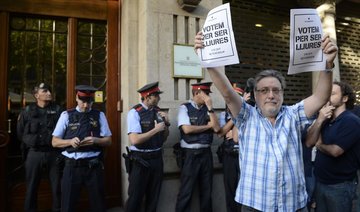
At the demonstration outside the Catalan regional ministry of economy, protester Charo Rovira said she felt sad at the turn of events.
“Catalonia is practically in a state of siege,” she said. She added that the arrested politicians were merely acting according to the will of the people.
Catalonia’s president, Carles Puigdemont, blasted the police operations as “unlawful” and accused the national government of adopting a “totalitarian attitude.” He accused Madrid of bringing a state of emergency to Catalonia and of effectively canceling the northeastern region’s self-rule.
His televised statement came as Spain’s Finance Ministry said it was imposing further controls over the Catalan government’s finances to ensure no public money is used for the referendum.
Finance Minister Cristobal Montoro’s order means that virtually all of Catalonia’s public spending will be handled in Madrid and that no credits could be requested for non-essential payments.
Catalonia represents a fifth of Spain’s 1.1-trillion-euro ($1.32 trillion) economy and enjoys wide self-government authority, although key areas such as infrastructure and taxes are in the hands of central authorities. The region’s 7.5 million inhabitants overwhelmingly favor holding a referendum, but are roughly evenly divided over independence.
As part of the crackdown, police confiscated nearly 10 million ballot papers, the Interior Ministry said. Polling station signs and documents for election officers were also seized during a raid on a warehouse in a small town outside Barcelona.
“Today the government of Rajoy has crossed a very dangerous red line,” Jordi Sanchez, president of Catalan National Assembly, a civic group leading the independence drive said. “We will do all we can for democracy and freedom to prevail.”
Barcelona Football Club, which is popular around the world, waded into the controversy, too. The soccer team said it “condemns any act that may impede the free exercise of (democratic) rights” and vowed to “continue to support the will of the majority of Catalan people, and will do so in a civil, peaceful, and exemplary way.”
Spain’s Interior Ministry canceled time off and scheduled leave for Civil Guard and National Police officers who are being deployed to ensure the vote doesn’t happen. It gave no details on the number of agents involved.
___
AP photographer Emilio Morenatti and videographer Hernan Munoz contributed from Barcelona. Barry Hatton contributed from Lisbon, Portugal.


![]()
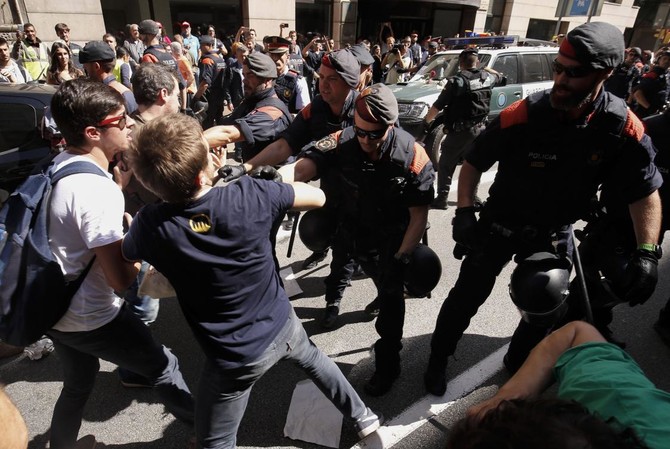
Clash over Catalan vote heats up in Spain as police swoop in
Clash over Catalan vote heats up in Spain as police swoop in

Latest updates


Recommended


© 2026 SAUDI RESEARCH & PUBLISHING COMPANY, All Rights Reserved And subject to Terms of Use Agreement.