Trump signaled dislike, but not demise of Iran deal — envoy

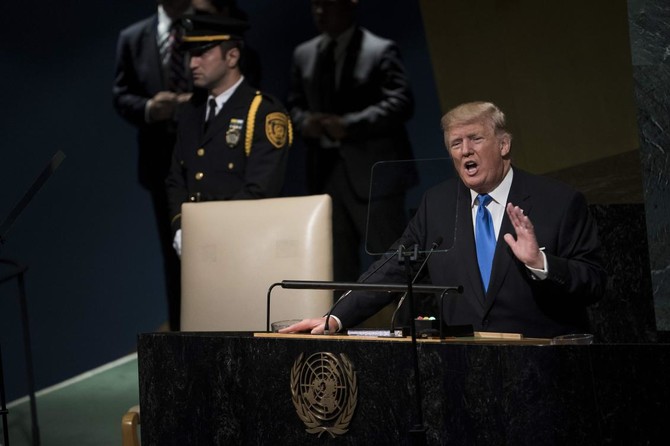
US President Donald Trump addresses the 72nd Annual UN General Assembly in New York on September 19, 2017. (File photo by AFP)
Updated 20 September 2017
Follow

Trump signaled dislike, but not demise of Iran deal — envoy

UNITED NATIONS: US President Donald Trump is unhappy with the Iran nuclear deal but has not signaled he will abandon it, the US ambassador to the United Nations said on Wednesday.
“It’s not a clear signal that he plans to withdraw. What it is, is a clear signal that he’s not happy with the deal,” the envoy, Nikki Haley, told CBS News of Trump’s pugnacious speech to the UN General Assembly on Tuesday in which he called the 2015 international accord “an embarrassment.”
Trump hinted in his speech to the annual gathering of world leaders that he may not recertify the agreement, negotiated by his predecessor, Barack Obama. “I don’t think you’ve heard the last of it,” he said.
The US president must decide by Oct. 15 whether to certify that Iran is complying with the pact, a decision that could sink the deal. If he does not, the US Congress has 60 days to decide whether to reimpose sanctions waived under the accord.
Under the agreement between Iran and six major powers — Britain, China, France, Germany, Russia and the United States — the Iranian government agreed to restrict its nuclear program in return for western countries loosening economic sanctions.
Haley spoke ahead of Iranian President Hassan Rouhani’s UN speech in which he is expected to respond to Trump’s accusations that Iran exports “violence, bloodshed and chaos.”
The head of Iran’s Revolutionary Guards said the United States should experience “painful responses” following Trump’s harsh criticism.
“Taking a definitive stand against Trump is only the beginning of the path,” said General Mohammad Ali Jafari, according to Sepah News, the news site of the Revolutionary Guards. “What is strategically important is that America witnesses more painful responses in the actions, behavior and decisions that Iran takes in the coming months.”
The prospect of Washington reneging on the agreement has worried some US partners that helped negotiate it, especially as the world grapples with another nuclear crisis, North Korea’s nuclear and ballistic missile development.
Russia is concerned by Trump questioning the Iran nuclear deal, Foreign Minister Sergei Lavrov told Russian reporters at the United Nations in comments published by his ministry on Wednesday.
“It’s extremely worrying,” Lavrov said. “We will defend this document, this consensus, which was met with relief by the entire international community and genuinely strengthened both regional and international security.”
Lavrov, referring to Trump’s speech, said that “if you simply condemn and threaten, then we’re going to antagonize countries over whom we want to exert influence.”


Trump insists he struck Iran on his own terms

Updated 7 sec ago
Follow

Trump insists he struck Iran on his own terms

  • “We are now a nation divided between those who want to fight wars for Israel and those who just want peace and to be able to afford their bills and health insurance,” Marjorie Taylor Greene posted on X.
  • Rubio himself doubled down on Tuesday after meeting with US House and Senate members, while insisting that “No, I told you this had to happen anyway”

WASHINGTON, United States: President Donald Trump and his team scrambled Tuesday to reclaim the narrative on why he decided to attack Iran, after his top diplomat suggested the US struck only after learning of an imminent Israeli strike.
Secretary of State Marco Rubio alarmed Democrats — who say only Congress can declare war — as well as many of Trump’s MAGA supporters on Monday when he said: “We knew that there was going to be an Israeli action.”
“We knew that that would precipitate an attack against American forces, and we knew that if we didn’t pre-emptively go after them before they launched those attacks, we would suffer higher casualties,” Rubio told reporters.
Administration officials quickly backpedalled, insisting Trump authorized the strikes because Tehran was not seriously negotiating an accord on limiting its nuclear ambitions, and the United States needed to destroy Iran’s missile capabilities.
“No, Marco Rubio Didn’t Claim That Israel Dragged Trump into War with Iran,” White House Press Secretary Karoline Leavitt posted Tuesday on X.
At an Oval Office meeting later with Germany’s chancellor, Trump went further, saying that “Based on the way the negotiation was going, I think they (Iran) were going to attack first. And I didn’t want that to happen.”
“So, if anything, I might have forced Israel’s hand.”

- Had to happen? -

Rubio himself doubled down on Tuesday after meeting with US House and Senate members, while insisting that “No, I told you this had to happen anyway.”
“The president made a decision. The decision he made was that Iran was not going to be allowed to hide... behind this ability to conduct an attack.”
Critics seized on the muddied messaging to accuse Trump of precipitating the country into a war without a clear rationale, without informing Congress — and without a clear idea of how it might end.
They noted that just two weeks ago, Israel Prime Minister Benjamin Netanyahu pressed Trump again in Washington to take a hard line, in their seventh meeting since Trump’s return to power last year.
Some Republican allies rallied behind the president, with Senator Tom Cotton, chairman of the Senate Intelligence Committee, insisting that “No one pushes or drags Donald Trump anywhere.”
“He acts in the vital national security interest of the United States,” Cotton told the “Fox & Friends” morning show.
But as crucial US midterm elections approach that could see Republicans lose their congressional majority, Trump risks shedding supporters who had welcomed his pledge to end foreign military interventions.
“We are now a nation divided between those who want to fight wars for Israel and those who just want peace and to be able to afford their bills and health insurance,” Marjorie Taylor Greene, a top former Trump ally and a major figure in the populist and isolationist hard right, posted on X.