Afghanistan arms civilians to protect mosques during holy month

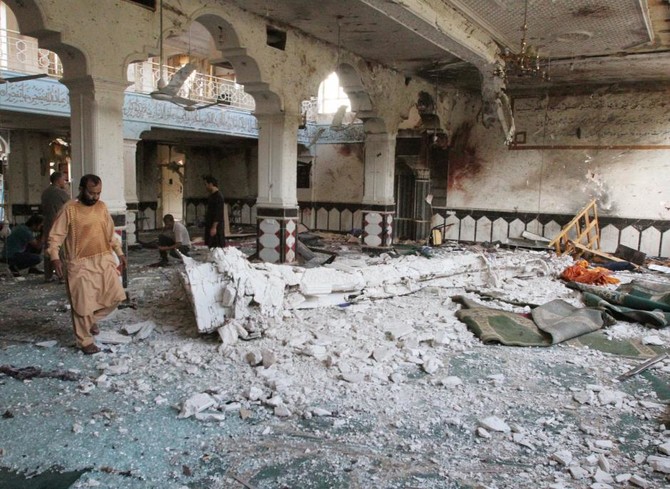
Relatives inspect after an overnight suicide attack at a mosque in Herat, Afghanistan. August 2, 2017. (REUTERS)
Updated 20 September 2017
Follow

Afghanistan arms civilians to protect mosques during holy month

KABUL: Afghanistan is arming hundreds of civilians nationwide to help protect mosques during one of the holiest months on the Islamic calendar after several deadly attacks on Shiite religious sites.
The government’s move comes as it considers a similar proposal to arm 20,000 villagers to fight Islamist militants, highlighting the impotence of Afghanistan’s army and police in beating back insurgents and stemming the bloody violence.
The extra protection for mosques was announced on the website of Second Vice President Sarwar Danish. It also involves the deployment during the mourning month of Muharram of more troops and police around places of worship, particularly those of the Shiite Muslim minority.
Shiites, who number around three million in overwhelmingly Sunni Afghanistan, have regularly been targeted by Daesh jihadists and accuse police and troops of failing to protect them.
“After the recent unfortunate incidents the people should not rely on security forces alone to provide them protection. The people, especially the youth, in their respective areas, need to focus on securing the mosques during the Muharram days,” Danish said after a meeting with top security officials and Shiite leaders on Monday.
Muharram, beginning this week, marks the start of the Islamic new year and the mourning period for the seventh century killing of the prophet’s grandson.
The holy day of Ashura, which falls on the 10th day of Muharram, is a key date.
Acting Interior Minister Wais Barmak said the training of “hundreds of people” recruited by the ministry to protect mosques had almost finished.
They will support the additional forces to be deployed around “sacred places.”
“Measures have been taken to distribute weapons, salaries and other necessary means to the newly recruited people,” Barmak said, according to the statement.
Daesh in the past 14 months has claimed a series of attacks which killed scores of Shiites.
There were two major assaults on Shiite mosques in August alone. In Kabul a suicide bomber and gunmen stormed a building during Friday prayers, killing 28 people and wounding scores more.
Earlier in the month an Daesh attack on a Shiite mosque in the western city of Herat left 33 worshippers dead and 66 wounded.
In July 2016 twin explosions ripped through crowds of Shiite Hazaras in Kabul, killing more than 80 people and wounding hundreds more.


Guterres warns UN risks ‘imminent financial collapse’

Updated 4 sec ago
Follow

Guterres warns UN risks ‘imminent financial collapse’

  • “Member States must fundamentally overhaul our financial rules to prevent an imminent financial collapse,” Guterres wrote
  • Trump has often questioned the UN’s relevance and attacked its priorities

UNITED NATIONS: United Nations chief Antonio Guterres on Friday warned that the world body is on the brink of financial collapse and could run out of cash by July, as he urged countries to pay their dues.
The UN faces chronic budget problems because some member states do not pay their mandatory contributions in full, while others do not pay on time, forcing it into hiring freezes and cutbacks.
“Either all Member States honor their obligations to pay in full and on time — or Member States must fundamentally overhaul our financial rules to prevent an imminent financial collapse,” Secretary-General Guterres wrote in a letter.
US President Donald Trump’s administration has in recent months reduced its funding to some UN agencies and has rejected or delayed some mandatory contributions.
Trump has often questioned the UN’s relevance and attacked its priorities.
The organization’s top decision-making body, the Security Council, is paralyzed because of tensions between the United States and Russia and China, all three of which are permanent, veto-wielding members.
Trump also launched his “Board of Peace” this month, which critics say is intended to become a rival to the UN.

- ‘Untenable’ -

Although more than 150 member states have paid their dues, the UN ended 2025 with $1.6 billion in unpaid contributions — more than double the amount for 2024.
“The current trajectory is untenable. It leaves the Organization exposed to structural financial risk,” Guterres wrote.
The UN is also facing a related problem: it must reimburse member states for unspent funds, Farhan Haq, one of the Guterres’ spokespeople, said during a press briefing.
The secretary-general also highlighted that problem, writing in the letter: “We are trapped in a Kafkaesque cycle; expected to give back cash that does not exist.”
“The practical reality is stark: unless collections drastically improve, we cannot fully execute the 2026 program budget approved in December,” Guterres’ wrote, adding: “Worse still, based on historical trends, regular budget cash could run out by July.”
Guterres, who will step down at the end of 2026, this month gave his last annual speech setting out his priorities for the year ahead and said the world was riven with “self-defeating geopolitical divides (and) brazen violations of international law.”
He also slammed “wholesale cuts in development and humanitarian aid” — an apparent reference to deep cuts to the budgets of UN agencies made by the United States under the Trump administration’s “America First” policies.