POINTE-À-PITRE: Hurricane Maria smashed into the eastern Caribbean island of Dominica on Tuesday, with its prime minister describing devastating damage as winds and rain from the powerful storm also hit territories still reeling from Irma.
As residents hunkered down in their homes the Category Five hurricane made landfall with top winds swirling at 160 miles (257 km) per hour, the US National Hurricane Center (NHC) said.
“We have lost all what money can buy and replace,” Dominica’s premier Roosevelt Skerrit posted on Facebook, saying there were initial reports of “widespread devastation.”
“My greatest fear for the morning is that we will wake to news of serious physical injury and possible deaths as a result of likely landslides triggered by persistent rains.”
Earlier, he said his roof had been blown off, his house was flooding and he was “at the complete mercy of the hurricane.”
After being rescued Skerrit appealed for “help of all kinds” but noted specifically that helicopters will be needed so that authorities could survey the damage.
Dominica’s airport and ports have been closed.
After moving across the tropical island of 72,000 people, Maria was downgraded to an “extremely dangerous” Category Four hurricane but could strengthen again as it races north toward the British Virgin Islands and Puerto Rico.
The NHC warned of dangerous storm surges, destructive waves, flash floods and mudslides and warned that “preparations to protect life and property should be rushed to completion.”
The French territory of Guadeloupe — the bridgehead for aid for Irma-hit French territories — ordered all residents to take shelter in a maximum-level “violet alert.” Heavy rain lashed the island and several areas were without power Tuesday morning.
The Dominican Republic, the east coast of which was battered by Irma, ordered citizens in part of the north to evacuate ahead of Maria’s arrival, expected Wednesday.
St. Kitts, Nevis, the British island of Montserrat, Culebra and Vieques were also on alert.
Martinique, a French island south of Dominica, suffered power cuts but avoided major damage as the storm skirted its shores.
Flooding, mudslides and power outages were also reported in parts of St. Lucia.
Criticized for the pace of relief efforts in their overseas territories devastated by Irma, Britain, France and the Netherlands said they were boosting resources for the Caribbean.
“We are planning for the unexpected, we are planning for the worst,” said Chris Austin, head of a UK military task force set up to deal with Irma, as the British Virgin Islands readied for a new onslaught.
On the island of St. Martin, which is split between France and the Netherlands, authorities announced a red alert ahead of Maria’s arrival.
“We’re watching its trajectory very closely, and we’re preparing for the worst-case scenario,” said local official Anne Laubies.
In Guadeloupe’s biggest city of Pointe-a-Pitre, Elodie Corte, the boss of a metalworking company, said there had been frantic preparations to limit the damage from the storm.
“We spent the morning strapping down the aluminum to stop it from flying away if the winds are strong,” she said Monday.
The Dutch navy tweeted that troops were heading to the two tiny neighboring islands of Saba and St. Eustatius to ensure security following widespread complaints after the first hurricane of looting and lawlessness on St. Martin, among the worst hit by Irma, with 14 killed.
French Interior Minister Gerard Collomb said 110 more soldiers would be deployed to the region to reinforce about 3,000 people already there shoring up security, rebuilding infrastructure and distributing aid.
But he warned of “major difficulties” if Guadeloupe is hard hit.
Irma, also a Category 5 hurricane, left around 40 people dead in the Caribbean before churning west and pounding Florida, where the death toll stood at 50 Monday.
It broke weather records when it whipped up winds of 295 kilometers per hour for more than 33 hours straight.
Another hurricane, Jose, is also active in the Atlantic and has triggered tropical storm warnings for the northeastern US.
Many scientists are convinced that megastorms such as Irma, and Harvey before it, are intensified by the greater energy they can draw from oceans that are warming as a result of climate change.


![]()
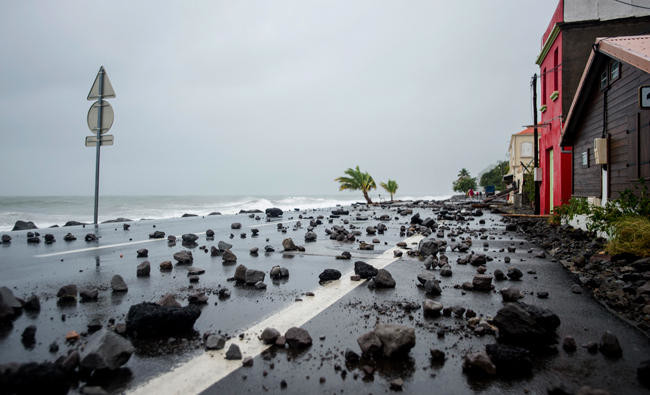
Hurricane Maria wreaks devastation in Dominica
Hurricane Maria wreaks devastation in Dominica
Latest updates


© 2026 SAUDI RESEARCH & PUBLISHING COMPANY, All Rights Reserved And subject to Terms of Use Agreement.