Rights groups critical of Myanmar leader’s Rohingya speech

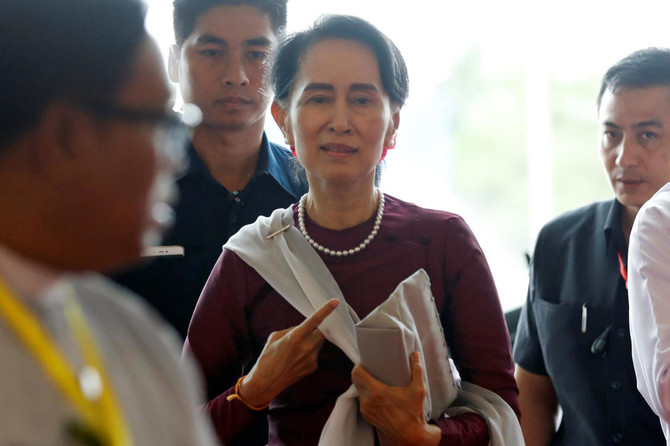
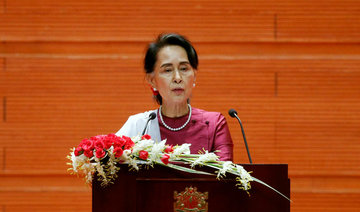
Myanmar State Counselor Aung San Suu Kyi arrives to deliver a speech to the nation over Rakhine and Rohingya situation, in Naypyitaw, Myanmar September 19, 2017. (Reuters)
Updated 19 September 2017
Follow

Rights groups critical of Myanmar leader’s Rohingya speech

NAYPYITAW, Myanmar: Rights groups are critical of Myanmar leader Aung San Suu Kyi’s defense of her country’s conduct in violence that has driven out more than 400,000 Rohingya Muslims, but some observers are glad that she invited diplomats to travel to northern Rakhine state to see for themselves.
Suu Kyi said Tuesday that most Muslims within the conflict zone stayed and that “more than 50 percent of their villages were intact.”
She says the government is working to restore normalcy. Rohingya, however, blame government forces for driving them out.
Amnesty International regional director James Gomez accused Suu Kyi of “a mix of untruths and victim-blaming.”
But Andrew Kirkwood of the United Nations’ Office for Project services said it was positive that Suu Kyi welcomed the international community to parts of northern Rakhine.


Prominent figures, doctors urge restoration of medical care in Gaza

Updated 38 min 1 sec ago
Follow

Prominent figures, doctors urge restoration of medical care in Gaza

  • Letter will be presented to UK, EU leaders

LONDON: Dozens of prominent figures, including Cynthia Nixon, Mark Ruffalo and Ilana Glazer, have joined doctors, human rights leaders and humanitarian organizations in calling for the immediate restoration of medical care in Gaza, in a letter addressed to Israel and world leaders.

“Israel’s systematic attacks on hospitals and unlawful blockade have collapsed Gaza’s healthcare system,” the letter says.

“Through its policies and military activities the government of Israel has deliberately inflicted conditions of life calculated to bring about the destruction of Palestinians in Gaza, and then denied the very help that could save them.”

The letter, shared with The Guardian, will be presented to UK and EU leaders this week and calls for the “immediate, unconditional, unhindered and sustained humanitarian access into Palestine,” including the entry of medical and humanitarian personnel.

The first signatory was Wesam Hamada, the mother of 5-year-old Hind Rajab, who was killed by Israeli fire in January 2024 while waiting for Palestinian paramedics whose ambulance was shelled as it tried to reach her.

Her story is told in Tunisian director Kaouther Ben Hania’s Oscar-shortlisted film “The Voice of Hind Rajab.”

Ben Hania said: “Hind Rajab did not die because help was impossible, but because it was denied.”

Human rights groups, including B’Tselem and Physicians for Human Rights, have also signed the letter, along with figures such as Brian Eno and Rosie O’Donnell.

The UN Human Rights Office estimates that 94 percent of Gaza’s hospitals have been damaged or destroyed since the conflict began in 2023, and at least 1,722 healthcare workers have been killed.

Many medical items, including wheelchairs and walkers, have been barred from entering the territory. UN experts have described the attacks on the healthcare sector as “medicide”.

Israel recently banned dozens of aid agencies, including Medecins Sans Frontieres, from working in Gaza and the West Bank.

The Coordinator of Government Activities in the Territories, also known as COGAT, the Israeli military agency that controls access to Gaza, said “the registration process is intended to prevent the exploitation of aid by Hamas,” although a US analysis found no evidence of Hamas systematically looting aid convoys.

More than 18,500 Palestinians are awaiting medical evacuation from Gaza, MSF estimated in December, with at least 1,000 people having died while waiting for care.

Dr. Thaer Gazawneh, a Chicago-based emergency physician who has signed the letter, said: “(They) are making the living conditions in Gaza so unbearable that people will be forced to be displaced again.”

Ilana Glazer said: “This call for medical access is urgent because medicine and care is the bare minimum of humanity, and when even that’s blocked, it puts every person on the planet at risk of being treated the same way: subhuman.”

Rajab’s mother said the issue was deeply personal because her daughter had dreamed of becoming a doctor.

Hamada said: “Hind never bought any ordinary toys or dolls like other children. She always chose doctor’s toys: a stethoscope, a plastic syringe, a small first-aid kit. She would treat her dolls, pat them, and promise them that everything would be all right.

“Hind’s dream is no longer to become a doctor, but for the children of Gaza to find a doctor, a hospital, medicine, and safety.”