

Suu Kyi appeals to global community over Rohingya crisis

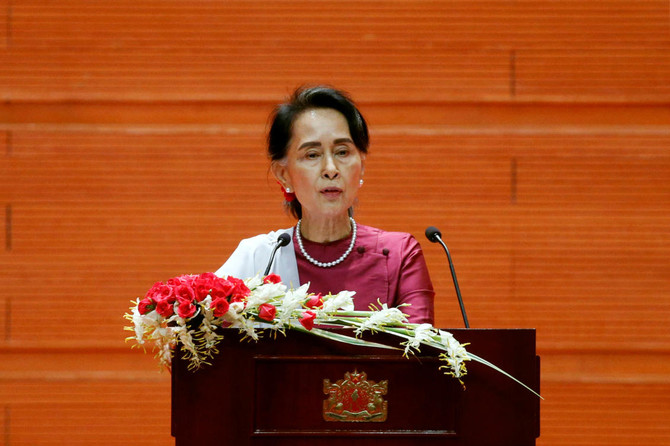
Myanmar State Counselor Aung San Suu Kyi delivers a speech to the nation over Rakhine and Rohingya situation, in Naypyitaw, Myanmar September 19, 2017. (Reuters)
Updated 19 September 2017
Follow

Suu Kyi appeals to global community over Rohingya crisis

NAYPYIDAW: Myanmar leader Aung San Suu Kyi reached out to the global community Tuesday in a broad appeal for support over a refugee crisis the UN has decried as “ethnic cleansing,” urging outsiders to help her nation unite across religious and ethnic lines and offering a pathway back to the country for some of the Rohingya Muslims forced to flee by army operations.
Communal violence has torn through Rakhine state since August 25, leaving hundreds dead and driving more than 410,000 of the Rohingya minority from Myanmar into Bangladesh.
Suu Kyi, a Nobel laureate, has been decried for failing to speak up publicly for the stateless Rohingya or urge restraint from the military.
But in 30-minute televised speech Tuesday she reached out to her critics, deploying the soaring rhetoric that once made her a darling of the global rights community.
“Hate and fear are the main scourges of our world,” she said.
“We don’t want Myanmar to be a nation divided by religious beliefs or ethnicity... we all have the right to our diverse identities.”
While expressing her sorrow for “all” groups displaced by violence, she said her country stood ready “at any time” to take back refugees subject to a “verification” process.
It was not immediately clear how many of the estimated 410,000 Rohingya who have fled Myanmar would qualify to return.
But the subject of their claims to live Myanmar is at the heart of a toxic debate about the Muslim group.
Myanmar’s army has previously it will not take back people linked with “terrorists” — suggesting many came from the hundreds of Rohingya villages that have subsequently been burnt to the ground.
Inside Myanmar, supporters say the 72-year-old lacks the power to rein in the army, with whom she is in a delicate power-sharing arrangement.
The UN has accused Myanmar’s army of “ethnic cleansing” over a campaign of alleged murder and arson that has left scores of Rohingya villages in ashes.
The army denies that, insisting its operations are a proportional response to the late August raids by Rohingya militants, who they label “extremist Bengali terrorists.”
Since then just under half of Rakhine’s Rohingya population has poured into Bangladesh, where they now languish in one of the world’s largest refugee camps.
A further 30,000 ethnic Rakhine Buddhists as well as Hindus have also been displaced — apparent targets of the August 25 attacks by the Arakan Rohingya Salvation Army (ARSA) militant group.
Suu Kyi skipped this week’s UN General Assembly in New York to manage the crisis at home and deliver her televised address — the biggest yet of her time in office.

Analysts say Suu Kyi must walk a treacherous line between global opinion and Islamophobic anti-Rohingya views at home, where the military has curdled hatred for the Muslim minority.
While stories of weary and hungry Rohingya civilians streaming into Bangladesh have dominated global headlines, there is little sympathy for the Muslim group among Myanmar’s Buddhist majority.
Many reject the existence of a Rohingya ethnicity and insist they are “Bengalis” — illegal immigrants from Bangladesh.
That narrative has justified the denial of citizenship for the estimated one million Rohingya who lived in Rakhine before the recent crisis.
Loathing for the Rohingya has brought the public, including prominent pro-democracy activists, into an unlikely alignment with an army that once had them under its heel.
A siege mentality has emerged in Myanmar with the UN, international NGOs and foreign media the focus of ire for apparent pro-Rohingya bias.
Many Facebook users changed their profile picture on Tuesday to carry a banner with a photo of ‘The Lady’ and saying “We stand with you Daw Aung San Suu Kyi” — using an honorific.
Tensions over the status of the Rohingya have been brewing for years in Myanmar, with bouts of anti-Muslim violence erupting around the country as Buddhist hard-liners fan fears of an Islamic takeover.
Although the military stepped down from outright junta rule in 2011, it kept control of security policy and key levers of government.
Any overt break from the army’s policy in Rakhine could enrage the generals and derail Suu Kyi’s efforts to prevent a rollback on recent democratic gains.
Observers say the military may be deliberately destabilising her government with one eye on 2020 elections.
Commander-in-chief Min Aung Hlaing has emerged during the crisis as an unexpectedly popular figure, pitching himself as a defender Myanmar’s territorial integrity and the Buddhist faith.

Pakistani fighter jet crashes in Jalalabad, pilot captured: Afghan military, police

Updated 28 February 2026
Follow

Pakistani fighter jet crashes in Jalalabad, pilot captured: Afghan military, police

  • Fighting between Pakistan and Afghanistan’s Taliban military entered its third day on Saturday
  • Pakistan’s strikes on Friday hit Taliban military installations and posts, including in Kabul and Kandahar

JALALABAD: A Pakistani jet has crashed in Jalalabad city and the pilot captured alive, the Afghan military and police said Saturday, with residents telling AFP the man parachuted from the plane before being detained.
"A Pakistani fighter jet was shot down in the sixth district of Jalalabad city, and its pilot was captured alive," police spokesman Tayeb Hammad said.
Wahidullah Mohammadi, spokesman for the military in eastern Afghanistan, confirmed the Pakistani jet was downed by Afghan forces "and the pilot was captured alive".

The AFP journalist heard a jet overhead before blasts from the direction of the airport in Jalalabad, the capital of Nangarhar province, which sits on the road between Kabul and the Pakistani border.

Fighting between Pakistan and Afghanistan’s Taliban military entered its third day on Saturday, following overnight clashes as the international community expressed increasing concern about the conflict and called for urgent talks.

Pakistan’s strikes on Friday hit Taliban military installations and posts, including in Kabul and Kandahar, in one of the deepest Pakistani incursions into its western neighbor in years, officials said.

Islamabad accuses the Taliban of harboring Tehreek-e-Taliban Pakistan (TTP) militants, who it claims are waging an insurgency inside Pakistan, a charge the Taliban denies.

Pakistan described its actions as a response to cross-border assaults, while Kabul denounced them as a breach of its sovereignty, saying it remained open to dialogue but warned any wider conflict would result in serious consequences.

The fighting has raised ‌the risk ‌of a protracted conflict along the rugged 2,600-kilometer frontier.

Diplomatic efforts gathered ‌pace ⁠late on Friday ⁠as Afghanistan said its foreign minister, Amir Khan Muttaqi, spoke by telephone with Saudi Arabia’s Prince Faisal bin Farhan about reducing tensions and keeping diplomatic channels open.

The European Union called for both sides to de-escalate and engage in dialogue, while the United Nations urged an immediate end to hostilities.

Russia urged both sides to halt the clashes and return to talks, while China said it was deeply concerned and ready to help ease tensions.

The United States supports Pakistan’s right to defend itself against attacks by ⁠the Taliban, a State Department spokesperson said.

Border fighting continues

Exchanges of fire continued along ‌the border overnight.

Pakistani security sources said an operation dubbed “Ghazab Lil Haq” was ongoing and that Pakistani forces had destroyed multiple Taliban posts and camps in several sectors. Reuters could not independently verify the claims.

Both sides have reported heavy losses with conflicting tolls that Reuters could not verify. Pakistan said 12 of its ‌soldiers and 274 Taliban were killed while the Taliban said 13 of its fighters and 55 Pakistani soldiers died.

Taliban deputy spokesman Hamdullah Fitrat ⁠said 19 civilians were ⁠killed and 26 wounded in Khost and Paktika. Reuters could not verify the claim.

Pakistan’s Defense Minister Khawaja Muhammad Asif said “our cup of patience has overflowed” and described the fighting as “open war,” warning that Pakistan would respond to further attacks.

Taliban Interior Minister Sirajuddin Haqqani said in a speech in Khost province that the conflict “will be very costly,” and that Afghan forces had not deployed broadly beyond those already engaged.

He said the Taliban had defeated “the world, not through technology, but through unity and solidarity,” and through “great patience and perseverance,” rather than superior military power.

Pakistan’s military capabilities far exceed those of Afghanistan, with a standing army of hundreds of thousands and a modern air force.

In stark contrast, the Taliban lacks a conventional air force and relies largely on light weaponry and ground forces.

However, the Islamist group is battle-hardened after two decades of insurgency against US-led forces before returning to power in 2021.