YANGON, Myanmar: For generations, Rohingya Muslims have called Myanmar home. Now, in what appears to be a systematic purge, they are, quite literally, being wiped off the map.
After a series of attacks by Muslim militants last month, security forces and allied mobs retaliated by burning down thousands of homes in the enclaves of the predominantly Buddhist nation where the Rohingya live.
That has sent some 417,000 people fleeing to neighboring Bangladesh, according to UN estimates. There they have joined tens of thousands of others who have fled over the past year.
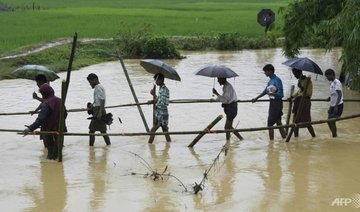
And they are still leaving, piling into wooden boats that take them to sprawling, monsoon-drenched refugee camps in Bangladesh. Decried as ethnic cleansing by UN Secretary General Antonio Guterres, few believe they will ever be welcomed back to Myanmar.
“This is the worst crisis in Rohingya history,” said Chris Lewa, founder of the Arakan Project, which works to improve conditions for the ethnic minority, citing the monumental size and speed of the exodus. “Security forces have been burning villages one by one, in a very systematic way. And it’s still ongoing.”
Using a network of monitors, Lewa and her agency are meticulously documenting tracts of villages that have been partially or completely burned down in three townships in northern Rakhine state, where the vast majority of Myanmar’s 1.1 million Rohingya once lived. It’s a painstaking task because there are hundreds of them, and information is almost impossible to verify because the army has blocked access to the area. Satellite imagery released by Amnesty International and Human Rights Watch, limited at times because of heavy cloud coverage, shows massive swaths of scorched landscape.
The Arakan Project has found that almost every tract of villages in Maungdaw township suffered some burning, and that all of Maungdaw has been almost completely abandoned by Rohingya.
Of the 21 Rohingya villages in Rathedaung, to the north, only five were not targeted. Three camps for Rohingya who were displaced in communal riots five years ago also were torched.
Buthidaung, to the east, so far has been largely spared. It is the only township where security operations appear limited to areas where attacks by Rohingya militants, which triggered the ongoing crackdown, occurred.
The Rohingya have had a long and troubled history in Myanmar, where many in the country’s 60 million people look on them with disdain.
Though members of the ethnic minority first arrived generations ago, they were stripped of their citizenship in 1982, denying them almost all rights and rendering them stateless. They cannot travel freely, practice their religion, or work as teachers or doctors, and they have little access to medical care, food or education.
The UN has labeled the Rohingya one of the world’s most persecuted religious minorities.
Still, if it weren’t for their safety, many would rather live in Myanmar than be forced to another country that doesn’t want them.
“Now we can’t even buy plastic to make a shelter,” said 32-year-old Kefayet Ullah of the camp in Bangladesh where he and his family are struggling to get from one day to the next.
In Rakhine, they had land for farming and a small shop. Now they have nothing.
“Our heart is crying for our home,” he said, tears streaming down his face. “Even the father of my grandfather was born in Myanmar.”
This is not the first time the Rohingya have fled en masse.
Hundreds of thousands left in 1978 and again in the early 1990s, fleeing military and government oppression, though policies were later put in place that allowed many to return. Communal violence in 2012, as the country was transitioning from a half-century of dictatorship to democracy, sent another 100,000 fleeing by boat. Some 120,000 remain trapped in camps under apartheid-like conditions outside Rakhine’s capital, Sittwe.
But no exodus has been as massive and swift as the one taking place now.
The military crackdown came in retaliation for a series of coordinated attacks by Rohingya militants led by Attaullah Abu Ammar Jununi, who was born in Pakistan and raised in Saudi Arabia.
Last October, the militants struck police posts, killing several officers and triggering a brutal military response that sent 87,000 Rohingya fleeing. Then on Aug. 25, a day after a state-appointed commission of inquiry headed by former UN chief Kofi Annan released a report about the earlier bloodshed, the militants struck again.
This time they attacked more than 30 police and army posts.
It was the excuse security forces were looking for. They hit back and hard. Together with Buddhist mobs, they burned down villages, killed, looted and raped.
“The military crackdown resembles a cynical ploy to forcibly transfer large numbers of people without possibility of return,” Zeid Ra’ad Al-Hussein, the UN high commissioner for human rights, said earlier this month in Geneva, calling it a “textbook example of ethnic cleansing.”
It could be months before the extent of the devastation is clear because the army has blocked access to the affected areas. Yanghee Lee, the UN Special Rapporteur on the human rights situation in Myanmar, said at least 1,000 civilians were killed. The government claims more than 400 died, the vast majority Rohingya militants. They put the number of civilians killed at 30.
The Myanmar government says 176 of Northern Rakhine’s 471 villages have been abandoned, but it has provided few details and no names.
Whether it’s the end game for the Rohingya in Myanmar remains to be seen, said Richard Horsey, a political analyst in Yangon. It depends in part on whether arrangements will be made by Bangladesh and Myanmar for their eventual return and the extent of the destruction.
“We are still waiting for a full picture of how many villages are depopulated versus how many were destroyed,” he said.


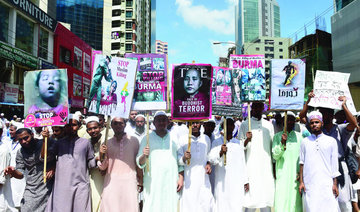
Rohingya Muslims being wiped off Myanmar’s map

Rohingya Muslims being wiped off Myanmar’s map


Court ruling jeopardizes freedom for pro-Palestinian activist Mahmoud Khalil
- The panel ruled a federal judge in New Jersey didn’t have jurisdiction to decide the matter at this time
- The law bars Khalil “from attacking his detention and removal in a habeas petition,” the panel added
WASHINGTON: A federal appeals panel on Thursday reversed a lower court decision that released former Columbia University graduate student Mahmoud Khalil from an immigration jail, bringing the government one step closer to detaining and ultimately deporting the Palestinian activist.
The three-judge panel of the 3rd US Circuit Court of Appeals didn’t decide the key issue in Khalil’s case: whether the Trump administration’s effort to throw Khalil out of the US over his campus activism and criticism of Israel is unconstitutional.
But in its 2-1 decision, the panel ruled a federal judge in New Jersey didn’t have jurisdiction to decide the matter at this time. Federal law requires the case to fully move through the immigration courts first, before Khalil can challenge the decision, they wrote.
“That scheme ensures that petitioners get just one bite at the apple — not zero or two,” the panel wrote. “But it also means that some petitioners, like Khalil, will have to wait to seek relief for allegedly unlawful government conduct.”
The law bars Khalil “from attacking his detention and removal in a habeas petition,” the panel added.
Ruling won’t result in immediate detention
It was not clear whether the government would seek to detain Khalil, a legal permanent resident, again while his legal challenges continue.
Thursday’s decision marked a major win for the Trump administration’s sweeping campaign to detain and deport noncitizens who joined protests against Israel.
In a statement distributed by the American Civil Liberties Union, Khalil said the appeals ruling was “deeply disappointing, but it does not break our resolve.”
He added: “The door may have been opened for potential re-detainment down the line, but it has not closed our commitment to Palestine and to justice and accountability. I will continue to fight, through every legal avenue and with every ounce of determination, until my rights, and the rights of others like me, are fully protected.”
Baher Azmy, one of Khalil’s lawyers, said the ruling was “contrary to rulings of other federal courts.” He noted the panel’s finding concerned a “hypertechnical jurisdictional matter,” rather than the legality of the Trump administration’s policy.
“Our legal options are by no means concluded, and we will fight with every available avenue,” he added, saying Khalil would remain free pending the full resolution of all appeals, which could take months or longer.
The ACLU said the Trump administration cannot lawfully re-detain Khalil until the order takes formal effect, which won’t happen while he can still immediately appeal.
Khalil has multiple options to appeal
Khalil’s lawyers can request the active judges on the 3rd Circuit hear an appeal, or they can go to the US Supreme Court.
An outspoken leader of the pro-Palestinian movement at Columbia, Khalil was arrested on March 8, 2025. He then spent three months detained in a Louisiana immigration jail, missing the birth of his firstborn.
Federal officials have accused Khalil of leading activities “aligned to Hamas,” though they have not presented evidence to support the claim and have not accused him of criminal conduct. They have also accused Khalil, 30, of failing to disclose information on his green card application.
The government has justified the arrest under a seldom-used statute that allows for the expulsion of noncitizens whose beliefs are deemed to pose a threat to US foreign policy interests.
In June, a federal judge in New Jersey ruled that justification would likely be declared unconstitutional and ordered Khalil released.
President Donald Trump’s administration appealed that ruling, arguing the deportation decision should fall to an immigration judge, rather than a federal court.
Khalil has dismissed the allegations as “baseless and ridiculous,” framing his arrest and detention as a “direct consequence of exercising my right to free speech as I advocated for a free Palestine and an end to the genocide in Gaza.”
Dissenting judge says Khalil has right to fight detention
Judge Arianna Freeman dissented Thursday, writing that her colleagues were holding Khalil to the wrong legal standard. Khalil, she wrote, is raising “now-or-never claims” that can be handled at the district court level. He does not have a final order of removal, which would permit a challenge in an appellate court, she wrote.
Both judges who ruled against Khalil, Thomas Hardiman and Stephanos Bibas, were Republican appointees. President George W. Bush appointed Hardiman to the 3rd Circuit, while Trump appointed Bibas. President Joe Biden, a Democrat, appointed Freeman.
The majority opinion noted Freeman worried the ruling would leave Khalil with no remedy for unconstitutional immigration detention, even if he later can appeal.
“But our legal system routinely forces petitioners — even those with meritorious claims — to wait to raise their arguments, the judges wrote. “To be sure, the immigration judge’s order of removal is not yet final; the Board has not affirmed her ruling and has held the parties’ briefing deadlines in abeyance pending this opinion. But if the Board ultimately affirms, Khalil can get meaningful review.”
The decision comes as an appeals board in the immigration court system weighs a previous order that found Khalil could be deported. His attorneys have argued that the federal order should take precedence.
That judge has suggested Khalil could be deported to Algeria, where he maintains citizenship through a distant relative, or Syria, where he was born in a refugee camp to a Palestinian family.
His attorneys have said he faces mortal danger if forced to return to either country.


