UN urged to punish Myanmar army over Rohingya ‘atrocities’

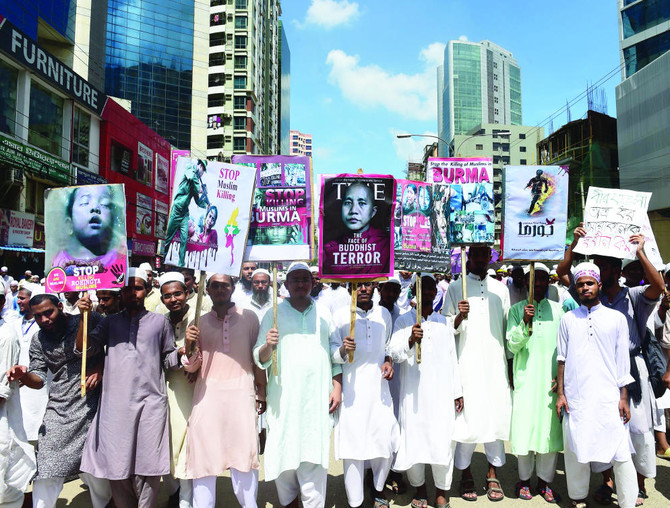
Protesters hold placards and shout slogans during a rally to protest the prosecution of Rohingya Muslims in Myanmar, in Dhaka on Monday. (AFP)
Updated 19 September 2017
Follow

UN urged to punish Myanmar army over Rohingya ‘atrocities’

YANGON: Pressure grew on Myanmar Monday as a rights group urged world leaders to impose sanctions on its military, which is accused of driving out more than 410,000 Rohingya Muslims in an orchestrated “ethnic cleansing” campaign.
The call from Human Rights Watch came as the UN General Assembly prepared to convene in New York, with the crisis in Myanmar one of the most pressing topics.
It also came on the eve of a highly-anticipated national address by Myanmar’s civilian leader Aung San Suu Kyi — her first on the Rakhine crisis.
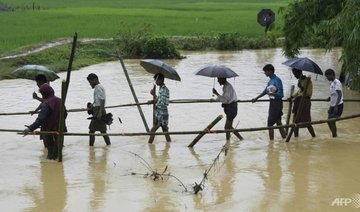
The exodus of Rohingya refugees from mainly Buddhist Myanmar to neighboring Bangladesh has sparked a humanitarian emergency. Aid groups are struggling to provide relief to a daily stream of new arrivals, more than half of whom are children.
Myanmar has suggested it will not take back all who had fled across the border, accusing those refugees of having links to the Rohingya militants whose raids on police posts in August triggered the army backlash.
Any clear moves to block the refugees’ return will likely anger Bangladesh Prime Minister Sheikh Hasina, who will press the General Assembly to raise global pressure Myanmar to take back all the Rohingya massing in shanty towns and camps near the border.
Human Rights Watch also called for the “safe and voluntary return” of the displaced as it urge governments around the globe to punish Myanmar’s army with sanctions for the “ongoing atrocities” against the Rohingya.
“The United Nations Security Council and concerned countries should impose targeted sanctions and an arms embargo on the Burmese military to end its ethnic cleansing campaign against Rohingya Muslims,” the group said in a statement.
Myanmar’s military was hit with Western sanctions during its 50-year rule of the country. But most have been lifted in recent years as the generals have allowed a partial transition to democracy.
“Burma’s (Myanmar) senior military commanders are more likely to heed the calls of the international community if they are suffering real economic consequences,” said John Sifton, HRW’s Asia advocacy director.
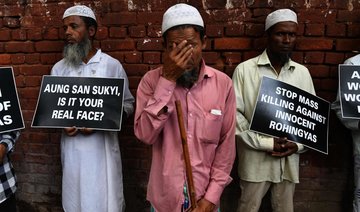
Nobel peace laureate Suu Kyi has shocked the international community with her near-silence on the plight of the Rohingya and her failure to condemn the actions of the army, with whom she has a delicate power-sharing arrangement.
Speaking to the BBC over the weekend, UN Secretary General Antonio Guterres called Suu Kyi’s upcoming address a “last chance” to stop the unfolding humanitarian calamity.
But analysts say it will be difficult for her to tamp both global outrage and combustible religious tensions at home, where there is broad support among the mainly Buddhist populace for the army’s crackdown.
“I’m worried that there is almost no possibility given the political climate in Myanmar for balancing the expectations of most of the country and the expectations of the international community,” Richard Horsey, an independent analyst based in Myanmar, told AFP.
The sharp divide was on display Monday as protests broke out in Dhaka — where 20,000 demonstrators marched in solidarity with the Rohingya — and in Yangon, where a much smaller group of 300 gathered to blast global interference in the conflict.
The ultra-nationalists in Yangon braved a downpour as they waved Myanmar flags and banners describing the UN and global NGOs as “supporting organizations for the terrorists.”
While the world has watched the refugee crisis unfold with horror, there is little sympathy for the Rohingya inside Myanmar.
Many Buddhists revile the Muslim minority and have long denied the existence of the Rohingya as an ethnic group, insisting they are illegal immigrants from Bangladesh.
Suu Kyi’s government has so far defended the military campaign as a legitimate crackdown on the Rohingya militants, who first emerged as a fighting force last October.
On Sunday Myanmar’s Information Committee accused those who fled to Bangladesh — more than a third of the Rohingya population — of working in cahoots with the Rohingya militants, a rag-tag group of fighters armed with mostly rudimentary weapons.
“Those who fled the villages made their way to the other country for fear of being arrested as they got involved in the violent attacks,” the statement said.
“Legal protection will be given to the villages whose residents did not flee,” it added.
The violence has gutted large swaths of northern Rakhine in just over three weeks, with fires visible almost daily across the border from the Bangladesh camps.
Some 30,000 ethnic Rakhine Buddhists and Hindus have also been displaced by unrest in northern Rakhine, where foreign aid has been severely curtailed.
On Monday, Doctors Without Borders repeated calls for “unfettered access” to the conflict zone, saying hundreds of thousands of people are thought to be languishing “without any meaningful form of humanitarian assistance.”


‘Content to die’: Afghanistan’s hunger crisis worsened by winter, aid cuts

Updated 16 min 43 sec ago
Follow

‘Content to die’: Afghanistan’s hunger crisis worsened by winter, aid cuts

  • As winter spreads across Afghanistan’s arid landscape, work opportunities have dried up, while the wave of returning Afghans has swelled the population by a tenth, said Aylieff of WFP
  • “Last year was the biggest malnutrition surge ever recorded in Afghanistan and sadly the prediction is that it’s going to get worse“

KABUL: In the dull glow of a single bulb lighting their tent on the outskirts of Kabul, Samiullah and his wife Bibi Rehana sit down to dry bread and tea, their only meal of the day, accompanied by their five children and three-month-old grandchild.
“We have reached a point where we are content with death,” said 55-year-old Samiullah, whose family, including two older sons aged 18 and 20 and their wives, is among the millions deported by neighboring Iran and Pakistan in the past year.
“Day by day, things are getting worse,” he added, after their return to a war-torn nation where the United Nations’ World Food Programme estimates 17 million battle acute hunger after massive cuts in international aid.
“Whatever happens to us has happened, but at least our children’s lives should be better.”
He was one of the returned Afghans speaking before protests in Iran sparked a massive crackdown by the clerical establishment, killing more than 2,000 in ensuing violence.
Samiullah said his family went virtually overnight from its modest home in Iran to their makeshift tent, partially propped up by rocks and rubble, after a raid by Iranian authorities led to their arrests and then deportation.
They salvaged a few belongings but were not able to carry out all their savings, which would have carried them through the winter, Samiullah added.
Reuters was unable to reach authorities in Iran for ⁠comment.
“Migrants who are newly returning to the country receive assistance as much as possible,” said Afghan administration spokesman Zabiullah Mujahid, in areas from transport to housing, health care and food.
It was impossible to eradicate poverty quickly in a country that suffered 40 years of conflict and the loss of all its revenue and resources, he added in a statement, despite an extensive rebuilding effort.
“Economic programs take time and do not have an immediate impact on people’s lives.”
The WFP says Iran and Pakistan have expelled more than 2.5 million Afghans in massive repatriation programs.
Tehran ramped up deportations last year amid a flurry of accusations that they were spying for Israel. Authorities blamed the expulsions on concerns about security and resources.
Islamabad accelerated deportations amid accusations that the Taliban was harboring militants responsible for cross-border attacks ⁠on Pakistani soil, allegations Afghanistan has denied.

NO INCOME, NO AID
As winter spreads across Afghanistan’s arid landscape, work opportunities have dried up, while the wave of returning Afghans has swelled the population by a tenth, said John Aylieff, the WFP’s country director.
“Many of these Afghans were working in Iran and Pakistan and they were sending back remittances,” he told Reuters, adding that 3 million more people now face acute hunger. “Those remittances were a lifeline for Afghanistan.”
Cuts to global programs since US President Donald Trump returned to the White House have sapped the resources of organizations such as the WFP, while other donor countries have also scaled back, putting millions at risk worldwide.
“Last year was the biggest malnutrition surge ever recorded in Afghanistan and sadly the prediction is that it’s going to get worse,” added Aylieff, estimating that 200,000 more children would suffer acute malnourishment in 2026.
At the WFP’s aid distribution site in Bamiyan, about 180 km (111 miles) from Kabul, the capital, are stacks of rice bags and jugs of palm oil, while wheelbarrows trundle in more food, but it is still too little for the long queues of people.
“I am forced to manage the winter with these ⁠supplies; sometimes we eat, sometimes we don’t,” said Zahra Ahmadi, 50, a widowed mother of eight daughters, as she received aid for the first time.

’LIFE NEVER REMAINS THE SAME’
At the Qasaba Clinic in the capital, mothers soothed their children during the wait for medicine and supplements.
“Compared to the time when there were no migrants, the number of our patients has now doubled,” said Dr. Rabia Rahimi Yadgari.
The clinic treats about 30 cases of malnutrition each day but the supplements are not sufficient to sustain the families, who previously relied on WFP aid and hospital support, she said.
Laila, 30, said her son, Abdul Rahman, showed signs of recovery after taking the supplements.
“But after some time, he loses the weight again,” she said.
After the Taliban takeover, she said, “My husband lost his (government) job, and gradually our economic situation collapsed. Life never remains the same.”
The United States led a hasty withdrawal of international forces from Afghanistan in July 2021, after 20 years of war against the Taliban, opening the doors for the Islamists to take control of Kabul.
As dusk gathers and the temperature falls, Samiullah brings in firewood and Bibi Rehama lights a stove for warmth.
“At night, when it gets very cold, my children say, ‘Father, I’m cold, I’m freezing.’ I hold them in my arms and say, ‘It’s OK.’ What choice do we have?” Samiullah said.
“(When) I worked in Iran, at least I could provide a full meal. Here, there is neither work nor livelihood.”