ANKARA: Turkey has again boosted its military presence along its southern border to prevent hostile incursions by Kurdish fighters from the People’s Protection Units (YPG) in northern Syria.
Ten trucks carrying tanks and howitzer artillery pieces moved into position on Saturday in Kilis province, immediately across the border from the Kurdish-controlled Afrin region of Syria.
The YPG are US allies in the fight against Daesh in Syria, but Ankara views the group as terrorists, and an extension of the outlawed Kurdistan Workers’ Party (PKK), which has conducted an armed insurgency in Turkey for more than 30 years.
YPG militias have de facto autonomy in parts of northern Syria bordering Turkey, and there was an exchange of fire with Turkish artillery in Afrin in June.
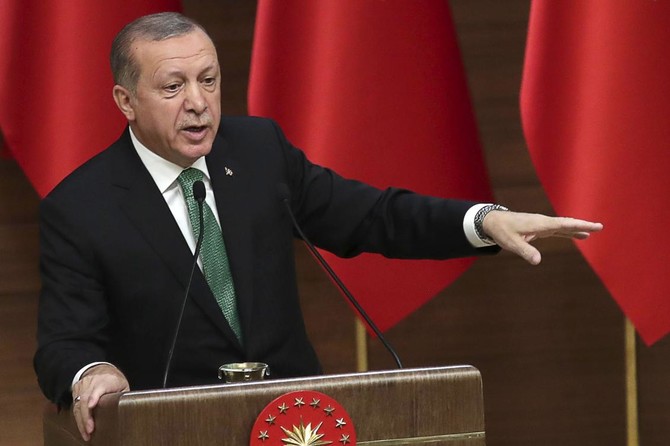
Turkish President Recep Tayyip Erdogan has said Turkey will not allow “terror groups” to create a corridor in northern Syria. The Turkish military’s Operation Euphrates Shield from August 2016 until March this year targeted Daesh, but also aimed to prevent the YPG from forming such a corridor by linking areas such as Aziz and Manjib.
Turkey views the establishment of a Kurdish entity in northern Syria as a threat to its integrity and national security, said Kadir Ertac Celik, an adviser at the Ankara Center for Crisis and Policy Studies (ANKASAM).
“In this context, Turkey places the protection of the regional status quo and stability at the top of its foreign policy agenda. And if needed, Turkey can launch a military intervention into Afrin region,” he said.
The current rapprochement between Russia and Iran strengthened Turkey’s hand, Celik said.
Ankara has begun identifying its security line beyond its national borders, and it has the ability and determination to intervene against any national threat on legitimate grounds, Celik said.
“This border reinforcement move is a clear message and a precaution vis-a-vis the unfolding geopolitics in northern Syria.”
Turkey has openly expressed its willingness to intervene in the PKK/YPG presence in northern Syria for some time, as manifested by a series of discussions in recent weeks, said Merve Seren, a researcher on security studies at the Foundation for Political, Economic and Social Research (SETA), a think tank in Ankara.
“The visits to Ankara by the Iranian chief of staff, Gen. Mohammad Baqeri, and Jim Mattis, US defense secretary, have been considered as showing support by these countries to Turkey’s counterterrorism efforts against PKK and its offshoots,” he said.
Turkey could launch a partial military intervention into the Tal Rifaat area of northern Aleppo and then into Afrin, Seren said.


Turkey sends tanks to confront Kurds on Syrian border
Turkey sends tanks to confront Kurds on Syrian border

Abbas says Palestinians stand in solidarity with Jordan amid US-Iran tensions
- Palestinian president condemned Iranian attacks targeting Jordan
- Al-Aqsa Mosque has remained closed since Saturday morning as Israeli authorities declared a state of emergency
LONDON: Palestinian President Mahmoud Abbas expressed solidarity with Jordan during a phone call with King Abdullah II on Tuesday.
Abbas condemned the Iranian attacks targeting Jordan, reaffirming the Palestinian rejection of any assault that undermines Jordan’s sovereignty or threatens its security and stability, according to Wafa news agency.
After the military actions by the Israeli and US forces in Iran on Saturday, Iran launched suicide drones and missiles into the cities of the Arab Gulf. It also targeted US fighter jets deployed in Azraq, while some missiles struck civilian areas.
Abbas highlighted the importance of dialogue and expressed support for Arab efforts to protect Arab nations, and ensure their security against attacks that violate international law, Wafa added.
For the fourth consecutive day, Israeli forces have intensified military measures throughout the occupied West Bank, closing checkpoints and entrances to cities, towns and villages.
The Al-Aqsa Mosque in the walled city of occupied East Jerusalem has remained closed since Saturday morning, as Israeli authorities declared a state of emergency amid the conflict with Iran.


