Russia’s Rosneft clinches gas pipeline deal with Iraq’s Kurdistan

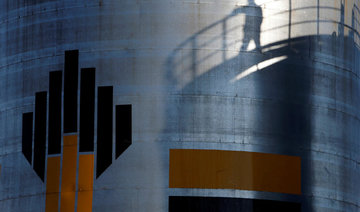
Rosneft, the world’s largest publicly listed oil company by production, clinched gas pipeline deal with Iraq’s Kurdistan. (Reuters)
Updated 18 September 2017
Follow

Russia’s Rosneft clinches gas pipeline deal with Iraq’s Kurdistan

LONDON: Russian oil major Rosneft will invest in gas pipelines in Iraq’s Kurdistan, expanding its commitment to the region ahead of its independence vote to help it become a major exporter of gas to Turkey and Europe.
Kurdistan has been exporting oil independently from the central government in Baghdad since 2014 and Kremlin-controlled Rosneft joined the list of buyers this year, lending the semi-autonomous region hundreds of millions of dollars in loans guaranteed by future oil sales.
Now Rosneft is widening its investments to gas by agreeing to fund a natural gas pipeline in Kurdistan, Rosneft and the Kurdistan Regional Government (KRG) said on Monday. Two sources close to the deal said the investments would amount to more than $1 billion.
Kurdistan is holding an independence vote on Sept. 25 as it seeks to part ways from Baghdad after years of disputes over budget revenues and the sharing of oil exports.
Erbil, the seat of the KRG in northern Iraq, needs money to fund the fight against Islamic state and a budget crisis caused by low oil prices.
Kurdistan has relied on oil pre-finance deals to improve its fiscal position but has struggled to develop its large gas reserves, which can require more investment to develop on a longer-term scale.
The arrival of Rosneft will speed up gas development, which has so far largely been driven by mid-sized companies.
For Rosneft, the world’s largest publicly listed oil company by production, the deal is a major boost to its international gas ambitions. Rosneft has long sought to challenge Gazprom, Russia’s gas export monopoly, in supplying gas to Europe.
For Turkey, it means the arrival of new supplies for its energy-hungry economy and the potential to become a major center for gas supplies to Europe.
The pipeline’s capacity is expected to handle up to 30 billion cubic meters (bcm) of gas exports a year, in addition to supplying domestic users. Kurdistan sits on some of the largest untapped gas deposits on Europe’s doorstep.
The volumes that Rosneft wants to help Kurdistan supply to export markets are big — they represent 6 percent of total European gas demand and one-sixth of current gas export volumes by Russia — by far the largest supplier of gas to Europe.
The pipeline will be constructed in 2019 for Kurdish domestic use, with exports due to begin in 2020.
Rosneft has previously loaned money to Kurdistan guaranteed by future oil sales and has also agreed to help the region expand its pipeline infrastructure.
Kurdistan is seeking to boost oil exports to one million barrels per day (bpd) by the end of this decade from the current 0.65 million bpd.


Saudi Arabia approves over 1k chemical permits, awards 172 mining licenses

Updated 56 min 22 sec ago
Follow

Saudi Arabia approves over 1k chemical permits, awards 172 mining licenses

RIYADH: Saudi Arabia processed more than 1,000 chemical permit requests in November and awarded exploration rights for 172 mining sites in what the government described as its largest licensing round on record. 

The Ministry of Industry and Mineral Resources said it handled 1,095 chemical clearance requests during the month, including 1,041 approvals for non-restricted chemicals and 54 for restricted substances, covering 2,081 product classifications, the Saudi Press Agency reported. 

It forms part of ongoing efforts to accelerate the discovery and development of mineral resources valued at over SR9.4 trillion ($2.51 trillion), aligning with Vision 2030’s objective to position mining as the third pillar of the national industrial sector.   

Ministry spokesperson Jarrah Al-Jarrah explained that the chemical clearance service enables industrial investors to obtain import or export permits for chemicals used in manufacturing through the “Sanaei” digital platform.  

“He clarified that the service aims to ensure that chemical clearances for industrial facilities are granted through streamlined procedures and in a timely manner, thus serving investors and facilitating the entry of their materials through ports of entry,” the SPA report stated. 

Al-Jarrah explained that the service plays a critical role in enhancing industrial output by developing and automating permit procedures for production-related chemicals as part of the ministry’s digital services.  

In a separate development, the ministry announced that 24 domestic and international companies and consortiums won exploration licenses across 172 mining sites in Saudi Arabia, with 76 of those sites awarded through a multi-round public auction.   

These sites span three mineral belts in the Riyadh, Madinah, and Qassim regions, with committed exploration spending exceeding SR671 million during the first two years of project implementation.  

The ministry described this licensing round as the largest mining tender in the Kingdom’s history.   

The competition covered more than 24,000 sq. km across regions known for strategic minerals including gold, copper, silver, zinc, and nickel.   

Additionally, the ministry noted that 26 qualified companies participated through the electronic bidding platform, progressing through a transparent process that began with prequalification and culminated in competitive multi-round auctions.  

The ministry confirmed that these investments aim to develop untapped exploration zones and enhance the utilization of Saudi Arabia’s mineral wealth, strengthening global supply chains.   

It also announced plans to launch further exploration license tenders covering 13,000 sq. km across Madinah, Makkah, Riyadh, Qassim, and Hail, with additional opportunities to be revealed at the 5th Future Minerals Forum in Riyadh from Jan. 13 to 15.  

These efforts, the ministry stated, reflect a broader mining strategy focused on maximizing resource potential, attracting foreign investment, creating employment opportunities, and integrating value chains to establish Saudi Arabia as a global mining hub.