IRBIL, IRAQ: Iraq’s Kurds are to vote on their independence in a September 25 referendum, but the poll is more of a tool to pressure Baghdad than a step toward real secession, observers say.
Iraqi Kurdish leader Massud Barzani announced the referendum in June and has pushed ahead with the vote despite strong opposition from regional powers, the Kurds’ international backers and the central government in Baghdad, which considers it unconstitutional.
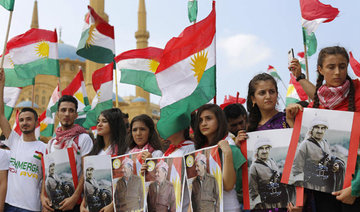
In the months since, the streets of the regional capital Irbil have been festooned with red, white and green Kurdish flags and huge crowds have gathered at rallies to support the vote.
The result seems a foregone conclusion. The Kurds — more than 30 million people spread across Iraq, Turkey, Iran and Syria — have long sought a state of their own.
But with not just Baghdad, Turkey and Iran but also the United States and United Nations opposing the vote, there is little hope that dream will be quickly realized in Iraq.
Instead, observers say, Barzani is using the referendum as leverage in the Kurdish Regional Government’s longstanding disputes with federal authorities.
Barzani is hoping the referendum will deliver “wide-ranging benefits” on issues including oil exports, budget payments and control of ethnically divided areas, Karim Pakzad of the Paris-based Institute for International and Strategic Affairs (IRIS) told AFP.
He said the Kurdish leader wants to pressure Baghdad to resume payments to the cash-strapped KRG from the national budget, long blocked over the autonomous region’s unilateral oil sales.
Barzani is aiming to win “a greater political and economic role and recognition of the Kurds’ right to exploit and export oil from the north,” Pakzad added.
The other key bone of contention is control of areas with mixed Kurdish and Arab populations, notably the province of Kirkuk.
The KRG has already expanded the territory it effectively controls and its peshmerga forces have seized areas outside its borders from the jihadists of the Daesh group.
But some observers are warning that Barzani’s power play is a dangerous gamble, raising the threat of sectarian clashes.
The oil-rich province of Kirkuk in particular has become a tinderbox.
The province, home to numerous minorities, voted in August to take part in the referendum in defiance of Baghdad.
The government responded by sacking Kirkuk’s Kurdish governor, who has refused to leave his post. Rumours are rife that rival communities are stockpiling arms in anticipation of a conflict.
Hadi Al-Ameri, head of the powerful Iranian-backed Badr organization, has warned that the Kurdish referendum could lead to partition and civil war, vowing to defend the unity of Iraq.
Pressure for the vote to be put off has mounted, with Washington urging the KRG to resolve its differences with Baghdad without seeking to divide Iraq.
The United States argues that the vote will weaken Arab-Kurdish joint military operations which have helped to send IS into retreat in both Iraq and war-torn Syria.
The US and other Western nations are backing a UN-supported “alternative” plan for immediate negotiations on future relations in exchange for dropping the referendum.
Turkey, unsettled at the prospect that Irbil might provoke the separatist dreams of its own Kurdish minority, has threatened that Kurdistan will pay “a price” in the event of a “yes” vote.
The autonomous region’s economy is heavily dependent on oil exports via a pipeline running through Turkey to the Mediterranean.
Israel is alone in openly supporting Kurdish independence.
KRG officials have sought to downplay concerns, with the Iraqi Kurdish envoy to Iran Nazem Dabbagh saying in July the referendum was more about “solving problems with Iraq” than breaking away.
Barzani has said a “yes” vote would not lead to a unilateral declaration of independence but rather kick-start “serious discussions” with Baghdad.
Some believe the vote is also designed to help Barzani stay in power, two years after his mandate as president expired.
Kurdish officials said the real test in the referendum will not be the result itself but the level of participation. If it doesn’t reach 70 percent, the poll will be a failure, they said.
Not everyone in Iraqi Kurdistan supports the vote, especially among the current government’s political rivals.
Rebwar Khudar of the KRG’s Jamaa Islamiya opposition movement said the referendum was premature.
“Before the referendum, we must put our Kurdish internal affairs in order and hold a real dialogue with our neighboring countries so they will support us,” he said.
But in Irbil, many are looking forward to having the chance to finally cast a vote for their people’s independence.
“I will vote ‘yes’ with all 10 fingers,” said Berwar Aziz, 23, flashing a wide smile in the shop where he sells scarves near in the city’s famed citadel.


![]()
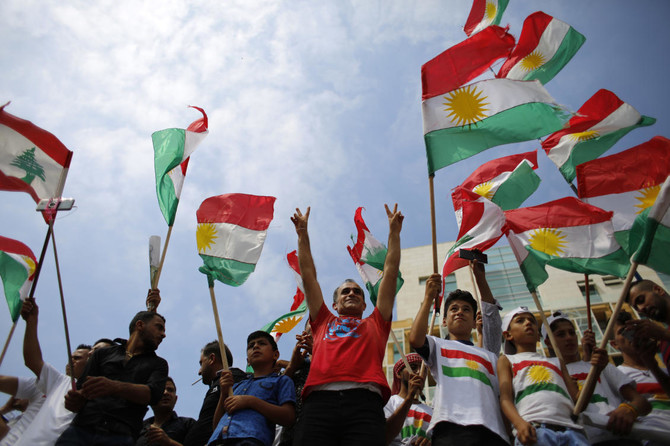
Iraqi Kurds push ahead with referendum to pressure Baghdad
Iraqi Kurds push ahead with referendum to pressure Baghdad

Latest updates


Recommended


© 2026 SAUDI RESEARCH & PUBLISHING COMPANY, All Rights Reserved And subject to Terms of Use Agreement.