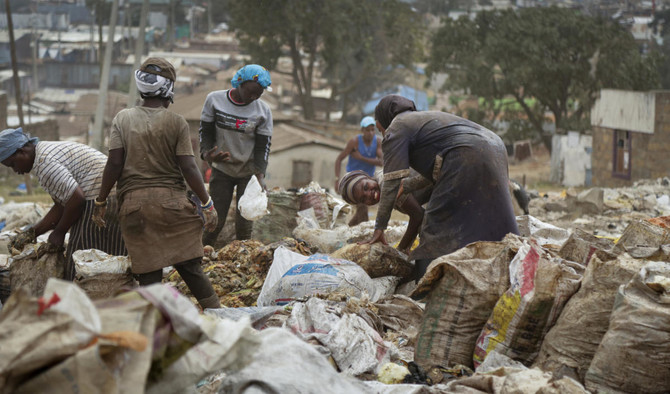
NAIROBI: In one of Africa’s largest dumps, some residents are making a living by collecting and recycling hair from mountains of rubbish.
Nairobi’s Dandora Municipal Dumpsite stretches as far as the eye can see. It was declared full in 2001 but has remained active, with 850 to 1,500 tons of waste arriving every day. Kenya last month implemented a ban on plastic bags, a major contributor to the towering piles of trash.
Many environmentalists have campaigned for years to have the dump shut down, calling it an eyesore and a hazard. But for thousands of Kenyans, the dump is their means of existence.
Winnie Wanjira, 31, has spent her whole life at the dump, one of an estimated 6,000 people making their living by scavenging in the rubbish. Some people raise pigs on the organic waste, while others find items to sell.
Wanjira has tapped into the multi-billion-dollar global hair care industry, buying hair extensions collected by young boys in the dump and then selling it to beauty salons for a small profit.
You can get lucky and find unused human hair,” she said. “Maybe someone bought it and wasn’t satisfied with it, maybe the color, then they threw it away.” Of the different types of hair extensions, human hair is the most coveted for its softness and versatility.
The rising demand in Africa and elsewhere has countries such as India, China and Brazil competing for the biggest share of the market.
Much of the recycled hair is sold to hairdressers in Korogocho, a slum across the river from the dump. Dozens of women have set up makeshift hair salons in the local market.
In a back alley in Korogocho, 29-year-old Mary Wanjiku washes the hair she recently bought. She uses detergent to wash and rinse it, sometimes applying oil and perfume.
“After we get the hair from the dumpsite we usually sort them out and pick the good ones,” Wanjiku said. She has been a hairdresser in Korogocho for nearly 10 years. Business can be slow — she averages seven customers a week — as she competes with more than 30 other stalls lined with hundreds of hairpieces.
But she is happy to be working there and says using hair from the dump makes a lot of business sense.
“We prefer to use those because they are cheap and easy to get because of close proximity, instead of those from the central business district that are expensive and also far away,” she said.
Wanjiku said she doesn’t go out of her way to tell customers where the hair comes from.
But she said many know and are happy that the hair has been sufficiently cleaned and is more affordable than hair in town, where a good weave can go for up to 50,000 Kenyan shillings ($485). A weave in Korogocho can go for around 600 shillings ($6).
One regular customer, 25-year-old housewife Ruth Njeri, said she has been coming to the salon since 2013.
She knows that the hair comes from the dump but said the benefits outweigh the negatives.
“They have good products that have a variety of colors and texture,” she said. “You get to choose what you want, some you can wash. Yeah, they are just good.”

Kenya dump dwellers make a living recycling hair extensions
GCC chambers plan Gulf Guarantee project to boost intra-regional trade
DAMMAM: The Federation of GCC Chambers, in cooperation with the Customs Union Authority, intends to launch the Gulf Guarantee Project to provide a unified mechanism for exports and trade transactions and to enhance the efficiency of intra-GCC trade, which reached about $146 billion by the end of 2024, Saleh Al-Sharqi, Secretary-General of the federation, told Al-Eqtisadiah.
Al-Sharqi said, on the sidelines of his meeting with media representatives at the federation’s headquarters in Dammam, that the initiative represents a qualitative leap in supporting intra-GCC trade by facilitating transit movement through a single point, contributing to cost reduction, accelerating the flow of goods, and enhancing the reliability of trade operations among Gulf markets.
He explained that the federation recently launched a package of strategic initiatives, including the Tawasul initiative aimed at strengthening communication among Gulf business owners and supporting the building of trade and investment partnerships, in addition to the Gulf Business Facilitation initiative, which seeks to address challenges facing Gulf investors and traders, simplify procedures, and improve the business environment across member states.
He noted that these initiatives fall within an integrated vision to address obstacles hindering investment and intra-regional trade flows by developing regulatory frameworks, activating communication channels between the public and private sectors, and supporting Gulf economic integration in line with the objectives of the Gulf Common Market.
In a related context, the Secretary-General affirmed the direction of GCC countries to leverage artificial intelligence technologies to support trade and investment flows, stressing the importance of establishing a unified Gulf committee for artificial intelligence to coordinate efforts and exchange expertise among member states. He said the federation will support this direction in the coming phase, drawing on leading international experiences, particularly the Chinese experience in this field.
Regarding the recently announced electric railway project between Riyadh and Doha, Al-Sharqi revealed that technical and advisory committees are working to complete the necessary studies for the project, confirming that it will positively impact passenger and freight movement between the two countries, enhance Gulf logistical integration, and support regional supply chains.
On investment opportunities available to Gulf nationals in the Syrian market, he said the federation is coordinating with private sector representatives in Syria to overcome obstacles that may face the flow of Gulf investments, in addition to working to provide adequate guarantees to protect these investments and ensure a stable and attractive investment environment.
In response to a question from Al-Eqtisadiah about the impact of tariffs imposed by the US on imports of iron, steel, and aluminum, he said that economic and technical committees in GCC countries are continuously monitoring the repercussions of these tariffs on the Gulf private sector, assessing their effects, and taking the necessary measures to protect it from any potential negative impacts.
Al-Sharqi also pointed to the launch of two specialized committees in the transport and logistics sectors and in real estate activities, given their pivotal role and active contribution to Gulf gross domestic product, stressing that developing these two sectors is a fundamental pillar for enhancing economic diversification and increasing the competitiveness of GCC economies.
He added that during the past year the federation held more than 40 meetings and official engagements with Gulf and international entities, participated in nine regional and international events to strengthen the presence of the Gulf private sector on the global stage, and signed 12 agreements and memoranda of understanding with Gulf, regional, and international entities to open new horizons for economic and investment cooperation.
During the same year, the federation launched four digital platforms to support the Gulf private sector, bringing the total number of its digital platforms to eight serving the business community across member states.
The Secretary-General affirmed that the federation will continue working with relevant economic entities to unify procedures and regulations, reduce non-tariff barriers, and accelerate mutual recognition of products and standard specifications, in a way that enhances the competitiveness of the Gulf economy and supports the growth of intra-GCC trade.