Uproar in Turkey over removing evolution from biology class

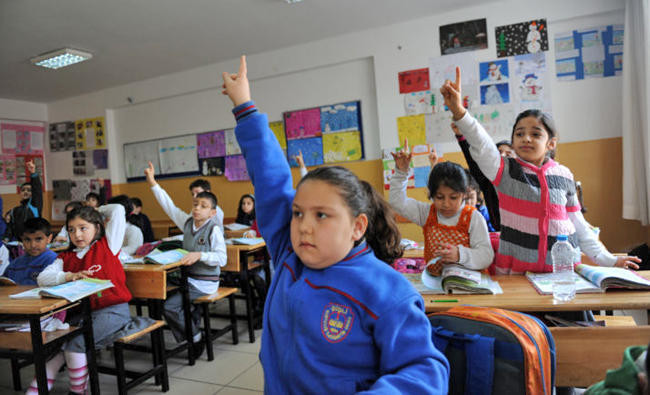
Turkish students attend a lesson at their school in Istanbul on March 23, 2012. Turkey has announced an overhaul of more than 170 topics in the country’s school curriculum, including removing all direct references to evolution from high school biology classes. (BULENT KILIC/AFP/GettyImages/File photo)
Updated 18 September 2017
Follow

Uproar in Turkey over removing evolution from biology class

ISTANBUL: Students in Turkey are returning to school Monday where they will be taught evolution for the last time in their biology classes. Next fall, evolution and Charles Darwin will be scrapped from their textbooks.
Turkey has announced an overhaul of more than 170 topics in the country’s school curriculum, including removing all direct references to evolution from high school biology classes.
The upcoming changes have caused uproar, with critics calling them a reshaping of education along the conservative, Islam-oriented government’s line. Opposition parties and unions have organized protests against the changes, demanding that Turkey provide a scientific, secular education for its students. Lawmakers have also opposed the new curriculum in parliament.
Education Minister Ismet Yilmaz said the new “value-based” program had simplified topics in “harmonization with students’ development.” He said evolutionary biology, which his ministry deemed was too advanced for high school, would still be taught in universities.
Evolution has been taught in 12th-grade biology classes in a chapter called “The Beginning of Life and Evolution.” The unit will be replaced by “Living Beings and the Environment” in September 2018 where evolutionary mechanisms like adaptation, mutation and natural and artificial selection will be taught without a mention of evolution or Darwin.
Yilmaz said students would learn the nature of being, including “evolution and other ontological opinions” in 11th-grade philosophy.
Other contentious changes include teaching about jihad or holy war in religion classes as the “love of homeland,” and a lessened emphasis on Mustafa Kemal Ataturk, the founder of the Turkish republic who is revered by Turkey’s secularists. Ataturk instituted the separation of state and religion, but President Recep Tayyip Erdogan’s party has challenged that strict split with a more religious approach.
Students will also learn about the groups that Turkey is fighting: the Kurdistan Workers’ Party or PKK, the Daesh group and the network of US-based cleric Fethullah Gulen.
Turkey’s education system is already reeling from the trauma of the failed July 15, 2016 coup attempt — and the new scholastic program highlights that government victory as “a legendary, heroic story.”
More than 33,000 of the nation’s teachers — about 4 percent — have been purged in a government crackdown after the coup, nearly 5,600 academics have been dismissed and some 880 schools shuttered for alleged links to terror groups.
Many who lost their jobs say the government is using the failed coup as a way to silence its critics.
Turkey blames Gulen for orchestrating the coup, which he denies.
The belief in creationism — that life originated and changed through divine creation — is widespread in Turkey. Many educators are worried because Turkish students are already globally ranked “below average” in science, mathematics and reading compared to their peers across the world, according the Organization for Economic Co-operation and Development.
Mehmet Somel, the head of the Ecology and Evolutionary Biology Society of Turkey, says Turkish students will be unable to understand even basic science if their studies make no direct reference to evolution.
“We won’t be able to produce good doctors, good scientists, when students graduate from high school with this level of ignorance,” Somel said.
Studying evolution allows future doctors to see the causal link between, for example, resistant strains of microbes and excessive antibiotic use, he said.
Cagri Mert Bakirci, a biologist who founded an online learning project called the “Tree of Evolution,” calls the ministry’s claim that evolution is too difficult for Turkish students an “insult” to them and their teachers. His volunteer project reaches nearly 8 million people each week over Facebook with videos and articles.
“I can explain evolution in 10 seconds,” he said.
The two biologists say evolution was never adequately taught in Turkish public schools in the first place. But Somel says the mention of evolution in past programs at least meant that teachers could introduce the topic.
Orkide Kuleli, a retired pharmaceutical professional, said her 15-year-old daughter will now have to learn about Darwin by herself. She was worried, however, about a more insidious change that she says is taking place in Turkey’s education system.
“The goal is to transform society politically and ideologically rather than develop it through science,” she said. “A generation that does not question is one that blindly obeys.”
Erdogan has repeatedly voiced his desire for a “devout generation.” Previous changes to the education system have included an increase in public schools providing religious studies and more elective classes on Islam.
The new curriculum will be rolled out in steps and assessed. This year, students in first, fifth and ninth grades will use the updated program. Other classes, including the changed biology program, will be fully integrated next fall.
The education minister has called the uproar on evolution “partisan,” arguing that the new curriculum had been open to input. The head of Turkey’s education board, Alpaslan Durmus, insisted it was “utterly ignorant” to say evolution has been scrapped when its mechanisms are still being taught.
Latif Selvi of the pro-government Educators Trade Union, which was involved in drafting the changes, also called the widespread criticism of the plan “ideologically motivated.”
“My opinion, based on an evaluation with evolutionary teachers, is that this change is positive,” Selvi said.
Somel, the biologist, believes that self-censorship may be at work rather than a top-down decision to toss out evolution entirely.
“There is serious fear in universities and in the ministry of education that one may be pushed out, and evolution has become one of those scary themes,” he said.
He said Turkish academics now avoid using the word evolution in project proposals even while studying evolutionary topics. This spring, the Museum of Natural History in the capital of Ankara put new stickers on posters changing the word “evolution” to “development.”
Bakirci said hundreds of experts in Turkey would be willing to help the government improve the country’s science education.
“It’s not too late to take a step back from this mistake,” he warned.


Sudan’s war puts charity kitchen workers feeding displaced families at risk

Updated 7 sec ago
Follow

Sudan’s war puts charity kitchen workers feeding displaced families at risk

CAIRO: Enas Arbab fled Sudan’s western region of Darfur after her hometown fell to Sudanese paramilitary forces, taking only her year-old son with her and the memory of her father, who was killed, she said, simply for working at a charity kitchen serving people displaced by the fighting.
The Rapid Support Forces — or RSF, a paramilitary group that has been at war with the Sudanese army since April 2023 — had laid siege on el-Fasher in the western Darfur region, starving people out before it overran the city.
UN officials say several thousand civilians were killed in the RSF takeover of el-Fasher last October. Only 40 percent of the city’s 260,000 residents managed to flee the onslaught, thousands of whom were wounded, the officials said. The fate of the rest remains unknown.
During the fighting, Arbab says RSF fighters took her father, Mohamed ِArbab, from their home after beating him in front of the family, and demanded a ransom. When the family couldn’t pay, they told them they had killed him, she says. To this day, the family doesn’t know where his body is.
When her husband disappeared a month later, Enas Arbab decided to flee north, to Egypt. “We couldn’t stay in el-Fasher,” she said. “It was no longer safe and there was no food or water.”
Her father was one of more than 100 charity kitchen workers who have been killed since the war began, according to workers who spoke with The Associated Press and the Aid Workers Security database, a group that tracks major incidents around the world impacting aid workers.
In areas of intense fighting — especially in Darfur — famine is spreading and food and basic supplies are scarce. The community-led public kitchens have become a lifeline but many working there have been abducted, robbed, arrested, beaten or killed.
Grim numbers in a brutal war
Volunteer Salah Semsaya with the Emergency Response Rooms — a group that emerged as a local initiative and now operates in 13 provinces across Sudan, with 26,000 volunteers — acknowledges the dangers faced by workers in charity kitchens.
The real number of workers killed is likely far higher than the estimated 100, he says, but the war has prevented reliable data collection and record-keeping.
Semsaya shared records showing that 57 percent of the documented killings of charity kitchen workers occurred in Khartoum, mainly while the Sudanese capital was under RSF control, before the army retook it last March. At least 21 percent of the killings were in Darfur.
More than 50 of those killed in Khartoum worked with his group, Semsaya said.
Sudan’s war erupted after tensions between the army and the RSF escalated into fighting that began in Khartoum and spread nationwide, killing thousands and triggering mass displacement, disease outbreaks and severe food insecurity. Aid workers were frequently targeted.
Dan Teng’o, communications chief at the UN office for humanitarian affairs, says it’s unclear whether charity kitchen workers are targeted because of their work or because of their perceived affiliation with one side or other in the war.
The kitchen workers are prominent in their communities because of the work they do, making them obvious targets, activists say. Ransom demands typically range from $2,000 to $5,000, often rising once families make initial payments.
“A clear deterioration in the security context ... has significantly affected local communities, including volunteers supporting community kitchens,” Teng’o said.
Kitchen workers face risks
Farouk Abkar, a 60-year-old from el-Fasher, spent a year handing out sacks of grain at a charity kitchen in Zamzam camp, just 15 kilometers (9 miles) south of the city. He survived drone strikes and remembers the day RSF fighters attacked his kitchen. One of them punched him in the face, knocking some of his teeth out.
Abkar said he fled el-Fasher at night with his daughter, walking for 10 days. Along the way, some RSF fighters fired birdshot, which hit him in the head, leaving a chronic headache.
Now in Egypt, he shares an apartment with at least 10 other Sudanese refugees and can’t afford medical care. The harrowing images from his hometown still haunt him.
“Many things happened in el-Fasher,” he said. “There was death. There was starvation.”
Mustafa Khater, a 28-year-old charity kitchen worker, fled with his pregnant wife to Egypt a few days before el-Fasher fell to the RSF.
During the 18-month siege, some el-Fasher residents collaborated with the RSF, telling the paramilitary fighters who the kitchen workers were, Khater said. Many disappeared.
“They would take you to an area where there is a dry riverbed and kill you there,” Khater said.
A volunteer working with Semsaya’s aid group in Darfur said some of his colleagues were beaten, arrested and interrogated, with their attackers accusing them of receiving “illicit funds” for the kitchen. The volunteer spoke on condition of anonymity for fear of reprisals.
Despite the challenges, many charity kitchens remain the only reliable food source in areas gripped by conflict and a place people can come to and give each other support, Semsaya said.
Struggling to feed thousands
The town of Khazan Jedid in East Darfur province has three charity kitchens feeding about 5,000 people daily, said Haroun Abdelrahman, a spokesperson for the Emergency Response Rooms’ branch in the area.
Abdelrahman says he was once interrogated by RSF fighters, while several of his colleagues have been robbed at knifepoint. Despite the fear and harassment, many kitchen workers are still volunteering and working, he said.
In Kassala in eastern Sudan, military agents questioned a volunteer with the branch there and his colleagues in January 2024, he said, after their kitchen started serving food and providing shelter to people who escaped nearby Wad Madani when RSF seized that town. He also spoke anonymously for fear of reprisals.
Khater, the 28-year-old who fled el-Fasher, said he heard from friends back home that after the RSF takeover, all charity kitchens in the city closed and his colleagues were either “killed or fled.”
Teng’o says the closures in areas of fighting have left “vulnerable households with no viable alternatives” and forced people to shop at local “markets where food prices are unaffordable.”
Arbab, the pregnant 19-year-old who fled with her baby boy, had hoped to rebuild her life in Egypt, her friends and a humanitarian worker said, speaking on condition of anonymity to talk about the young mother.
But while on the road to the northern city of Alexandria last month, she and her son were stopped by Egyptian authorities and deported back to Sudan.