French journalist freed by Turkey to arrive in Paris Sunday

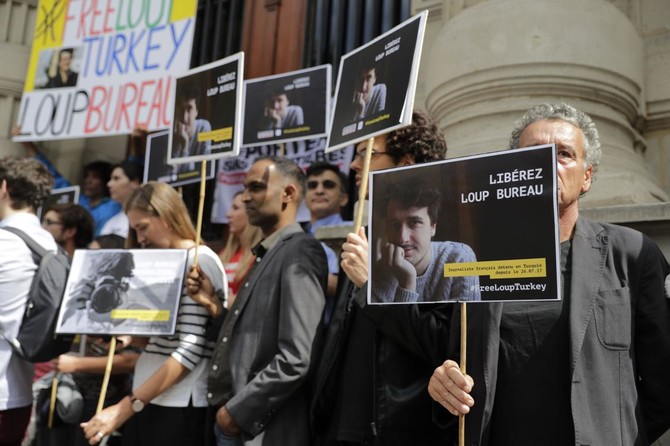
People attend a rally in support of French journalist Loup Bureau, who has been detained in Turkey for the past month, in front of Paris’ 4th district hall in August. (AFP)
Updated 17 September 2017
Follow

French journalist freed by Turkey to arrive in Paris Sunday

PARIS: A young French reporter who had been held on terror charges in Turkey, in a case that sparked tensions with France, arrived in Paris on Sunday after being freed.
Loup Bureau, 27, arrived onboard an Air France jet at Charles de Gaulle airport on a flight from Istanbul, the campaign group Reporters without Borders (RSF) said in a tweet.
After his arrival, he was taken to a VIP suite where he was effusively greeted by his family and friends. Culture Minister Francoise Nyssen was also there to welcome him.
"I am very relieved to be back," Bureau said.
Bureau, a journalism student who has worked with the television channels TV5 and Arte and the website Slate, was detained on July 26 at Habur border post in southeastern Sirnak province on the border with Iraq.
He was charged with membership of the Kurdish People's Protection Units (YPG), a group which Ankara says is a terrorist organisation.
Bureau's arrest spurred a high-profile campaign in France for his freedom.
His release was announced on Friday after French Foreign Minister Jean-Yves Le Drian visited Ankara and lobbied on his behalf.
The case has heightened alarm in Europe over press freedom in Turkey under President Recep Tayyip Erdogan, who has carried out a wide-ranging crackdown after surviving an attempted coup in July 2016.
In June, Ankara released and deported French photojournalist Mathias Depardon who was held for a month on charges of supporting terror groups. He was also detained in Turkey's restive southeast.
Germany's Die Welt correspondent Deniz Yucel was imprisoned in February and has been personally accused by Erdogan of working as a "terror agent".
Turkey ranks 155th on the latest world press freedom index compiled by Reporters Without Borders, falling below Belarus and the Democratic Republic of Congo.
According to the P24 press freedom website, there are 171 journalists behind bars in Turkey, most of whom were detained under the state of emergency imposed after last year's coup attempt.


MenaML hosts 2026 Winter School in Saudi Arabia to boost AI education, collaboration in region

Updated 16 January 2026
Follow

MenaML hosts 2026 Winter School in Saudi Arabia to boost AI education, collaboration in region

  • Second edition of Winter School will be hosted in partnership with KAUST

DUBAI: The Middle East and North Africa Machine Learning Winter School will host its second edition in Saudi Arabia this year, in partnership with the King Abdullah University of Science and Technology.

The non-profit held its inaugural edition in Doha last year in partnership with the Qatar Computing Research Institute.

The initiative began when like-minded individuals from Google DeepMind and QCRI came together to launch a platform connecting a “community of top-tier AI practitioners with a shared interest in shaping the future of the MENA region,” Sami Alabed, a research scientist at Google DeepMind and one of the co-founders of MenaML, told Arab News.

Along with Alabed, the core team includes Maria Abi Raad and Amal Rannen-Triki from Google DeepMind, as well as Safa Messaoud and Yazan Boshmaf from QCRI.

Maria Abi Raad

Messaoud said that the school has three goals: building local talent in artificial intelligence, enhancing employability and connection, and reversing brain drain while fostering regional opportunity.

AI has dominated boardrooms and courtrooms alike globally, but “AI research and education in MENA are currently in a nascent, yet booming, stage,” she added.

Launched at a pivotal moment for the region, the initiative was timed to ensure “regional representation in the global AI story while cultivating AI models that are culturally aligned,” said Rannen-Triki.

The school’s vision is to cultivate researchers capable of developing “sophisticated, culturally aligned AI models” that reflect the region’s values and linguistic and cultural diversity, said Messaoud.

This approach, she added, enables the region to contribute meaningfully to the global AI ecosystem while ensuring that AI technologies remain locally relevant and ethically grounded.

MenaML aims to host its annual program in a different city each year, partnering with reputable institutions in each host location.

“Innovation does not happen in silos; breakthroughs are born from collaboration that extends beyond borders and lab lines,” said Alabed.

“Bringing together frontier labs to share their knowledge echoes this message, where each partner brings a unique viewpoint,” he added.

This year, MenaML has partnered with KAUST, which “offers deep dives into specialized areas critical to the region, blending collaborative spaces with self-learning and placement programs,” said Abi Raad.

The program, developed in partnership with KAUST, brings together speakers from 16 institutions and focuses on four key areas: AI and society, AI and sciences, AI development, and regional initiatives.

“These themes align with the scientific priorities and research excellence pillars of KAUST as well as the needs of regional industries seeking to deploy AI safely and effectively,” said Bernard Ghanem, professor of electrical and computer engineering and computer science at KAUST and director of the Center of Excellence in Generative AI.

The program will also highlight efficiency in AI systems, with the overall goal of equipping “participants with the conceptual and practical understanding needed to contribute meaningfully to next-generation AI research and development,” he told Arab News.

For KAUST, hosting the MenaML Winter School aligns with Saudi Arabia’s ambition to become a global hub for AI research under Vision 2030.

By attracting top researchers, industry partners, and young talent to the Kingdom, it helps cement the Kingdom’s position as a center for AI excellence, Ghanem said.

It also aligns closely with Vision 2030’s “goals of building human capital, fostering innovation, and developing a knowledge-based economy” and “contributes to the long-term development of a world-leading AI ecosystem in Saudi Arabia,” he added.

Although the program accepts students from around the world, participants must demonstrate a connection to the MENA region, Abi Raad said.

The goal is to build bridges between those who may have left the region and those who remain, enabling them to start conversations and collaborate, she added.

A certain percentage of spots is reserved for participants from the host country, while a small percentage is allocated to fully international students with no regional ties, with the objective of offering them a glimpse into the regional AI ecosystem.

Looking ahead, MenaML envisions growing from an annual event into a sustainable, central pillar of the regional AI ecosystem, inspired by the growth trajectory of global movements like TED or the Deep Learning Indaba, a sister organization supporting AI research and education in Africa.

Boshmaf said MenaML’s long-term ambition is to evolve beyond its flagship event into a broader movement, anchored by local MenaMLx chapters across the region.

Over time, the initiative aims to play a central role in strengthening the regional AI ecosystem by working with governments and the private sector to support workforce development, AI governance and safety education, and collaborative research, while raising the region’s global visibility through its talent network and international partnerships.

He added: “If TED is the global stage for ‘ideas worth spreading,’ MenaML is to be the regional stage for ‘AI ideas worth building.’”

The MenaML Winter School will run from Jan. 24 to 29 at KAUST in Saudi Arabia.