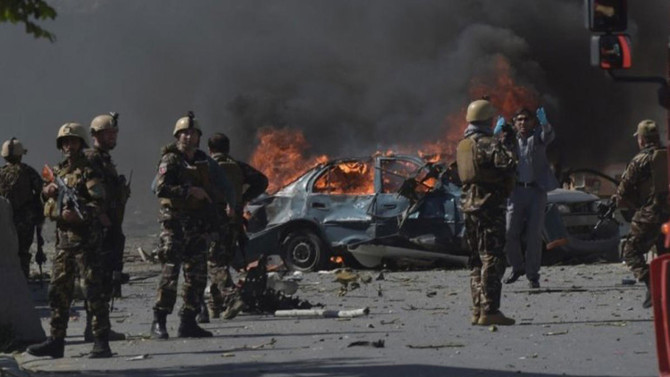
KHOST, Afghanistan: Four people were killed and 14 others wounded in an explosion at a mobile phone market in southeastern Afghanistan on Sunday, officials said.
“The blast happened at around noon in a market where people go to download music and videos to their mobile phones,” Khost provincial police chief Faizullah Khairat told AFP.
There was no immediate claim of responsibility for the attack but the volatile province bordering Pakistan is contested by the Taliban.
Music was one of the many forms of entertainment banned during the Taliban’s 1996-2001 rule and the militants have previously attacked such markets.
Khairat said the explosion was caused by a “remote controlled bomb.”
Khost health department director Habib Shah Ansari confirmed four people had been killed and said “over a dozen wounded” had been taken to hospitals in the provincial capital of the same name.
Afghan security forces have been struggling to beat back a resurgent Taliban since US-led NATO forces ended their combat mission in 2014.

Four killed in market explosion in Afghanistan: officials
US military boards sanctioned oil tanker in Indian Ocean
- Tanker tracking website says Aquila II departed the Venezuelan coast after US forces captured then-President Nicolás Maduro
- Pentagon says it 'hunted' the vessel all the way from the Caribbean to the Indian Ocean
WASHINGTON: US military forces boarded a sanctioned oil tanker in the Indian Ocean after tracking the ship from the Caribbean Sea, the Pentagon said Monday.
The Pentagon’s statement on social media did not say whether the ship was connected to Venezuela, which faces US sanctions on its oil and relies on a shadow fleet of falsely flagged tankers to smuggle crude into global supply chains.
However, the Aquila II was one of at least 16 tankers that departed the Venezuelan coast last month after US forces captured then-President Nicolás Maduro, said Samir Madani, co-founder of TankerTrackers.com. He said his organization used satellite imagery and surface-level photos to document the ship’s movements.
According to data transmitted from the ship on Monday, it is not currently laden with a cargo of crude oil.
The Aquila II is a Panamanian-flagged tanker under US sanctions related to the shipment of illicit Russian oil. Owned by a company with a listed address in Hong Kong, ship tracking data shows it has spent much of the last year with its radio transponder turned off, a practice known as “running dark” commonly employed by smugglers to hide their location.
US Southern Command, which oversees Latin America, said in an email that it had nothing to add to the Pentagon’s post on X. The post said the military “conducted a right-of-visit, maritime interdiction” on the ship.
“The Aquila II was operating in defiance of President Trump’s established quarantine of sanctioned vessels in the Caribbean,” the Pentagon said. “It ran, and we followed.”
The US did not say it had seized the ship, which the US has done previously with at least seven other sanctioned oil tankers linked to Venezuela.
A Navy official, who spoke on condition of anonymity to discuss military operations, would not say what forces were used in the operation but confirmed the destroyers USS Pinckney and USS John Finn as well as the mobile base ship USS Miguel Keith were operating in the Indian Ocean.
In videos the Pentagon posted to social media, uniformed forces can be seen boarding a Navy helicopter that takes off from a ship that matches the profile of the Miguel Keith. Video and photos of the tanker shot from inside a helicopter also show a Navy destroyer sailing alongside the ship.
Since the US ouster of Maduro in a surprise nighttime raid on Jan. 3, the Trump administration has set out to control the production, refining and global distribution of Venezuela’s petroleum products. Officials in President Donald Trump’s Republican administration have made it clear they see seizing the tankers as a way to generate cash as they seek to rebuild Venezuela’s battered oil industry and restore its economy.
Trump also has been trying to restrict the flow of oil to Cuba, which faces strict economic sanctions by the US and relies heavily on oil shipments from allies like Mexico, Russia and Venezuela.
Since the Venezuela operation, Trump has said no more Venezuelan oil will go to Cuba and that the Cuban government is ready to fall. Trump also recently signed an executive order that would impose a tariff on any goods from countries that sell or provide oil to Cuba, primarily pressuring Mexico because it has acted as an oil lifeline for Cuba.