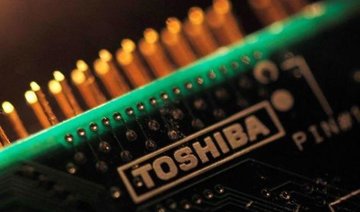
Apple, Dell join bid to buy Toshiba’s chip business: US fund

Toshiba is reportedly aiming to finalize a deal to sell its memory chips business by September 20. (AFP)
Updated 17 September 2017
Follow

Apple, Dell join bid to buy Toshiba’s chip business: US fund

TOKYO: US tech titans Apple and Dell have joined a bid to buy Toshiba’s memory chip business, a deal seen as key to the survival of the cash-stripped Japanese industrial conglomerate, the US investor leading the consortium has said.
“Last week Bain Capital made a revised offer” for Toshiba, which “brings in a broad list of strategic partners including Apple, Dell” and others who will invest in the business, Bain Capital said in a statement obtained by AFP on Sunday.
It was the first time Apple’s name has been officially confirmed as part of the bid, although it has reportedly also been involved in rival bids for the lucrative Toshiba segment.
The announcement came after Toshiba said last week it had picked the Bain Capital-led consortium as the leading candidate to buy its prized chip business in a deal reportedly worth some $18 billion.
The development was the latest twist in a long-running saga as Toshiba agonizes between three groups of suitors for its chip business.
The Bain Capital-led group also includes the state-backed Development Bank of Japan and the public-private Innovation Network Corp. of Japan as well as South Korean chipmaker SK Hynix.
However, Toshiba has stressed that it was a “non-exclusive” agreement with Bain Capital that “does not exclude the possibility of negotiations with other consortia”.
Other suitors in the frame are a group led by Western Digital, Toshiba’s US-based chip factory partner, and Taiwan’s Hon Hai Precision, better known as Foxconn.
Western Digital demanded control of the memory chip business, frustrating Toshiba’s management, which prompted them to turn to the Bain Capital-led group, according to reports in the local media.
Toshiba has sued Western Digital for trying to block the sales process.
In the latest statement, Bain Capital said: “We believe this proposal represents a solution that meets the needs of all stakeholders.”
The proposal “represents the best possible outcome for Toshiba by ensuring” the memory chip business’s independence, Bain Capital said.


Saudi ports brace for cargo surge as shipping lines reroute

Updated 09 March 2026
Follow

Saudi ports brace for cargo surge as shipping lines reroute

RIYADH: Preliminary estimates suggest that several global shipping lines could reroute part of their operations to Saudi Arabia’s Red Sea ports, potentially adding 250,000 containers and 70,000 vehicles per month, according to Rayan Qutub, head of the Logistics Council at the Jeddah Chamber of Commerce, in an interview with Al-Eqtisadiah.

“Any disruption in the Strait of Hormuz not only affects maritime traffic in the Arabian Gulf but could also reshape global trade routes,” Qutub said, highlighting the strait’s status as one of the world’s most critical maritime chokepoints for energy and goods transport.

With rising regional tensions, international shipping companies are reassessing their routes, adjusting shipping lines, or exploring alternative sea lanes. This signals that the current challenges extend beyond the Arabian Gulf, impacting the global supply chain as a whole.

Limited impact on US, European shipments

The effects of these developments will not be uniform across trade routes. Qutub noted that goods from China and India, which rely heavily on routes through the Arabian Gulf, are most vulnerable to disruption. In contrast, shipments from Europe and the US typically traverse western maritime routes via the Suez Canal and the Red Sea, making them less susceptible to regional disturbances.

Saudi Arabia’s strategic location, he emphasized, strengthens the resilience of regional trade. The Kingdom operates an integrated network of Red Sea ports — including Jeddah, Rabigh, Yanbu, and Neom — that have benefited from substantial infrastructure upgrades and technological enhancements in recent years, boosting their capacity to absorb increased cargo volumes.

Red Sea bookings

Several major carriers, including MSC, CMA CGM, and Maersk, have already opened bookings to Saudi Red Sea ports, signaling a shift in operational focus to these strategically positioned hubs.

However, Qutub warned that rerouted shipments could increase sailing times. Cargo from Asia, which normally takes 30-45 days, might now require longer voyages via the Cape of Good Hope and the Mediterranean, potentially extending transit to 60-75 days in some cases.

These changes are also reflected in rising shipping costs, driven by longer routes, higher fuel consumption, and increased insurance premiums — a typical response when global trade patterns shift due to geopolitical pressures.

Qutub emphasized that Saudi Arabia’s transport and logistics sector is managing these developments through coordinated government oversight. The Ministry of Transport and Logistics, the Logistics National Committee, and the Logistics Partnership Council recently convened to evaluate the impact on trade and supply chains. Regular weekly meetings have been established to monitor developments and implement solutions to safeguard the stability of supplies and continuity of trade.

He noted that the Kingdom’s logistical readiness is the result of long-term strategic investments, encompassing ports, airports, road networks, rail systems, and logistics zones. Today, Saudi logistics integrates maritime, land, rail, and air transport, enabling a resilient response to global disruptions.

Qutub also highlighted the need for the private sector to continuously review logistics and crisis management strategies, develop alternative plans, and manage strategic stockpiles. Such measures are essential to mitigate temporary fluctuations in global trade and ensure smooth supply chain operations.