Hospital overwhelmed by Rohingya with lost limbs and bullet wounds

1 / 4
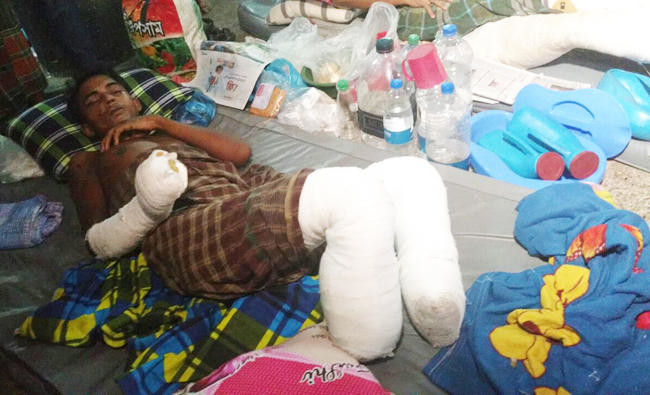
MOHAMMAD HOSSAIN: LOST ONE LEG
2 / 4
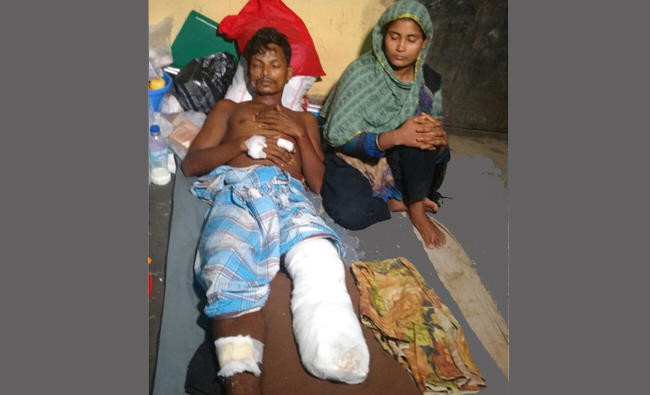
YUSUF NABI: LOST TWO LEGS.
3 / 4
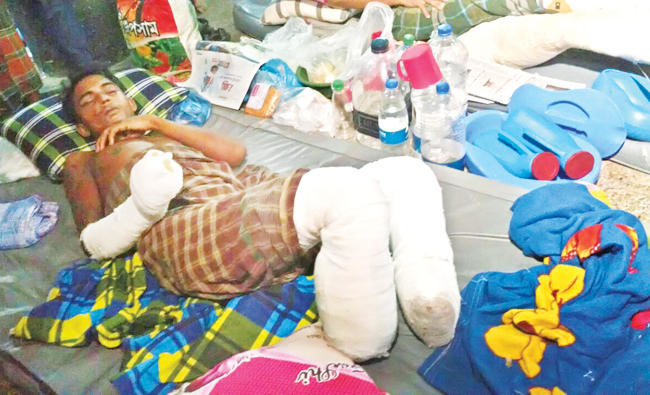
A Rohingya Muslim who lost both legs after hitting a land mine planted by the Myanmar Army lies bandaged at a temporary camp at the Bangladesh-Myanmar border. (AN photo)
4 / 4
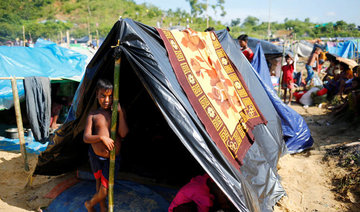
Yusuf who lost both the legs in mine blast
Updated 17 September 2017
Follow

Hospital overwhelmed by Rohingya with lost limbs and bullet wounds

CHITTAGONG: Dozens of Rohingya refugees are being treated in a Bangladesh hospital for bullet wounds and blast injuries suffered in their flight from persecution in Rakhine state in Myanmar.
Many have lost limbs and eyes in land mine explosions, and doctors at Chittagong Medical College Hospital, the largest government hospital in the southeast Bangladesh, are struggling to cope.
One of their patients, Yusuf Nobi, 32, a day laborer from Yazdina Para, lost both legs and both eyes in a land mine blast. “I don't want to live anymore,” he said. “Please kill me.”
Yusuf’s wife Rajiv Begum, 26, is distraught. “Our family is in crisis,” she said. “We don’t know what to do.”
Her husband suffered his injuries when he stepped on a mine as the family crossed the border from Myanmar to Bangladesh.
“We were all crossing the border in a group,” Rajiv said. “There was my mother, two brothers, my husband, two of my sons and a daughter. We were about to reach the Bangladesh border. On the other side, we could see the people of Bangladesh.
“All of a sudden there was a big explosion. We got scattered and ran. A few minutes later, when we reached the Bangladesh border, I noticed that my husband was missing. My brothers went back and found him with a severe mine injury, he lost both his legs instantly.
“We put him into a bamboo basket and rushed to the local health center of Medicins Sans Frontieres. Later Yusuf was taken here by ambulance.”
Next to Yusuf’s bed is another refugee, Mohammad Hossain, who also lost his leg in a land mine blast. “While crossing the border, I stepped on one of the landmines planted by the Myanmar Army,” he said. “The explosion threw me around 10 feet up in the air. I lost consciousness when I hit the ground and later found myself in a local health complex inside Bangladesh.”
Hossain’s wife and children narrowly escaped. His wife now looks after the family and tends to her husband at the hospital.
Dr. Tanvir Ahmed, a duty doctor at the hospital, said he had never seen such a large number of patients injured by land mines and bullets.
“In the last two weeks alone, we have treated around 50 Rohingya Muslims, all of them with gunshot wounds and mine explosion injuries. Two of them lost both their legs, two lost both their eyes,” he said.
About 42 Rohingya refugees with serious injuries are being treated at the hospital, and most of them are at risk of losing at least one leg, he said.
“Our hospital is already over-burdened and we cannot accommodate more beds in the wards for new patients. Many of the patients are kept in the corridor and the hospital is trying its best to provide them with medicines and treatment.”


Filipino rescuers detect ‘signs of life’ in garbage avalanche that killed 4 and left dozens missing

Updated 4 sec ago
Follow

Filipino rescuers detect ‘signs of life’ in garbage avalanche that killed 4 and left dozens missing

  • Twelve workers have been rescued with injuries from the huge mound of garbage
  • “Authorities confirmed the presence of detected signs of life in specific areas, requiring continued careful excavation,” Cebu City Mayor Nestor Archival said

MANILA: Rescuers detected signs of life in an avalanche of garbage that killed at least four workers and left more than 30 others missing Thursday in a central Philippines landfill and plan to intensify search efforts, an official said Saturday.
Twelve workers have been rescued with injuries from the huge mound of garbage that collapsed among the low-slung buildings of a waste management facility in the village of Binaliw in Cebu City, authorities said.
Dozens of rescuers including police, firefighters and disaster-response personnel have raced against time to find more survivors in dangerous conditions in the rubble of twisted tin roofs, iron bars and combustible heaps of garbage and debris.
“Authorities confirmed the presence of detected signs of life in specific areas, requiring continued careful excavation and the deployment of a more advanced 50-ton crane, which is enroute with police escort,” Cebu City Mayor Nestor Archival said in a statement.
“Safety of responders remains paramount due to hazards such as unstable debris and acetylene risks, prompting adjustments to the security perimeter and controlled access,” Archival said.
The four dead, including an engineer and a female office worker, were all employees of the landfill and waste management facility with a staff of 110, according to the mayor and police.
The initial list of victims on Friday included two dead and 36 missing, which increased Saturday to four dead, according to Archival, who did not provide an updated nunber of people missing.
The cause of the collapse of the mountain of garbage remains unclear, but a survivor told The Associated Press on Friday that it happened in an instant without any warning despite fairly good weather at the time.
Jaylord Antigua, a 31-year-old office worker at the landfill, said the wall of garbage cascaded down and destroyed the administrative office he was in. He extricated himself with bruises on his face and arms by crawling in darkness in the rubble and debris.
“I saw a light and crawled toward it in a hurry, because I feared there will be more landslides,” Antigua said. “It was traumatic. I feared that it was my end, so this is my second life.”
It is unclear how the accident would affect garbage disposal in the landfill in Cebu, a bustling port city of nearly a million people that serves as a regional hub for trade, commerce and tourism.
Preparations “are also underway to manage the looming garbage collection issue,” Archival said in his statement without further details.
Such landfills and open dumpsites have long been a source of safety and health concerns throughout the Philippines, especially in areas close to poor communities where many residents scavenge for junk and leftover food in the garbage heaps.
In July 2000, a huge garbage mound in a shantytown in suburban Quezon City, part of metropolitan Manila, collapsed and ignited a fire after days of stormy weather.
The disaster left more than 200 people dead and many more missing, damaged scores of shanties and prompted a law requiring the closure of illegal dump sites nationwide, as well as improved and more sustainable waste management by authorities.