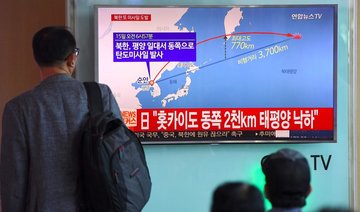
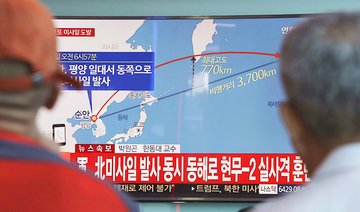
SEOUL, South Korea: North Korea said Saturday leader Kim Jong Un vowed to complete his nuclear weapons program in the face of strengthening sanctions after he inspected a powerful new intermediate-range missile that was fired over Japan.
The North’s official Korean Central News Agency carried Kim’s comments a day after US and South Korean militaries detected the missile launch from the North Korean capital of Pyongyang.
It traveled 3,700 kilometers (2,300 miles) before landing into the northern Pacific Ocean. It was the country’s longest-ever test flight of a ballistic missile.
The North has confirmed the missile as an intermediate range Hwasong-12, which it also launched over Japan on Aug. 29.
The KCNA said Kim expressed great satisfaction over the launch, which he said verified the “combat efficiency and reliability” of the missile and the success of efforts to increase its power. While the English version of the report was less straightforward, the Korean version quoted Kim as declaring the missile as operationally ready.
Kim also said the country, despite “limitless” international sanctions, has nearly completed the building of its nuclear weapons force and called for “all-state efforts” to reach the goal and obtain a “capacity for nuclear counterattack the US cannot cope with.”
“As recognized by the whole world, we have made all these achievements despite the UN sanctions that have lasted for decades,” the agency quoted Kim as saying.
Kim said the country’s final goal is to “is to establish the equilibrium of real force with the US and make the US rulers dare not talk about military option for the DPRK,” referring to North Korea’s official name, the Democratic People’s Republic of Korea.
Prior to the launches over Japan, North Korean had threatened to fire a salvo of Hwasong-12s toward Guam, the US Pacific island territory and military hub the North has called an “advanced base of invasion.”
Friday’s launch followed North Korea’s sixth and most powerful nuclear test on Sept. 3 in what it described as a detonation of a thermonuclear weapon built for its developmental intercontinental ballistic missiles.
The North flight tested its Hwasong-14 ICBMs twice in July and analysts say the missiles could potentially reach deep into the US mainland when perfected.

North Korea leader says he will complete nuclear program

EU reconsidering funds for Serbia as justice laws ‘eroding trust’
BELGRADE: The European Union could withhold funds from a 1.6 billion euro allocation of loans and grants to Serbia, after Belgrade passed laws that are “eroding trust” in its commitment to the rule of law, the bloc’s enlargement commissioner said.
Reforms to centralize the judiciary that came into force this week brought criticism from judges and prosecutors who see them as bolstering President Aleksandar Vucic’s hold on power, weakening the fight against organized crime and undermining Serbia’s bid to join the EU.
“These amendments are eroding trust. It is becoming harder for those in Brussels who are willing to advance with Serbia to make their case,” EU enlargement commissioner Marta Kos said in emailed comments to Reuters late on Thursday.
Kos said the commission was reviewing funding for Serbia under the EU Growth Plan for the Western Balkans, aimed at aligning the region to EU rules and ultimately bringing countries such as Serbia into the bloc. Serbia was allocated 1.6 billion euros of loans and grants under the program.
“These (funds) contain preconditions linked to the rule of law,” she said.
Serbia began official talks to join the EU in 2014 but widespread corruption and weak institutions have slowed progress.
The judicial reforms include limiting the mandate of chief public prosecutors and granting court presidents — responsible for court administration — greater powers over judges. Critics fear the reforms will erode judges’ independence and jeopardize high-level corruption cases overseen by the Public Prosecutor’s Office for Organized Crime.
The government did not immediately respond to a request for comment on Friday. The justice ministry has said that the new laws will make the judiciary more efficient by streamlining the decision-making process.
Since the backlash, Serbia has requested the opinion of the Venice Commission, a panel of constitutional law experts of the Council of Europe, a human rights body.
“Once that opinion is issued, we expect these laws to be revised accordingly and in an inclusive manner,” Kos said.
Reforms to centralize the judiciary that came into force this week brought criticism from judges and prosecutors who see them as bolstering President Aleksandar Vucic’s hold on power, weakening the fight against organized crime and undermining Serbia’s bid to join the EU.
“These amendments are eroding trust. It is becoming harder for those in Brussels who are willing to advance with Serbia to make their case,” EU enlargement commissioner Marta Kos said in emailed comments to Reuters late on Thursday.
Kos said the commission was reviewing funding for Serbia under the EU Growth Plan for the Western Balkans, aimed at aligning the region to EU rules and ultimately bringing countries such as Serbia into the bloc. Serbia was allocated 1.6 billion euros of loans and grants under the program.
“These (funds) contain preconditions linked to the rule of law,” she said.
Serbia began official talks to join the EU in 2014 but widespread corruption and weak institutions have slowed progress.
The judicial reforms include limiting the mandate of chief public prosecutors and granting court presidents — responsible for court administration — greater powers over judges. Critics fear the reforms will erode judges’ independence and jeopardize high-level corruption cases overseen by the Public Prosecutor’s Office for Organized Crime.
The government did not immediately respond to a request for comment on Friday. The justice ministry has said that the new laws will make the judiciary more efficient by streamlining the decision-making process.
Since the backlash, Serbia has requested the opinion of the Venice Commission, a panel of constitutional law experts of the Council of Europe, a human rights body.
“Once that opinion is issued, we expect these laws to be revised accordingly and in an inclusive manner,” Kos said.
© 2026 SAUDI RESEARCH & PUBLISHING COMPANY, All Rights Reserved And subject to Terms of Use Agreement.