BEIJING: China condemned North Korea’s launch of a ballistic missile over Japan on Friday, but said it was “irresponsible” to blame Beijing for regional tensions after Washington urged it to rein in its ally.
The Kremlin meanwhile said that North Korea’s latest missile test was part of a series of unacceptable provocations and that the United Nations Security Council was united in believing such launches should not be taking place.
Kremlin spokesman Dmitry Peskov made the comments to reporters on a conference call after Pyongyang fired a missile that flew over Japan’s northern Hokkaido far out into the Pacific Ocean on Friday, deepening tension after its recent test of its most powerful nuclear bomb.
“In Russia we are deeply concerned about these provocative launches which are further stoking tensions. Clearly demonstrating that our position is that such launches are unacceptable is the most tangible thing we can do right now,” said Peskov.
After the North’s latest test, US Secretary of State Rex Tillerson called on China to use the oil it supplies to North Korea as leverage to pressure the isolated nation into reconsidering its nuclear program.
But Chinese foreign ministry spokeswoman Hua Chunying said Beijing had made “enormous sacrifices at a great price” by implementing UN Security Council sanctions on North Korea.
“The core lies in a conflict between the DPRK and the US. The focal point of the contradiction is not China,” Hua told a regular news briefing, using the acronym for the North’s official name.
“China is not the driver behind the escalation of the tensions. China also does not hold the key to the Korean peninsula issue. The initiators of a trouble should end it,” she said.
“It’s irresponsible and unhelpful for the settlement of the issue to unjustly blame others and shirk responsibilities in any form.”
China on Monday backed an eighth set of sanctions against North Korea at the UN Security Council after Pyongyang’s latest and largest nuclear test, banning it from trading in textiles and restricting oil imports.
Washington had called for an oil embargo, but it softened its stance in order to secure the backing of China and Russia.
“China supplies North Korea with most of its oil. Russia is the largest employer of North Korean forced labor,” Tillerson said.
“China and Russia must indicate their intolerance for these reckless missile launches by taking direct actions of their own.”
In New York, the Security Council called an emergency meeting for later Friday after Pyongyang conducted its furthest-ever missile flight over Japan and into the Pacific.
“The Chinese side opposes the DPRK’s violation of the resolution of the Security Council, and its use of ballistic missile technology for launch activities,” Hua said.
“The concerned parties should exercise restraint. They should not take any further action that could aggravate the situation on the peninsula and in the region,” Hua added.
Asked if Beijing would change its approach, Hua said China will “continue to comprehensively and completely implement the relevant resolutions of the Security Council”.
She said UN resolutions should be implemented in a “balanced and comprehensive way”.
“That means on the one hand, we should maintain the pressure to prevent the development of the nuclear and ballistic activities from the DPRK,” Hua said.
“But on the other hand, all parties should take concrete, effective and reasonable actions to create favorable conditions for the early resumption of peace talks, in order to push forward a peaceful resolution of the nuclear issue.


![]()
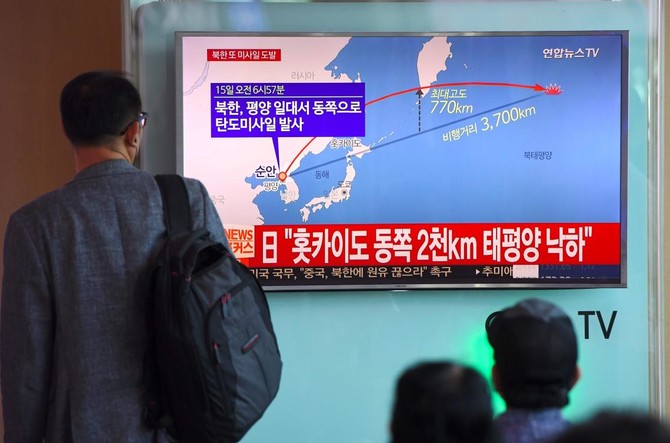
China ‘opposes’ North Korea missile launch, Kremlin calls it another ‘provocation’
China ‘opposes’ North Korea missile launch, Kremlin calls it another ‘provocation’


Latest updates


© 2026 SAUDI RESEARCH & PUBLISHING COMPANY, All Rights Reserved And subject to Terms of Use Agreement.