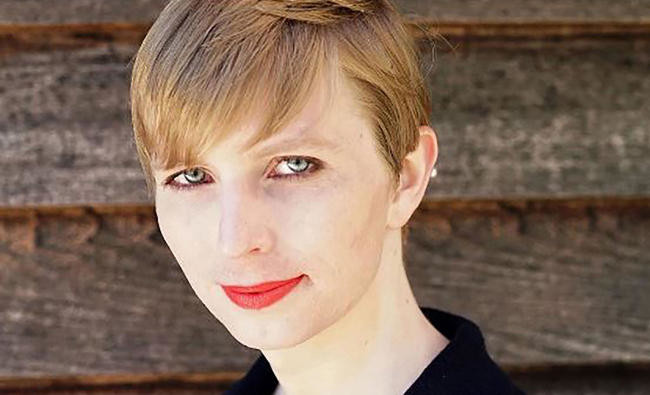
Harvard scraps decision to give Chelsea Manning a fellowship

Chelsea Manning. (AFP)
Updated 16 September 2017
Follow

Harvard scraps decision to give Chelsea Manning a fellowship

WASHINGTON: Harvard University reversed its decision to name Chelsea Manning a visiting fellow early Friday, a day after CIA Director Mike Pompeo scrapped a planned appearance over the title for the soldier who was convicted of leaking classified information.
Douglas Elmendorf, the dean of the university’s John F. Kennedy School of Government, wrote in a statement posted to the university’s website that naming Manning a visiting fellow was a mistake, even though he said the title carries no special honor.
“We invited Chelsea Manning to spend a day at the Kennedy School,” he wrote. “On that basis, we also named Chelsea Manning a Visiting Fellow. We did not intend to honor her in any way or to endorse any of her words or deeds, as we do not honor or endorse any Fellow.”
Elmendorf apologized to Manning and to “many concerned people” he said he had heard from “for not recognizing upfront the full implications of our original invitation.” Manning is still invited to spend a day at the school and speak to students, though without the visiting fellow title, he wrote.
Manning responded on Twitter early Friday, writing that she was “honored to be 1st disinvited trans woman visiting @harvard fellow.”
“They chill marginalized voices under @cia pressure,” she said while also accusing the school of letting the CIA determine “what is and is not taught.”
Elmendorf delivered the news in a brief phone call with Manning and three of her representatives hours after the canceled Pompeo event Thursday, according to a member of Manning’s team who was the room with her.
One of Manning’s assistants questioned Elmendorf on why two other visiting fellows, former White House press secretary Sean Spicer and former Trump campaign manager Corey Lewandowski, could keep their titles as visiting fellows, the team member told The Associated Press.
Elmendorf explained that the former Trump aides had something to teach Harvard students, which Manning’s team took as an implication that she did not, according to the team member, who spoke on condition of anonymity because of security concerns.
Elmendorf didn’t immediately return a request for comment Friday.
Manning’s publicist didn’t immediately respond when asked if she would still accept Harvard’s invitation to visit the school.
The 29-year-old Manning is a transgender woman who was known as Bradley Manning when she was convicted in 2013 of leaking a trove of classified documents. She was released from a military prison in May after serving seven years of a 35-year sentence, which was commuted by President Barack Obama in his final days in office. Obama said in January he felt justice had been served. Manning explained on ABC’s “Good Morning America” in a recent interview that she was prompted to give the information to WikiLeaks because of the human toll of the “death, destruction and mayhem” she saw while serving in Iraq.
Pompeo was a last-minute cancelation at a speaking event at Harvard on Thursday night. Minutes after the event was to begin, Elmendorf took the stage and told the audience Pompeo was not there and would not speak.
The CIA later released a letter that Pompeo, who has a law degree from Harvard, wrote to a university official. Pompeo said an appearance would betray the trust of CIA employees and stressed that his decision had nothing to do with Manning’s transgender identity.
“It has everything to do with her identity as a traitor to the United States of America and my loyalty to the officers of the CIA,” Pompeo said.
Earlier Thursday, Mike Morell, a former deputy director and acting director of the CIA, resigned from his post as a senior fellow at the Kennedy School, telling Elmendorf in a letter that he could not be part of an organization that “honors a convicted felon and leaker of classified information.”
In addition to Manning, Harvard this week invited Spicer, Lewandowski and MSNBC hosts Joe Scarborough and Mika Brzezinski to serve as visiting fellows.


At top UN court, Myanmar denies deadly Rohingya campaign amounts to genocide

Updated 57 min ago
Follow

At top UN court, Myanmar denies deadly Rohingya campaign amounts to genocide

  • The country defended itself Friday at the United Nations top court against allegations of breaching the genocide convention
  • Myanmar launched the campaign in Rakhine state in 2017 after an attack by a Rohingya insurgent group

THE HAGUE: Myanmar insisted Friday that its deadly military campaign against the Rohingya ethnic minority was a legitimate counter-terrorism operation and did not amount to genocide, as it defended itself at the top United Nations court against an allegation of breaching the genocide convention.
Myanmar launched the campaign in Rakhine state in 2017 after an attack by a Rohingya insurgent group. Security forces were accused of mass rapes, killings and torching thousands of homes as more than 700,000 Rohingya fled into neighboring Bangladesh.
“Myanmar was not obliged to remain idle and allow terrorists to have free reign of northern Rakhine state,” the country’s representative Ko Ko Hlaing told black-robed judges at the International Court of Justice.
Gambia filed genocide case in 2019
African nation Gambia brought a case at the court in 2019 alleging that Myanmar’s military actions amount to a breach of the Genocide Convention that was drawn up in the aftermath of World War II and the Holocaust.
Some 1.2 million members of the Rohingya minority are still languishing in chaotic, overcrowded camps in Bangladesh, where armed groups recruit children and girls as young as 12 are forced into prostitution. The sudden and severe foreign aid cuts imposed last year by US President Donald Trump shuttered thousands of the camps’ schools and have caused children to starve to death.
Buddhist-majority Myanmar has long considered the Rohingya Muslim minority to be “Bengalis” from Bangladesh even though their families have lived in the country for generations. Nearly all have been denied citizenship since 1982.
Myanmar denies Gambia claims of ‘genocidal intent’
As hearings opened Monday, Gambian Justice Minister Dawda Jallow said his nation filed the case after the Rohingya “endured decades of appalling persecution, and years of dehumanizing propaganda. This culminated in the savage, genocidal ‘clearance operations’ of 2016 and 2017, which were followed by continued genocidal policies meant to erase their existence in Myanmar.”
Hlaing disputed the evidence Gambia cited in its case, including the findings of an international fact-finding mission set up by the UN’s Human Rights Council.
“Myanmar’s position is that the Gambia has failed to meet its burden of proof,” he said. “This case will be decided on the basis of proven facts, not unsubstantiated allegations. Emotional anguish and blurry factual pictures are not a substitute for rigorous presentation of facts.”
Aung San Suu Kyi represented Myanmar at court in 2019. Now she’s imprisoned
Nobel Peace Prize winner Aung San Suu Kyi represented her country at jurisdiction hearings in the case in 2019, denying that Myanmar armed forces committed genocide and instead casting the mass exodus of Rohingya people from the country she led as an unfortunate result of a battle with insurgents.
The pro-democracy icon is now in prison after being convicted of what her supporters call trumped-up charges after a military takeover of power.
Myanmar contested the court’s jurisdiction, saying Gambia was not directly involved in the conflict and therefore could not initiate a case. Both countries are signatories to the genocide convention, and in 2022, judges rejected the argument, allowing the case to move forward.
Gambia rejects Myanmar’s claims that it was combating terrorism, with Jallow telling judges on Monday that “genocidal intent is the only reasonable inference that can be drawn from Myanmar’s pattern of conduct.”
In late 2024, prosecutors at another Hague-based tribunal, the International Criminal Court, requested an arrest warrant for the head of Myanmar’s military regime for crimes committed against the country’s Rohingya Muslim minority. Senior Gen. Min Aung Hlaing, who seized power from Suu Kyi in 2021, is accused of crimes against humanity for the persecution of the Rohingya. The request is still pending.