MANILA: Philippine President Rodrigo Duterte may declare nationwide martial law next week if threatened massive protests by communists and other leftists against his rule turn violent or disrupt the country, his defense chief said Friday.
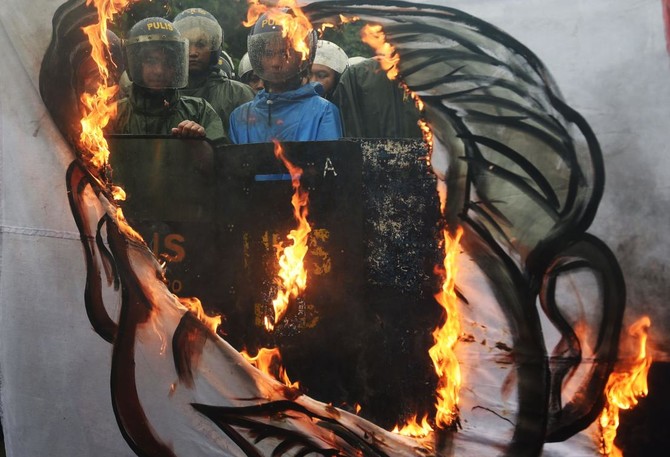
“He said, if the left will try to have a massive protest, start fires on the streets, they will disrupt the country, then I might (declare martial law),” Defense Secretary Delfin Lorenzana told reporters, recounting a conversation with Duterte this week.
Lorenzana emphasized he thought the chances of Duterte declaring martial law were remote because he doubted the scheduled protests on Thursday next week would be as big as the organizers said they were planning.
“But the president is indeed very concerned because it might get out of hand. So he said I might declare martial law.”
A coalition of groups naming themselves the “Movement Against Tyranny” had announced it was planning protests on September 21, the 45-year anniversary of late dictator Ferdinand Marcos imposing his military rule.
It said the protests, to be held at a park in the capital of Manila, would voice opposition against Duterte’s war on drugs that has claimed thousands of lives, as well as the president’s attacks on democratic institutions.
The coalition also voiced outrage at Duterte’s public support for Marcos, who was overthrown in the “People Power” revolution in 1986 and died in US exile three years later.
The announcement for the protest said its theme was: “Stop the Killings! Never Again to Tyranny and Dictatorship!”
Duterte won last year’s presidential elections on a brutal law-and-order platform in which he promised an unprecedented campaign to eradicate illegal drugs in society by killing up to 100,000 traffickers and addicts.
Police have reported killing more than 3,800 people in anti-drug operations since he took office 15 months ago, while thousands of others have been murdered in unexplained circumstances.
Duterte has repeatedly threatened to impose martial law across the country, but neither he nor his aides have previously given a specific timeframe or event that would trigger it.
He imposed martial law across the southern third of the Philippines in May after Daesh group supporters occupied a major Islamic city there, leading to a conflict that has claimed more than 800 lives.


Philippines’ Duterte may declare martial law if planned protests turn violent
Philippines’ Duterte may declare martial law if planned protests turn violent



Australia to deploy long-range reconnaissance plane to Gulf
- The government says there are about 115,000 Australian nationals across the Middle East, of whom about 2,600 have returned home.
SYDNEY: Australia will deploy a long-range military reconnaissance plane to the Gulf to protect civilians, Prime Minister Anthony Albanese said Tuesday.
An E-7A Wedgetail aircraft and supporting defense force personnel will be sent for an initial period of four weeks to help “protect and secure the airspace above the Gulf,” Albanese told a news conference.
Australia also plans to provide advanced, medium-range air-to-air missiles to the United Arab Emirates “in response to a request,” the prime minister said.
The UAE, in which there are an estimated 24,000 Australians, has shot down more than 1,500 rockets and drones fired by Iran in reprisal following US-Israeli strikes, he said.
Albanese said he decided to send the advanced radar surveillance plane to the Gulf following a discussion with UAE President Mohammed bin Zayed Al Nahyan.
“The first priority of my government is, and always will be, to keep Australians safe,” the prime minister said.
“Helping Australians means also helping the UAE and other Gulf nations to defend themselves against what are unprovoked attacks,” he added.
“My government has been clear that we’re not taking offensive action against Iran, and we’ve been clear that we are not deploying Australian troops on the ground in Iran.”
The government says there are about 115,000 Australian nationals across the Middle East, of whom about 2,600 have returned home.
“Significant challenges remain, and further work is underway to support those still seeking to leave,” Albanese said.
Australia said last week it had deployed a heavy transport plane and a fuel transport plane to the Middle East as part of plans to get its citizens out of the region.
Canberra has been careful to make clear that its forces are not engaging in offensive operations against Iran.
On Friday, Albanese revealed that Australian military personnel were aboard an American submarine that sank an Iranian navy ship off Sri Lanka.
The personnel were on the submarine as part of training arrangements under AUKUS, a multi-decade defense pact with Britain and the United States, he said, stressing that they did not take part in the attack.


