MANILA: The Philippine government has been accused of not learning lessons from typhoons Ketsana and Haiyan following widespread flooding and landslides caused by Typhoon Doksuri this week.
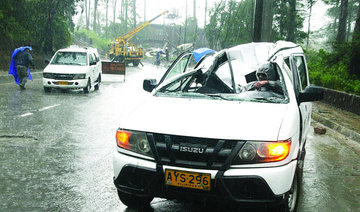
Doksuri hit Manila on Tuesday. While not as powerful as the devastating Ketsana, which left 464 dead, or Haiyan, which hit in late 2013 and left over 6,000 dead, Doksuri still wrought devastation on a country perennially at risk from storms. At least five were killed, with six missing, and an estimated 7,600 families in Metro Manila and parts of Luzon have been affected by the storm.
That led Salvador Belaro Jr., a politician in the Philippines’ House of Representatives, to hit out at the government, accusing it of putting lives at risk by not learning the lessons of previous typhoons.
Widespread flooding
“(Doksuri) was deceptive with only signal No. 1 (warning), and when it was at its strongest, it had only a top (speed) of 80 km per hour. But it brought a lot of rain, which caused widespread flooding,” he said.
“Filipinos should not just focus on the storm winds. The floods that follow the heavy rains are what really cause a lot of death and destruction along the path of storms,” he added.
Belaro Jr. said this is why he filed a bill in July that factors in flood warnings and rainfall in decision-making ahead of typhoons.
“All too often, authorities have not been timely and accurate in their declaration of class and work suspension or cancelations,” he said.
Confusion
“Widespread confusion, chaos and disruption of people’s lives have frequently resulted from the lack of a rational system governing suspension or cancelation of classes and work.
“It also seems that because (Doksuri) had only a storm signal No. 1 label, people did not prepare well for it and were not aware of the rainfall and floods it could bring.”
Belaro Jr.’s proposed bill states that it shall be declared policy of the state that “zero casualty is a prime indicator of the effectiveness and efficiency of disaster risk reduction and management.”
He urged his colleagues in Congress to expedite work on his proposed bill.


![]()

Philippine government accused of putting lives at risk following Typhoon Doksuri
Philippine government accused of putting lives at risk following Typhoon Doksuri


Latest updates



© 2026 SAUDI RESEARCH & PUBLISHING COMPANY, All Rights Reserved And subject to Terms of Use Agreement.