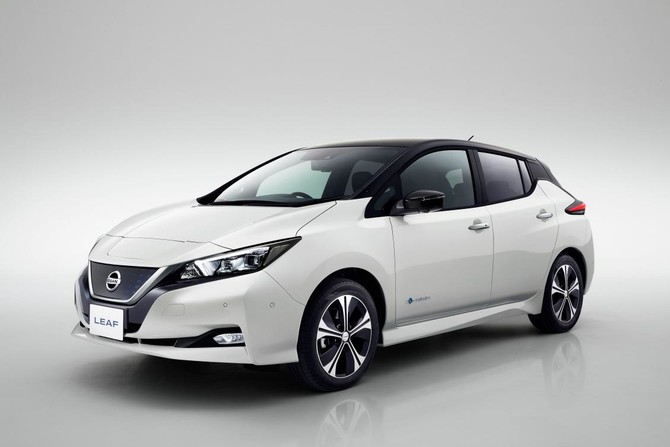
Nissan has introduced the new Nissan Leaf. The zero-emission electric vehicle has been completely reinvented, combining greater range with a dynamic new design and advanced technologies, which represent Nissan’s technological leadership, the carmaker said.
“The new Nissan Leaf drives Nissan Intelligent Mobility, which is the core brand strategy for Nissan’s future,” said Hiroto Saikawa, president and CEO of Nissan. “The new Nissan Leaf, with its improved autonomy range, combined with the evolution of autonomous drive technology, such as ProPILOT Park, and the simple operation of the e-Pedal, strengthens Nissan’s EV leadership, as well as the expansion of EVs globally. It also has core strengths that will be embodied by future Nissan models.”
The Nissan Leaf offers a range of 400 km, allowing drivers to enjoy a longer journey. The e-powertrain gives the Leaf 110 kW of power output and 320 Nm of torque, improving acceleration and driver enjoyment.
The Leaf adapts ProPILOT autonomous drive technology, used during single-lane driving on the highway.
It also offers ProPILOT Park. When activated, the car’s ProPILOT Park technology takes control of steering, acceleration, braking, shift changing and the parking brake to automatically guide it into a parking spot. It enables a driver to park, including parallel park, safely with a simple operation.
The Leaf’s e-Pedal technology lets drivers start, accelerate, decelerate and stop by increasing or decreasing the pressure applied to the accelerator. When the accelerator is fully released, regenerative and friction brakes are applied automatically, bringing the car to a complete stop. The car holds its position, even on steep uphill slopes, until the accelerator is pressed again.
The new Nissan Leaf’s redesigned cabin is focused on the driver, featuring a front panel in the form of a “gliding wing.”
The seven-inch, full-color (TFT) display has been redesigned to highlight key features, such as the Safety Shield technology power gauge and audio and navigation system information. Apple CarPlay has also been added.
Nissan said it will offer a higher power, longer range version at a higher price in 2018 (timing may vary by market). The new Nissan Leaf will go on sale Oct. 2 in Japan. The model is slated for deliveries in January 2018 in the US, Canada and Europe.

Nissan raises the bar for electric vehicles with Leaf
Kuwait Fund for Development: Six decades of humanitarian and developmental impact across globe
On Dec. 31, the Kuwait Fund for Development marks the anniversary of its establishment, opening a new chapter of success and ambition as one of the most prominent pioneers of development on both regional and global levels. Founded in 1961, the fund became the first and oldest development institution to operate in Arab countries and other developing nations.
Today, after more than six decades of continuous work, the Kuwait Fund for Development remains steadfast in its mission and has never ceased its efforts to support development causes in developing countries. As it celebrates its 64th anniversary, the fund has drawn a national portrait under the theme “Partners in Development,” reflected through its projects spread across the globe, all of which aim to build brighter and more sustainable future.
An external development arm
The establishment of the Kuwait Fund for Development embodied a wise and visionary decision by the leadership of Kuwait at the time. Kuwait was the only developing country that chose to share the challenges of development with other developing nations, cooperating with them through the provision of concessional loans, grants, financial assistance, and technical support tailored to their development priorities.
Since its inception, the Kuwait Fund for Development has served as Kuwait’s external development arm, sparing no effort in supporting development causes and extending assistance to developing countries worldwide.
Vision and early beginnings
In the early 1960s, the late Amir Sheikh Jaber Al-Ahmad Al-Sabah, then head of the financial department, proposed the idea of establishing a development entity that would serve Kuwait’s foreign policy and assist Arab and other developing countries in achieving development across various sectors. The idea received strong support from the late Amir Sheikh Abdullah Al-Salem Al-Sabah, as it aligned with Kuwait’s vision at the time to build a modern state.
Consequently, an Amiri decree was issued on Dec. 31, 1961, establishing the Kuwait Fund for Development with an initial capital of 50 million Kuwaiti dinars ($162.6 million).
Global reach and development impact
The fund’s activities have extended to all corners of the world, contributing to the financing of projects in 106 countries, including 16 Arab countries, 41 African countries, 19 in East and South Asia and the Pacific, 17 in Central Asia and Europe, and 12 in Latin America and the Caribbean.
This support was delivered through 1,037 concessional loans provided to the governments of these countries, with a total value of approximately 7 billion Kuwaiti dinars. In addition, the fund has provided grants and technical assistance to support a wide range of development services, helping beneficiary countries implement their development programs. A total of 420 grants and technical assistance operations were extended, amounting to approximately 401 million Kuwaiti dinars.
Loan agreements
During the past year, the Kuwait Fund for Development signed several loan agreements supporting development across different regions of the world. Among these were two loan agreements with the government of Bahrain. The first loan, valued at 31.25 million Kuwaiti dinars, contributed to financing the Electricity Transmission Networks Development Project. The second loan, valued at 10 million Kuwaiti dinars, supported the Sheikh Jaber Al-Ahmad Al-Sabah Highway Development Project (Phase II).
On the sidelines of the World Bank Group meetings held in Washington, D.C., the fund has also signed a 4 million Kuwaiti dinar-worth loan agreement with Saint Lucia to help finance the Sir Julian R. Hunte Highway Project, as well as another 4 million Kuwaiti dinar-worth loan agreement with Belize to support the George Price Highway Project.
Supporting and assisting refugees
The Kuwait Fund for Development’s contributions to humanitarian action stand out at both regional and international levels. Since its establishment, the fund has represented a unique model in supporting and assisting refugees in countries affected by disasters, conflicts, and wars, in line with Kuwait’s moderate and balanced policy.
These efforts have helped strengthen Kuwait’s relations with Arab and international partners. The fund has played a significant role in the reconstruction of Lebanon and Iraq following periods of crisis, and its assistance to the Palestinian people has never ceased.
International Participation
Over the past year, the Kuwait Fund for Development recorded notable participations in major international forums. These included taking part in the 2025 annual meetings of the World Bank Group and the International Monetary Fund in Washington, D.C., with a delegation headed by the fund’s Acting Director General Walid Shamlan Al-Bahar. The fund also took part in the Tokyo International Conference on African Development, held in Tokyo, Japan.
Additional international engagements included participation in the Third UN Conference on Landlocked Developing Countries, held in Awaza, Turkmenistan, and the Fourth International Conference on Financing for Development, organized by the UN in Seville, Spain.