BERLIN: Nihan Sen’s grandmother came to Germany in the 1960s but still speaks no German. By contrast, Nihan herself is a star of German youth culture, with 783,000 followers for her YouTube channel. Yet she acknowledges: “I really do like a bit of Turkish television.”
She is not alone. Turkish broadcasters have an 84 percent market share among Germany’s 3 million people of Turkish background, and 40 percent of them watch no German television at all, according to market researcher Data4U.
As a captive audience of television broadcast from Ankara, Germany’s Turkish citizens are caught in a tug-of-war for their loyalty ahead of a German national election on Sept. 24.
Turkey’s president, Recep Tayyip Erdogan, has called on German voters of Turkish background to reject Germany’s mainstream political parties, saying they are “unfriendly to Turkey.”
The parties worry that Erdogan has more access to Turkish-speaking German voters than they do.
Green Party co-leader Cem Ozdemir, the most prominent German politician of Turkish descent, has called for Germany’s public media to start broadcasting a Turkish channel for the benefit of Turks, both in Germany and in Turkey.
“We need a German-Turkish broadcaster,” he told the Rheinische Post newspaper in March. “For years we’ve neglected to help people from Turkey find a new political homeland, also politically, and now we’re seeing the fruits of that.”
Traditionally, Turks in Germany have voted mainly for the Social Democrats or the Greens, the main center-left parties, which are known for being friendly to immigrants. But Erdogan has repeatedly urged them instead to reject both those parties, as well as Merkel’s ruling conservatives.
“The majority, because they only watch Turkish TV, are informed very one-sidedly,” said Joachim Schulte, head of Data 4U, which specializes in polling Germany’s Turks. Schulte believes Erdogan’s call could sway 300,000 votes — a quarter of the Germans of Turkish descent who are eligible to vote.
For now, voters of Turkish descent who turn away from the Social Democrats and Greens have few other choices. Schulte said those who become disaffected are more likely to stay home than back rival parties. But that could still affect the outcome in an election that is likely to be hard fought for every vote.
A change in Germany’s citizenship law in 2000 means the number of ethnic Turks with the right to vote has nearly doubled over the past decade, increasing their importance as a bloc. Polls show most Turks in Germany backed Erdogan when voting as expatriates in Turkish elections.
For Erdogan, having influence over voters in Germany provides a chance to settle scores with German politicians he sees as enemies, while burnishing his credentials at home as a defender of Turks everywhere.
Germany’s mainstream parties have been outspoken critics of Turkey’s crackdown since a failed coup last year, in which thousands of Turks have been jailed, including around a dozen who hold German citizenship. Turkey also demands that Germany hand over asylum seekers it accuses of involvement in the coup.
For the Social Democrats and Greens, losing the Turkish vote poses a real risk: even a small swing could weaken them in potential talks with the conservatives about setting up a government after the vote.
In recent weeks, a new party, the Alliance of German Democrats, led by ethnic Turks, has campaigned with a poster of Erdogan. “Friends of Turkey,” it reads. “Stand with them!“
So far the new party is polling below one percent nationally and fielding candidates only in North Rhine-Westphalia, the big Western state home to more than a fifth of Germany’s population. The national prospects for a minority ethnic party may be limited in a country with a 5 percent threshold to win seats, but a party appealing directly to Turks could undermine the bigger parties.
“Our poster was a quote from Erdogan: He was criticizing German politics and saying we should vote for parties that are our friends,” said party spokesman Ertan Toker. “Unlike the other German parties that are always negative about Erdogan, we are not. We saw this as him encouraging us to vote.”
Among the causes the new party has taken up: Making it easier for ethnic Turks in Germany, most of whom still don’t have the right to vote, to gain it. That struck a chord for Rascha, a 17-year-old Turkish girl in Duisburg, North Rhine-Westphalia.
“I was born here and I still don’t have a German passport,” she said. “The process for getting one is long and bureaucratic. There’s a new party that wants to give all permanent residents voting rights.”
Turkish community leaders from the big political parties say Erdogan’s interventions into German politics are undoing decades of work on promoting integration.
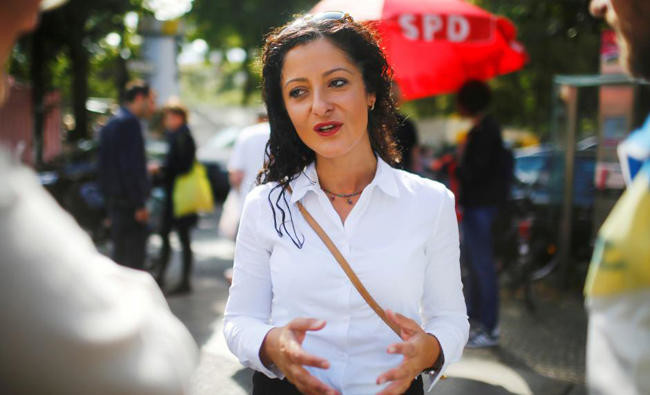
“The political climate is poisoned by this,” said Cansel Kiziltepe, Social Democrat parliamentary candidate in Berlin’s multi-ethnic Kreuzberg district, where the Social Democrats, Greens and conservatives are all fielding candidates with Turkish roots. “President Erdogan has torn down what we have built up over decades.”
“We get threats, e-mails as ethnic Turkish lawmakers saying we aren’t sufficiently loyal as ‘Turks’,” Kiziltepe said. “But I am a German politician and I do politics for Germany and for all people who live here.”
Timur Husein of Merkel’s Christian Democratic Union was categorical about his loyalties: “I am German, only German,” said the son of a Turkish father and a Croatian mother.
For YouTube personality Nihan, who confessed her passion for Turkish TV during an interview with Social Democrat leader Martin Schulz, the worry was that some Turks would end up alienated from wider German society.
“What can we do to stop parallel societies from emerging?” she asked Schulz.
Schulz was reassuring. “It’s not bad, or even hard, to have two identities. Why should you deny your roots?”


![]()
German parties fret about Turkish voters
German parties fret about Turkish voters

Latest updates


© 2026 SAUDI RESEARCH & PUBLISHING COMPANY, All Rights Reserved And subject to Terms of Use Agreement.