Philippines approves $7.6 billion for subway, other infrastructure projects

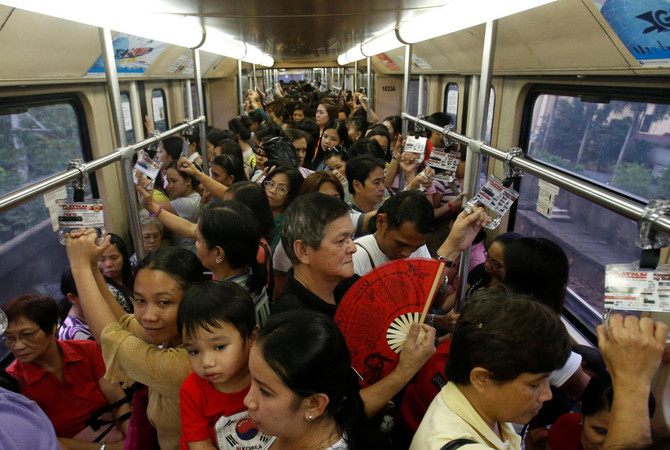
Commuters ride a train during rush hour on Southeast Asia's first light rail transit (LRT) network, which is 29-years-old, in Manila. (Reuters)
Updated 13 September 2017
Follow

Philippines approves $7.6 billion for subway, other infrastructure projects

MANILA: An interagency panel chaired by Philippines President Rodrigo Duterte has approved four major infrastructure projects worth 386.3 billion pesos ($7.59 billion), including bridges, roads and the country’s first subway.
The Philippines, one of the world’s fastest growing economies, is overhauling its aging infrastructure to boost its competitiveness, create jobs and attract foreign firms hesitant about power costs, logistics headaches and supply chains challenges.
The approval and eventual completion of these projects “will pave the way for us to achieve our mid-term and long-term goals” as a nation, Socioeconomic Planning Secretary Ernesto Pernia said.
The latest bundle brings the total number of approved projects to 35 worth 1.2 trillion pesos ($23.6 billion) since Duterte took office in July 2016.
The biggest plan approved on Tuesday was the 355.6 billion pesos Metro Manila Subway Project, the first of its kind in the Philippines, and seen as an urgently needed solution to the sprawling capital’s notorious gridlock.
It will be funded by overseas aid from Japan and construction is expected to start early next year.
Also endorsed was the expansion of roads in the southern Philippines worth 21.2 billion pesos, construction of bridges in Manila valued at 6 billion pesos and the improvement of an irrigation system north of the capital, worth 3.5 billion pesos.
Under the government’s “Build, Build, Build” initiative, Duterte has pledged to usher in a golden age of infrastructure through a six-year, $180 billion spending spree to modernize and build airports, roads, railways and ports.
A construction boom and a strong agriculture sector fueled annual growth of 6.5 percent in the Philippines’ gross domestic product in the second quarter.


Saudi exchange leads GCC in foreign net buying in 2025, hits $5.5bn: Kamco Invest

Updated 10 sec ago
Follow

Saudi exchange leads GCC in foreign net buying in 2025, hits $5.5bn: Kamco Invest

RIYADH: Foreign investors poured $5.5 billion into the Saudi exchange in 2025, the highest net buying in the Gulf Cooperation Council, an analysis showed. 

In its latest report, Kamco Invest said the Kingdom was followed by the Abu Dhabi and Kuwait exchanges, which saw net foreign inflows of $3.4 billion and $1.5 billion, respectively, over the 12 months.

Dubai and Qatar also registered net buying in 2025, amounting to $1.3 billion and $171 million, respectively. 

The steady performance in the majority of exchanges in the region comes as GCC equity markets continue to attract global capital, buoyed by strong corporate earnings and ongoing economic reforms.

“The yearly trend indicated continued positive activity by foreign investors on GCC exchanges in 2025, although total buying declined over the course of the year,” said Kamco Invest in the report. 

According to the analysis, the Oman Exchange recorded the largest net sales by foreign investors in 2025 at $440 million, followed by Bahrain, which posted net sales of $10.3 million. 

In the fourth quarter of 2025, net buying by foreign investors in the Kingdom stood at $1 billion, followed by Oman at $86.6 million. 

All other exchanges, excluding the Kingdom and Oman, witnessed a net selling trend in the fourth quarter. 

“Quarterly trading data showed that foreign investors were net sellers in Q4-2025 on all exchanges barring Saudi Arabia and Oman. Saudi Arabia recorded net foreign buying of $1 billion, while Oman saw net inflows of $86.6 million during the (fourth) quarter, partially offsetting the overall net sales across the region,” added Kamco Invest. 

Foreign investors were the biggest sellers of Abu Dhabi stocks with net sales of $1 billion during the quarter, followed by Kuwait at $187.9 million, Bahrain at $45.6 million, and Qatar at $8.8 million. 

Saudi Arabia and Oman also recorded consecutive net buying by foreign investors across all three months of the fourth quarter, signaling rising investor interest in these countries. 

Dubai exhibited a net selling trend during the first two months of the fourth quarter, which subsequently reversed to net buying in the final month of the year. 

Qatar registered net buying in the first month of the quarter before shifting to net selling in the second month, and returned to net buying in the final month.

The UAE and Kuwait exchanges experienced consistent net selling by foreign investors across all three months of the fourth quarter.

Kamco Invest said that the key factors which affected the flow of foreign money in the region included regional market trends, economic health of individual countries and crude oil prices.