SEOUL: North Korea vowed Wednesday to accelerate its weapons programs in response to the “evil” sanctions imposed by the UN Security Council following its latest and most powerful nuclear test.
The respected 38 North website in the US raised its estimate for the yield from the explosion, which Pyongyang says was a hydrogen bomb small enough to fit onto a missile, to around 250 kilotons — more than 16 times the size of the device that devastated Hiroshima in 1945.
The detonation, Pyongyang’s sixth nuclear blast, prompted global condemnation and came after it carried out two intercontinental ballistic missile launches in July that appeared to bring much of the US into range.
The UN Security Council unanimously imposed an eighth set of sanctions on the North Monday, banning it from trading in textiles and restricting its oil imports, which US President Donald Trump said was a prelude to stronger measures.
The resolution, passed after Washington toned down its original proposals to secure backing from China and Russia, came just one month after the council banned exports of coal, lead and seafood in response to the ICBM launch.
The North’s foreign ministry condemned the new measures “in the strongest terms,” calling them a “full-scale economic blockade” driven by the US and aimed at “suffocating” its state and people.
It was “another illegal and evil ‘resolution on sanctions’ piloted by the US,” it said in a statement carried by the official KCNA news agency.
“The DPRK will redouble the efforts to increase its strength to safeguard the country’s sovereignty and right to existence,” the ministry said, using the abbreviation for the North’s official name.
But the South’s unification ministry described the statement as “the most low-key form of response from North Korea to UN Security Council resolutions.”
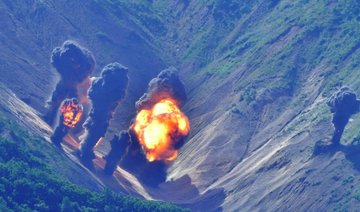
Seoul conducted its first live-fire exercise of its new long-range Taurus missile in response to the nuclear test, its Air Force said.
The German air-to-surface weapon was capable of precision strikes on key North Korean facilities even if launched from the central part of the South, it added.
The US and its allies argue that tougher sanctions will pile pressure on North Korea to negotiate an end to its weapons programs but experts are skeptical.
US President Donald Trump said the latest measures were a “very small step — not a big deal” that must lead to tougher measures.
“Those sanctions are nothing compared to ultimately what will happen,” Trump said, but added that it was “nice to get a 15 to nothing vote.”
The North says it needs nuclear weapons to protect itself from “hostile” US forces and analysts believe Pyongyang’s weapons program has made rapid progress under leader Kim Jong-Un, with previous sanctions having done little to deter it.
Government estimates of the yield from its sixth nuclear test vary from South Korea’s 50 kilotons to Japan’s 160, but 38 North, which is linked to Johns Hopkins University in the US, raised its estimate to “roughly 250 kilotons,” in line with upward revisions for the magnitude of the resulting tremor.
Washington had initially sought a full oil embargo and a freeze on the foreign assets of leader Kim Jong-Un in response to the test, but dropped them following strong opposition from China and Russia.
The new resolution instead bans trade in textiles, cuts off natural gas shipments to North Korea, places a ceiling of 2 million barrels a year on deliveries of refined oil products and caps crude oil shipments at current levels.
Retail petrol prices in the North jumped earlier this year, with some analysts suggesting the authorities were stockpiling in the expectation of a ban.
According to the US mission to the United Nations, the North imports around 8.5 million barrels a year of oil and oil products, 4 million as crude and 4.5 million in refined form — which includes substances such as petrol and diesel.
It added that the North’s textile exports averaged $760 million a year.
The UN resolution also barred countries from issuing new authorizations to North Korean workers sent abroad. There are almost 100,000 of them, according to the US mission, earning more than $500 million a year for the regime.
Under the measure, countries are authorized to inspect ships suspected of carrying banned North Korean cargo but must first seek the consent of the flag-state, and joint ventures were banned.