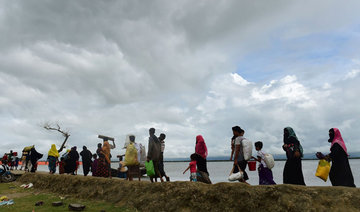
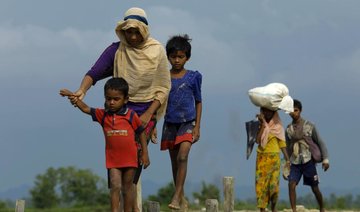
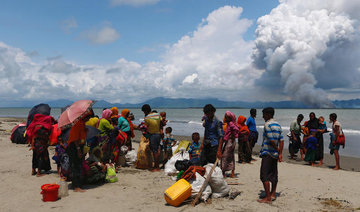
UKHIA, BANGLADESH: The lost Rohingya boy made the journey from Myanmar alone, following strangers from other villages across rivers and jungle until they reached Bangladesh, where he had no family and no idea where to go.
“Some women in the group asked, ‘Where are your parents?’ I said I didn’t know where they were,” said Abdul Aziz, a 10-year-old whose name has been changed to protect his identity.
“A woman said, ‘We’ll look after you like our own child, come along’. After that I went with them.”
More than 1,100 Rohingya children fleeing violence in western Myanmar have arrived alone in Bangladesh since August 25, according to the latest UNICEF figures.
These solo children are at risk of sexual abuse, human trafficking and psychological trauma, the UN children’s agency said.
Many have seen family members brutally killed in village massacres in Rakhine state, where the Myanmar army and Buddhist mobs have been accused of crimes described by the UN rights chief as “ethnic cleansing.”
Others narrowly escaped with their own lives — some children arriving in Bangladesh bear shrapnel and bullet wounds.
The number of children who crossed into Bangladesh alone, or were split up from family along the way is expected to climb as more cases are discovered.
More than half of the 370,000 Rohingya Muslims who have made it to Bangladesh since August 25 are minors, according to UN estimates.
A sample of 128,000 new arrivals conducted in early September across five different camps, found 60 percent were children, including 12,000 under one year of age.
This presents a needle in a haystack scenario for child protection officers trying to find unaccompanied minors in sprawling refugee camps, where toddlers roam naked, children sleep outdoors and infants play alone in filthy water.
“This is a big concern. These children need extra support and help being reunited with family members,” Save the Children’s humanitarian expert George Graham said in a statement.
“At first they don’t talk, don’t eat, don’t play. They just sit still, staring a lot,” Moazzem Hossain, a project manager with Bangladeshi charity BRAC told AFP at a ‘child-friendly space’ run in partnership with UNICEF at Kutupalong refugee camp.
There are 41 of these safe zones across Bangladesh’s ever-expanding network of refugee camps.
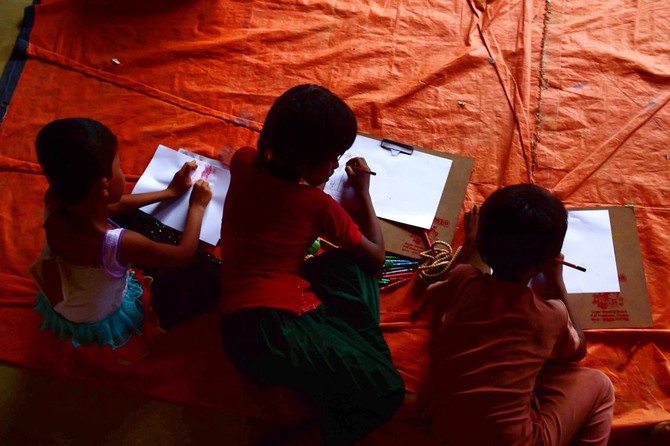
Every day children, some carrying younger siblings, flock to the simple wooden huts for activities like singing, playing with toys and blocks and skipping ropes.
It is a welcome distraction from the misery outside, where monsoon rain turns the camp into a quagmire and exhausted refugees compete for dwindling food and space.
But playtime also allows staff to register details about a child’s background, monitor newcomers and keep an eye out for the tell-tale signs of a child on their own.
One such youngster was 12-year-old Mohammad Ramiz, who found himself alone after fleeing his village and tagged along with a group of adults.
“There was a lot of violence going on, so I crossed the river with others,” said Ramiz, not his real name.
“I ate leaves from the tree, and drank water to survive.”
There are fears the vulnerable minors could be exploited if left unsupervised in the camps, UNICEF Geneva spokesman Christophe Boulierac told AFP.
Girls are particularly at risk of being lured into child marriages, or trafficked to red-light districts in big cities where they are forced into prostitution and abused, he added.
But the facilities for refugee children are vastly overstretched.
Over just two days, 2,000 children came through a single ‘safe space’ in Kutupalong, little larger than a classroom with just a few staff on hand.
Thirty-five unaccompanied minors were identified over that period, Boulierac said, but more resources were needed to ensure others did not slip through the cracks.
“The faster we act, the more chance we have of finding their family,” he told AFP.
“The most important thing is to protect them because unaccompanied children, separated children, are particularly vulnerable and in danger.”

Hundreds of Rohingya children arrive in Bangladesh alone

Argentina fires ravage pristine Patagonia forests, fueling criticism of Milei’s austerity
- The wildfires have devastated more than 45,000 hectares of Argentina’s forests in the last month and a half, forcing the evacuation of thousands of residents and tourists
LOS ALERCES NATIONAL PARK: These days, the majestic, forested slopes of Argentina’s Patagonia look like a war zone.
Mushroom clouds of smoke rise as if from missile strikes. Large flames illuminate the night sky, tainting the moon mango-orange and turning the glorious views that generations of writers and adventurers imprinted on the global psyche into something haunted.
Vast swaths of the Los Alerces National Park, a UNESCO World Heritage site home to 2,600-year-old trees, are now ablaze.
The wildfires, among the worst to hit the drought-stricken Patagonia region in decades, have devastated more than 45,000 hectares (174 square miles) of Argentina’s forests in the last month and a half, forcing the evacuation of thousands of residents and tourists. As of Monday, the inferno was still spreading.
The crisis, with most of Argentina’s fire season still ahead, has reignited anger toward the country’s radical libertarian president, Javier Milei, whose harsh austerity drive in the last two years has slashed spending on programs and agencies that not only work to combat fires but also protect parks and prevent blazes from igniting and spreading in the first place.
“There has been a political decision to dismantle firefighting institutions,” said Luis Schinelli, one of 16 park rangers covering the 259,000 hectares (1,000 square miles) of Los Alerces National Park. “Teams are stretched beyond their limits.”
After coming to office on a campaign to rescue Argentina’s economy from decades of staggering debt, Milei slashed spending on the National Fire Management Service by 80 percent in 2024 compared to the previous year, gutting the agency responsible for deploying brigades, maintaining air tankers, purchasing extra gear and tracking hazards.
The service faces another 71 percent reduction in funds this year, according to an analysis of the 2026 budget by the Environment and Natural Resources Foundation, or FARN, an Argentine environmental research and advocacy group.
The retrenchment arrives at a time when climate change is making extreme weather more frequent and severe, increasing the risk of wildfires.
“Climate change is something that’s undeniable. This is us living it,” said firefighter Hernán Mondino, his face smeared with sweat and soot after a backbreaking day battling blazes in Los Alerces National Park. “But we see no sign that the government is concerned about our situation.”
The Ministry of Security, which assumed oversight of firefighting efforts after Milei downgraded the Ministry of Environment, did not respond to requests for comment.
Milei and Trump take chainsaws to the state
Milei’s deep spending cuts have stabilized Argentina’s crisis-stricken economy and driven annual inflation down from 117 percent in 2024 to 31 percent last year — the lowest rate in eight years.
His battles against government bloat and “woke” culture have helped him cozy up to US President Donald Trump, whose own war on federal bureaucracy has similarly rippled through scientific research and disaster response programs.
After Trump announced last year that the US would leave the Paris climate agreement, Milei threatened to do the same. He boycotted UN climate summits and referred to human-caused climate change as a “socialist lie,” infuriating Argentines who understand that record-breaking heat and dryness, symptomatic of a warming planet, are fueling the fires in Patagonia.
“There’s a lot of anger building up. People here are very uncomfortable with our country’s politics,” said Lucas Panak, 41, who piled into a pickup truck with his friends last Thursday to fight the blazes enveloping the small town of Cholila after municipal firefighters were sent elsewhere.
Disaster management amid austerity
When lightning started a small fire along a lake in the northern fringes of Los Alerces in early December, firefighters struggled to respond, limited by the remote location and a lack of available aircraft to transport crews and douse the hills.
The initial delay forced the resignation of the park’s management and led residents to accuse them of negligence in a criminal complaint when the winds picked up and blasted the blaze through the native forest.
But some experts argue the problem wasn’t inaction after the fire erupted, but long before.
“Fires are not something you only fight once they exist. They must be addressed beforehand through planning, infrastructure and forecasting,” said Andrés Nápoli, director of FARN. “All the prevention work that’s so important to do year-round has essentially been abandoned.”
On top of cutting the National Fire Management Service budget, Milei’s government ripped tens of millions of dollars from the National Park Administration last year, leading to the dismissal or resignation of hundreds of rangers, firefighters and administrative workers.
As more tourists descend each year on Argentina’s parks, forest rangers say that cutbacks and deregulation measures make it harder to monitor fire dangers, clear trails and educate visitors on caring for the park. Last March the government scrapped a requirement for tourist activities such as glacier treks and rock climbs to be overseen by licensed guides.
“If you increase the number of visitors while cutting staff, you risk losing control,” said Alejo Fardjoume, a union representative for national park workers. “The consequences of these decisions is not always immediate, they will be noticed cumulatively, progressively.”
Firefighters strain to keep up
A 2023 National Park Administration report recommends a minimum deployment of 700 firefighters to cover the land under its purview. The agency employs 391 now, having lost 10 percent of staff as a result of layoffs and resignations in the last two years under Milei.
Budget cuts to the National Fire Management Service have scaled back training capacity and reduced available equipment, firefighters say, leaving many to rely on secondhand protective suits and donated gear.
Authorities at Los Alerces said that they’ve always been strapped for funds no matter the government and insisted that there were no shortages of resources to battle the blaze.
“Criticizing is always easy,” said Luciano Machado, head of the fire, communications and emergency division at the National Park Administration. “Sometimes adding aircraft doesn’t make things better. And in order to add firefighters, you need more food, shelter and rotation.”
But national park firefighters pushed beyond the brink of exhaustion said their ranks are constantly thinning, if not due to layoffs then to resignations over poverty-level wages that have failed to keep pace with inflation.
The average firefighter in Patagonia’s parks earns less than $600 a month. In provinces with cheaper living costs, the monthly wage drops below $450. A growing number of firefighters say they’ve had to pick up extra work as gardeners and farmhands.
“From the outside it looks like everything still functions, but our bodies bear the cost,” said Mondino. “When someone leaves, the rest of us carry more weight, sleep less and work longer hours.”
An untimely dance
For a month as the forests burned, Milei said almost nothing about the fires and carried on as usual. Last week, as provincial governors pleaded with him to declare a state of emergency in order to release federal funds, he danced onstage with his ex-girlfriend to Argentine rock ballads.
The split-screen image supplied his critics with powerful political ammunition. “While Patagonia burns, the president is having fun singing,” said centrist lawmaker Maximiliano Ferraro. Left-leaning opposition parties staged protests across provinces.
On Thursday Milei relented, decreeing a state of emergency that unlocked $70 million for volunteer firefighters and announcing “a historic fight against fire” on social media.
At a base camp this weekend, volunteer medics scurried around bleary-eyed firefighters, tending to scratchy throats, sore legs and irritated sinuses. Some expressed hope that more relief was on the way. Others dismissed the decree as symbolic. All, looking over the smoldering trees that take human generations to regenerate, couldn’t help but dwell on what had already been lost.
“It hurts because it’s not just a beautiful landscape, it’s where we live,” said Mariana Rivas, one of the volunteers. “There’s anger about what could have been avoided, and anger because every year it gets worse.”