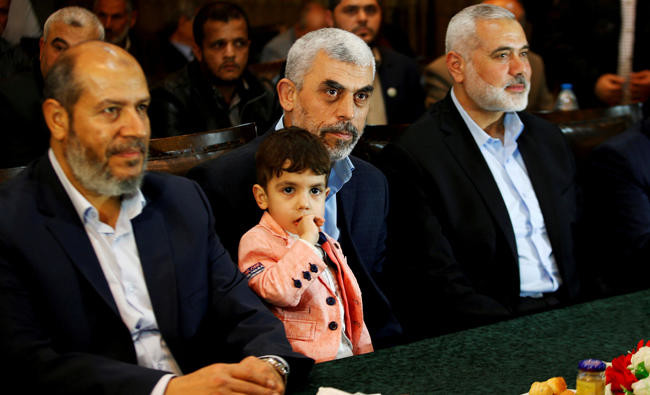
GAZA CITY: Hamas chief Ismail Haniyeh has told Egyptian officials that he would dissolve a key body causing tension with rival Palestinian faction Fatah, an official said Tuesday.
In March, Hamas announced the formation of a new “administrative committee” seen as a rival government to the internationally recognized administration led by President Mahmoud Abbas.
Hamas has denied the committee was a rival government.
Since the committee was formed, Abbas has sought to squeeze Hamas, reducing electricity payments for the Gaza Strip, which the movement controls among other measures.
The Hamas official, speaking on condition of anonymity, said Haniyeh told the head of Egyptian intelligence Khaled Fawzy and other officials in Cairo on Monday that they would dissolve the council without preconditions to make way for a unity government with Fatah.
Hamas, he said, wanted Egypt to “succeed in achieving Palestinian reconciliation, and I think there are no arguments now for Fatah to disrupt Egypt’s efforts.”
Hamas has run Gaza for a decade since seizing control of the territory from Abbas’ secular Fatah party, which leads the government in the West Bank. Multiple attempts at reconciliation between the two movements have failed.
A Hamas statement published late on Monday said that during talks in Egypt the Hamas delegation had “emphasized its readiness to hold negotiations with Fatah in Cairo immediately to conclude a (unity) agreement.”
Fatah spokesman in Gaza Fayez Abu Aita told AFP Abbas had made it clear any stopping of the measures against Hamas was “linked to a solution for the administration committee,” as well as allowing the Abbas-led government to exercise control in Gaza.
Haniyeh’s current visit to Cairo is his first since his election as Hamas leader in May.
Meanwhile, a sharp fall in international aid reaching the Palestinian territories due in part to Israel’s occupation is worsening humanitarian and economic crises in Gaza and the West Bank, the UN’s development agency said Tuesday.
The agency also said a spike in Israeli settlement building and confiscations of Palestinian land, water and other resources were keeping poverty and joblessness at intolerable levels.
In a report, the agency said international donor support for Palestinian territories fell by 38 percent between 2014 and 2016, “due in part to the fact that occupation (has prevented) previous aid flows from translating into tangible development gains.”


![]()
Hamas ‘will axe key body to promote Palestinian unity’: official
Hamas ‘will axe key body to promote Palestinian unity’: official
Latest updates







© 2026 SAUDI RESEARCH & PUBLISHING COMPANY, All Rights Reserved And subject to Terms of Use Agreement.