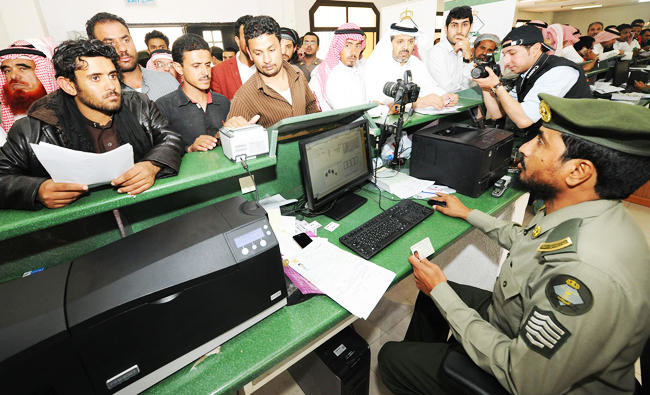
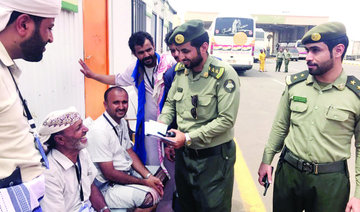
RIYADH: The General Directorate of Passports in Saudi Arabia has announced that, acting on the instructions of Minister of the Interior Prince Abdul Aziz bin Saud bin Naif, and starting from Oct. 5, regular residency permits (iqama) will be offered to Yemeni nationals holding visitor IDs, provided that the beneficiary holds a valid passport.
The beneficiary needs to complete certain service procedures with their employer in line with Labor and Social Development Ministry criteria. Individuals may also use the “Musaned” electronic system to complete the process.
However, the directorate said that dependents of holders of visitor IDs and those who entered the Kingdom legally and hold visitor IDs will not benefit from this decree.
They urged all employers — individual, family, organization — to benefit from the electronic services provided by the Ministry of the Interior (Absher and Muqeem) to issue resident IDs, and stressed that no applications will be accepted in person. All inquiries should be sent through the e-mail ([email protected]) and the official Twitter and Facebook accounts of the department.
This announcement follows a decree concerning the normalization of the status of Yemeni citizens who entered the Kingdom illegally by offering them renewable visitor IDs for six months.

Saudi Passport Department: Yemenis with visitor IDs to get iqamas from Oct. 5
Saudi hospitality boom sparks innovation beyond the plate
- At the Four Seasons Riyadh, Diageo hosted a private tasting at Tonic Bar followed by a 10-course dinner at Julien
- Dinner at Julien paired dishes with drinks made using Tanqueray 0.0, Captain Morgan 0.0, and Guinness 0.0
RIYADH: As restaurants and hotels in Saudi Arabia refine their culinary identities, beverages are increasingly being treated as crafted experiences in their own right, shaped by technique and intention.
At the Four Seasons Riyadh, Diageo hosted a private tasting at Tonic Bar followed by a 10-course dinner at Julien, offering a snapshot of how this evolution is beginning to take shape, as international players and local venues test new approaches to pairing and presentation.
Speaking to Arab News, Nick Rees, marketing director of Diageo MENA, pointed to the rapid growth of the nonalcoholic segment globally and in the region: “There’s a far faster growing percentage of it (the industry) is non-alcohol … There (are) trends globally … A lot of it will be pointed to wellness, mindful drinking.”
Rees said that Saudi Arabia’s fast-developing culinary and hospitality scene calls for beverages that match the level of excellence seen in kitchens across the Kingdom.
“It’s kind of the lack of choices and that’s where we want to be able to provide people the option, and people here absolutely have the same kind of talent and desire as their counterparts behind the kitchen,” he said.
“That’s where our role is to give people the kind of core ingredients for them to be able to work with … we have many more brands that we would love to introduce to the Kingdom.”
The dinner at Julien paired dishes with drinks made using Tanqueray 0.0, Captain Morgan 0.0, and Guinness 0.0, offering a glimpse into the range of styles Diageo is bringing to the market.
Flavor profiles ranged from light and refreshing combinations with cucumber and capers brine to richer, malt-forward blends, each designed to complement the accompanying dishes, from ravioli to black cod.
Rees emphasized that pairing food with thoughtfully crafted beverages is becoming an essential part of the hospitality experience.
“In the Kingdom, we’re looking at giving people the experience that currently is not available to them because I know for sure that the kind of quality and expertise and craftsmanship that can go into creating some of these drinks is absolutely as exciting as the work that the chefs would do with their food,” he said.
Anthony Abou Haider, head of Gulf at Diageo, said the company sees long-term potential in Saudi Arabia’s hospitality sector.
“It’s such an opportunity to be a part of this transformation journey,” he told Arab News. “We’re not looking for a short-term gain, we’re looking at a very long-term gain here because whatever we do now is building for the future.”