Al-Qaeda on the rise again in shadow of Daesh in Syria: Experts

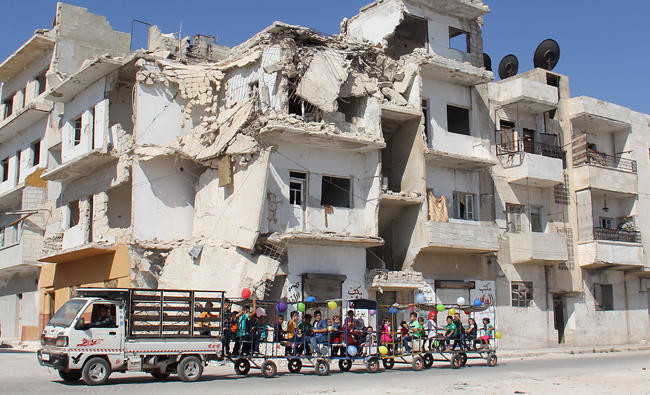
Syrian children ride in carriages decorated in balloons along a damaged street in the northwestern Syrian city of Idlib on September 1, 2017. (AFP)
Updated 12 September 2017
Follow

Al-Qaeda on the rise again in shadow of Daesh in Syria: Experts

WASHINGTON: Al-Qaeda is on the rise again in the shadow of Daesh in Syria, 16 years after the terrorists shocked the US in the Sept. 11, 2001 attacks, experts said.
They said that Hayat Tahrir Al-Sham (HTS), the group that last month seized control of the northern Syrian city of Idlib, is simply a “rebranding” of Al-Qaeda that is positioning itself as more moderate than Daesh in hopes of a resurgence.
“ISIS (Daesh) may be today’s preeminent terrorist threat, but Al-Qaeda in Syria is worrisome. It is Al-Qaeda’s largest global affiliate at this point,” said former White House counterterrorism director Joshua Geltzer.
Speaking on the current terror threat against the US at the New America think tank, Geltzer and other experts said they expect HTS to take center stage among jihadists as the Daesh group loses ground on the battlefield in Syria and Iraq.
HTS is simply a cosmetic name-change for Al-Qaeda, they said. In consolidating control of much of Idlib province, it has eliminated or absorbed rival groups, and is modernizing its propaganda on the web-savvy model of Daesh.
“The organization itself seems to have more lives than a cat,” said Daveed Gartenstein-Ross, co-author with Geltzer of a New America report on the current terrorist threat.
He called Al-Qaeda a “much stronger” organization than in 2010, when its weakness gave way to the rise of Daesh.
“It has skillfully played itself off of ISIS to portray its organization as being the ‘moderate jihadists’, people who you might not like but you can do business with.”
As such it has more popular support, and some official support in the Gulf States.
“Being more restrained than ISIS has been very helpful,” Gartenstein-Ross said.
The New America report stresses the need to focus on Islamic State as the most dangerous external threat at the moment, while noting that since 9/11 all lethal jihadist attacks in the US have been by US citizens or permanent residents.
But it says Al-Qaeda could resume the role of the foremost threat in the future, gathering followers turned off by Daesh’s most extreme tactics.
While current leader Ayman Al-Zawahiri is turgid and uninspiring, the younger leaders in Idlib are learning from the way that Daesh mastered the use of social media to attract followers.
“Al-Qaeda in Syria has undergone cosmetic changes to its naming and organizational design, but without truly renouncing its affiliation with its mother organization,” the study said.


Lebanese village buries child and father killed by Israeli drone

Updated 5 sec ago
Follow

Lebanese village buries child and father killed by Israeli drone

  • Hassan Jaber, a police officer, and his 3-year-old son, Ali, were on foot when the strike hit a passing car in Yanouh
  • Residents says the strike was carried out in a crowded area with shops and public buildings
YANOUH, Lebanon: Mourners in southern Lebanon on Tuesday buried a father and his young son killed in an Israeli drone strike that targeted a Hezbollah member.
Hassan Jaber, a police officer, and his child, Ali, were on foot when the strike on Monday hit a passing car in the center of their town, Yanouh, relatives said. Lebanon’s health ministry said the boy was 3 years old. Both were killed at the scene along with the car driver, Ahmad Salami, who the Israeli military said in a statement was an artillery official with the Lebanese militant group.
It said it was aware of a “claim that uninvolved civilians were killed” and that the case is under review, adding it “makes every effort to reduce the likelihood of harm” to civilians.
Salami, also from Yanouh, was buried in the village Tuesday along with the father and son.
“There are always people here, it’s a crowded area,” with coffee shops and corner stores, a Shiite religious gathering hall, the municipality building and a civil defense center, a cousin of the boy’s father, also named Hassan Jaber, told The Associated Press.
When the boy and his father were struck, he said, they were going to a bakery making Lebanese breakfast flatbread known as manakish to see how it was made. They were standing only about 5 meters from the car when it was struck, the cousin said.
“It is not new for the Israeli enemy to carry out such actions,” he said. “There was a car they wanted to hit and they struck it in the middle of this crowded place.”
Jaber said the little boy, Ali, had not yet entered school but “showed signs of unusual intelligence.”
“What did this innocent child do wrong, this angel?” asked Ghazaleh Haider, the wife of the boy’s uncle. “Was he a fighter or a jihadi?”
Attendees at the funeral carried photos of Ali, a striking child with large green eyes and blond hair. Some also carried flags of Hezbollah or Amal, a Shiite party that is allied with but also sometimes a rival of Hezbollah.
Lebanon’s Internal Security Forces, of which the child’s father was a member, said in a statement that the 37-year-old father of three had joined in 2013 and reached the rank of first sergeant.
The strike came as Israel has stepped up its campaign against Hezbollah and its allies in Lebanon.
The night before the strike in Yanouh, Israeli forces launched a rare ground raid in the Lebanese village of Hebbarieh, several kilometers (miles) from the border, in which they seized a local official with the Sunni Islamist group Al-Jamaa Al-Islamiya, or the Islamic Group in English. The group is allied with Hezbollah and the Palestinian militant group Hamas.
After the Oct. 7, 2023, Hamas-led attack on Israel triggered war in Gaza, Hezbollah began firing rockets from Lebanon into Israel in support of Hamas and the Palestinians.
Israel responded with airstrikes and shelling. The low-level conflict escalated into full-scale war in September 2024, later reined in but not fully stopped by a US-brokered ceasefire two months later.
Since then, Israel has accused Hezbollah of trying to rebuild and has carried out near-daily strikes in Lebanon that it says target Hezbollah militants and facilities.
Israeli forces also continue to occupy five hilltop points on the Lebanese side of the border. Hezbollah has claimed one strike against Israel since the ceasefire.