JEDDAH: Tension over plans for an independence referendum this month in the Kurdistan Region of Iraq grew on Tuesday when Iraq’s Parliament voted against it.
The nonbinding referendum planned for Sept. 25 has faced strong opposition from Iran and Turkey, who fear it will stoke separatist aspirations among their own sizable Kurdish minorities.
Critics of the vote, including the US and the EU, and even members of the 5.5 million-strong Iraqi Kurdish population, say it could distract from the fight against Daesh.
Iraqi and Kurdish peshmerga forces have played a key role in battling the terror group that captured swaths of the country in 2014.
Kurdish MPs walked out of Parliament after Tuesday’s vote, and the Kurdish Parliament said it would meet on Thursday, for the first time in two years, to hold its own vote on the issue.
Salim Al-Juburi, the speaker of the Iraqi Parliament, said the vote required the Baghdad government to “take all steps to protect the unity of Iraq and open a serious dialogue.”
The federal Parliament “strives for the unity of Iraq and rejects its division for any reason,” Al-Juburi was quoted as saying by AFP. Parliament “has set what can be the subject of a referendum, and Kurdistan is not one of those cases.”
Iraqi Prime Minister Haider Al-Abadi and other top officials have said repeatedly that the referendum would violate Iraq’s constitution.
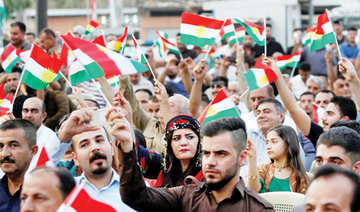
But the Iraqi Kurdish leader Masoud Barzani, who is organizing the referendum, said from the disputed city of Kirkuk that the vote would take place because all other efforts to secure Kurdish rights had have failed.
“This referendum would not necessarily lead to an immediate declaration of statehood, but rather to know the will and opinion of the people of Kurdistan about their future,” he said last year.
Other Kurdish leaders have said a “yes” vote would pave the way for the start of “serious negotiations” with the Baghdad government.
Former Kurdish MP Mahmoud Othman criticized Tuesday’s vote, and said Parliament should be reducing tension and creating calm. “It shouldn’t encourage the government to create problems,” he told Arab News. “It should help in cooling down tensions.”
Instead, Othman said Tuesday’s vote would only exacerbate tensions between Baghdad and the Kurdish government. He said either of the two parties could and should have approached the high court. “There is a provision for this in the constitution. Either party could have petitioned the court seeking an answer to whether the referendum is legal or not, whether it is constitutional or not.”
He said Parliament had behaved in a “totally improper” way, which was “not at all wise.”
“All I know is that this will lead to more tensions,” he said. “They are just talking through the media, adding to the tensions.”
Othman said he believed that Al-Abadi, being a moderate, would want the issue to be resolved peacefully. “He prefers to solve things through dialogue.”
On the possible outcome of the referendum, Othman said: “A big majority of Kurdish people will go for independence, but we don’t know what happens after the referendum. There will be negotiations with Baghdad and that will take a long time.”
Barzani paid a visit on Tuesday to the oil-rich Kirkuk province.
He insisted that holding the referendum in Kirkuk is “entirely legal.”
“Kirkuk will remain as safe and secure as it is now, kept safe by the peshmerga,” Barzani said, referring to the Kurdish forces that control the city. “We will not compromise Kirkuk’s identity. We would rather give up our own rights than to compromise the rights of the ethnic minorities that live here.”


![]()

Iraqi MPs vote against Kurdish referendum as Barzani visits Kirkuk
Iraqi MPs vote against Kurdish referendum as Barzani visits Kirkuk

Latest updates


© 2026 SAUDI RESEARCH & PUBLISHING COMPANY, All Rights Reserved And subject to Terms of Use Agreement.