KELAMBAKAM, India/KARACHI: I n a dilapidated shelter in south India, surrounded by squalor, Alakamma Bibi dials her home in Myanmar every few hours.
All she gets is a beeping tone.
In the two weeks since she first heard of the upsurge in violence in Myanmar, she has spent countless hours trying to reach her parents and siblings, desperate to hear their voices.
“I can’t sleep anymore,” she said, hunched over a pot of bubbling rice.
“My parents may be dead, you know. They stayed back because it was home. Now suddenly there is no place to call home.”
Bibi is one of hundreds of thousands of Rohingya Muslims who have fled from Rakhine state in Buddhist-majority Myanmar since 2012 to other countries, including Malaysia, Pakistan, India, Bangladesh, Saudi Arabia and the United Arab Emirates.
In the last fortnight alone, more than 300,000 Rohingya have fled across the border to Bangladesh, fleeing an explosion of violence.
Myanmar’s government regards the approximately 1 million Rohingya as illegal migrants from neighboring Bangladesh and denies them citizenship, even though many Rohingya families have lived there for generations.
In retaliation for attacks by Rohingya insurgents on police posts and an army base, the Myanmar army and Buddhist vigilantes have mounted a campaign of arson aimed at driving out the minority group, human rights monitors and fleeing Rohingya say, a charge the Myanmar government denies.
Pockets of Rohingya communities are dotted around South Asia, with exiles anxious for news of their relatives back in Myanmar.
In an alleyway in the garbage-strewn Hundred Quarters in Karachi, Hamida, who was born in the Pakistani city but speaks fluent Burmese and only a smattering of Urdu, has been reading verses from the Qur'an, praying for an end to the persecution of her Muslim relatives in Myanmar.
“My cousins fleeing from their village have told us many of our relatives have been butchered, even small babies,” said Hamida, aged in her 40s, adding many had asked for help.
“We know they desperately need money, but we ourselves live hand to mouth,” said the mother of seven whose fisherman husband Majid is often out of work.
HOUSES TORCHED
The United Nations’ top human rights official on Monday slammed Myanmar for conducting a “cruel military operation” against Rohingya Muslims in Rakhine state, branding it “a textbook example of ethnic cleansing.”
In southern India, Bibi’s mobile phone is full of video clips and Whatsapp messages describing the unfolding horror.
“We hear some are hiding in forests, their houses burnt down, their children killed,” Bibi told the Thomson Reuters Foundation.
“We had farms, a proper home, livestock. Look at where I live now — in dirt, with no savings, no hope and no future if this continues,” said Bibi.
In the run-down cyclone shelter in Kelambakkam that now serves as a refugee center, Rohingya families are constantly on their phones, desperately dialing in to Myanmar, hoping someone will pick up at the other end.
Mohammad Yusuf, 30, managed to get a call through to his aging father last week.
“My mother and sister are missing,” said Yusuf, just back from work as a daily laborer.
“My father said he was alone and dying. There is destruction everywhere, he told me. The few men left in the village are just about surviving, eating once every three days.”
“TENFOLD MORE BRUTAL“
On a Karachi backstreet, Hamida’s father-in-law, Saeed Islam, relives the terror of his own getaway from Myanmar 40 years ago every time he sees video clips of the current violence on his son’s mobile phone.
The older members of Karachi’s Rohingya community fled Myanmar, formerly Burma, when the military seized power in a 1962 coup, escaping on foot or by boat to Bangladesh, which was then East Pakistan. Eventually, they made their way to Karachi.
“We were told we should go to a Muslim country — like Pakistan — as there was no place for us in Myanmar. But what is happening now is tenfold more brutal,” he said, in broken Urdu.
“They will wade through rice paddies, and uneven and rocky mountainous terrain; some will come in boats over the river,” said Islam, who took the same path himself decades ago.
“We were 200 people, all related, but 15 of them were my immediate family including my wife Aisha and Majid, then aged just five,” he said pointing to his wife and son sitting by his side.
From Bangladesh they crossed northern India and reached the port of Karachi after a three-month trek.
“We traveled with just the clothes on our back, begged for food on the way and slept along the wayside. We crossed borders illegally during the night,” said Islam.
“The elderly and the sick died on the way.”
UNCERTAIN FUTURE
The Rohingya in Karachi largely work on fishing boats, or clean the catch brought by fishermen who set sail from the nearby Qur'angi Creek.
Like the Rohingya in southern India, they live in uncertainty, on the margins of society.
Most of them are stateless as they cannot obtain Pakistani identity cards, essential for opening bank accounts, enrolling into school, using public hospitals, and even getting a job.
In India’s Kelambakkam, the Rohingya work as ragpickers and casual laborers. As well as the violence in Myanmar, they are also following the Indian government’s talks on deporting them with concern.
“We are from Myanmar, but have no documents that recognize that fact,” said Yusuf, taking out papers carefully preserved in a plastic folder.
“All we can do now is pray for the safety of those back home and hope the Indian government does not deport us.”
Recalling his own flight from Myanmar in 2012, Yusuf said it had taken a year to reestablish contact with his family after he crossed over to Bangladesh and then made his way to India.
“My son Abu was born here, in this Kelambakkam refugee shelter. I had hoped to take him home one day, show him the house I grew up in, the streets I played in, the mosque I went to pray in. Now, he may never know where he is from and what can be worse than that,” Yusuf said, sitting on the steps to his cluttered and cramped room.
On the door behind him, scrawled in chalk is “Allah hu.”
“It’s all about keeping the faith now,” said Bibi, the woman stirring a pot of rice.
“And so we pray for peace back home.”


![]()
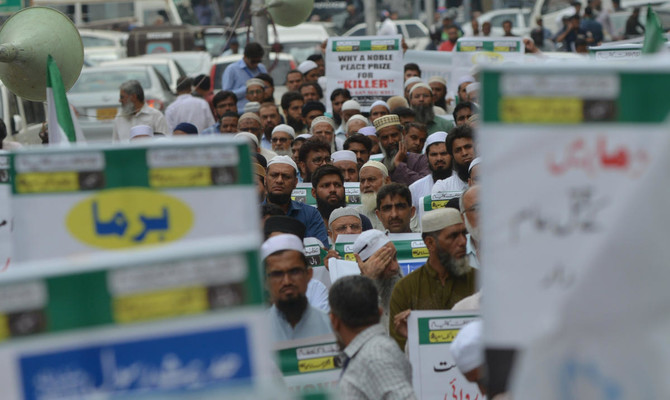
Pain and despair as Rohingya families in India and Pakistan watch from afar
Pain and despair as Rohingya families in India and Pakistan watch from afar
Latest updates


© 2026 SAUDI RESEARCH & PUBLISHING COMPANY, All Rights Reserved And subject to Terms of Use Agreement.